
To check GLP-1 insurance coverage, start with the exact medicine, formulation, and reason for treatment. Then ask the plan about its formulary, any benefit exclusion, prior authorization, pharmacy network, and the cost of the actual prescription. “We cover GLP-1s” is not a complete answer to those questions.
A clinician deciding that treatment is appropriate and an insurer agreeing to pay are separate decisions. Understanding the steps can make an insurance call more useful and help identify whether a delay is caused by missing information, an authorization requirement, an excluded benefit, or a pharmacy issue.
Identify the product before checking coverage
Write down the brand, active ingredient, route, strength if already prescribed, and treatment indication. If you have only discussed treatment in general, tell the insurer that a particular prescription has not yet been finalized.
Brands containing related ingredients can have different approved uses. Mounjaro and Zepbound both contain tirzepatide, while Ozempic and Wegovy contain semaglutide; that does not make their coverage interchangeable. Routes and devices may also matter. See our Zepbound versus Mounjaro guide and Wegovy prescription guide.
The current Ozempic, Wegovy, and Zepbound labels describe approved indications. An insurer may request documentation of the condition actually being treated. An off-label clinical decision does not change the FDA-approved label or automatically satisfy a payment policy.
For that benefit system, our guide to TRICARE GLP-1 coverage questions separates beneficiary category, treatment indication, authorization and pharmacy requirements, with TRICARE For Life addressed separately.
Find the documents for your actual plan
A formulary is a plan’s list of covered medicines. It can show drug tiers and restrictions, but it should be read alongside benefit documents and any relevant coverage policy.
For Marketplace coverage, HealthCare.gov recommends checking the insurer’s prescription list, Summary of Benefits and Coverage, mailed coverage materials, and the insurer directly. Use documents for your exact plan and benefit year. A policy from the same insurance company may describe a different employer plan, state, network, or contract. Source: HealthCare.gov prescription coverage guidance.
Save the document title or reference number and the date you checked it. If an online list and a phone representative give different answers, ask which current plan document controls the specific prescription and how to obtain it.
Separate five questions that often get mixed together
| Coverage question | What you are trying to learn |
|---|---|
| Is the medicine on the formulary? | Whether the exact product appears on the plan’s drug list |
| Is the treatment benefit excluded? | Whether the plan excludes a category or use, such as a particular weight-management benefit |
| Is prior authorization required? | Whether the plan needs clinical information before approving payment |
| Is step therapy or another limit involved? | Whether a plan-specific prerequisite or quantity rule applies |
| What will the pharmacy charge me? | The final patient responsibility for this prescription under the applicable payment route |
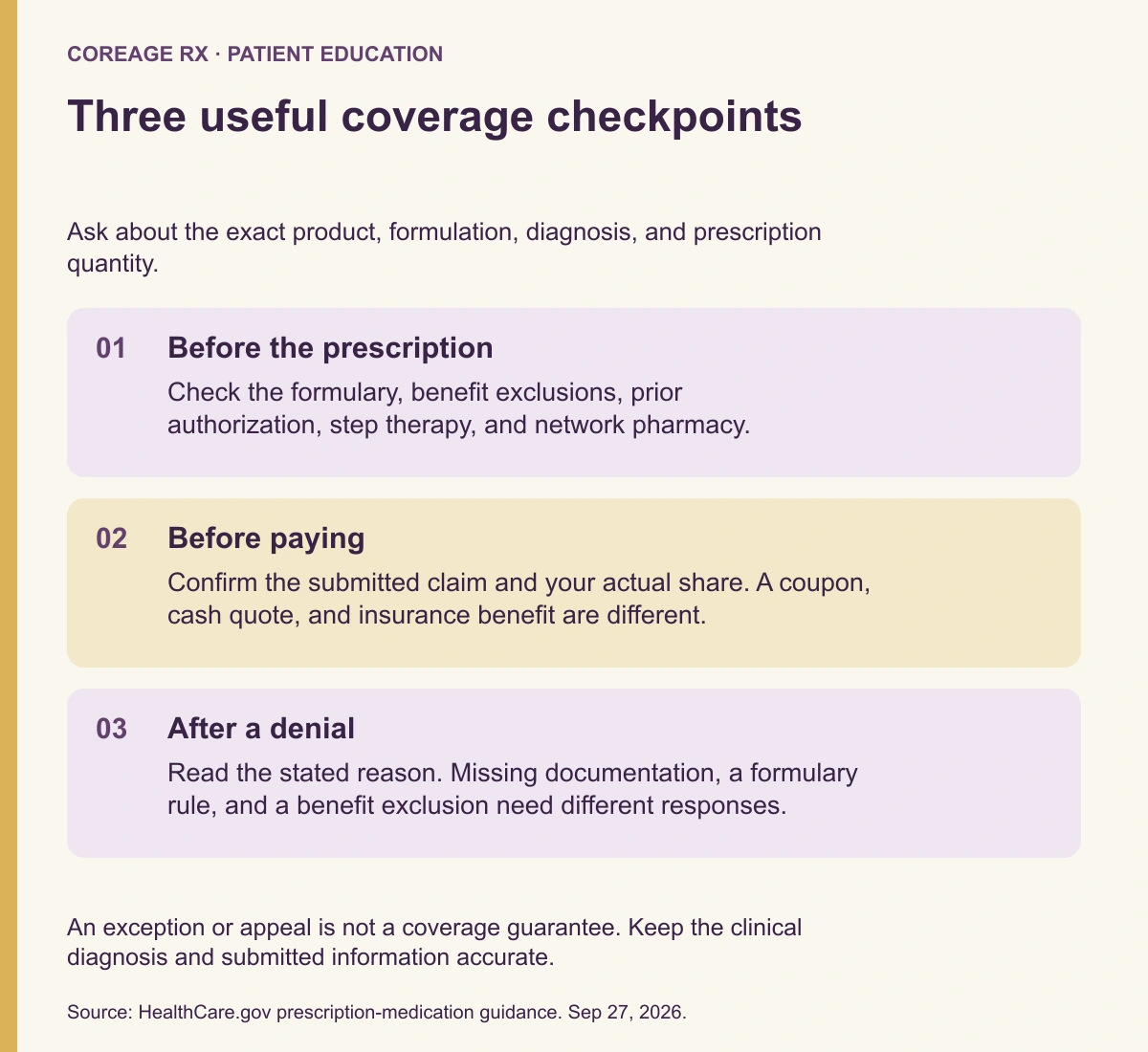
These are not interchangeable explanations for a denial. A missing authorization is different from a drug being outside the formulary, and a benefit exclusion is different from an incomplete clinical record. Ask for the exact reason rather than accepting “not covered” as the entire explanation.
What does prior authorization involve?
Prior authorization is a plan review that may require information from the prescribing team before the claim is paid. Requirements can depend on the product, diagnosis, and policy. The plan should explain what documentation is needed and how it must be submitted.
Ask the clinic who handles the request, whether the required information is available, and how you will receive an update. Clinical records may need to establish the diagnosis, relevant measurements, previous treatments, or the reason an alternative is unsuitable, depending on the actual policy.
Do not invent a diagnosis or a history of failed treatment to obtain a preferred medicine. If the plan’s criteria do not match the clinical situation, the prescriber can explain appropriate alternatives or a legitimate review process. Accurate documentation helps the insurer evaluate the actual request.
What if the plan requires another treatment first?
A step-therapy requirement is a separate policy question from the prescriber’s preferred treatment. Ask which treatment is required, what constitutes an adequate prior trial, and whether previous records or a documented medical reason can address the requirement.
Do not stop or start a medicine solely to satisfy an assumption about what the insurer might want. A clinician needs to assess whether that treatment is appropriate. The same principle applies to requests involving a previously tried medicine: record the actual duration, response, and reason it stopped.
If alternatives are being considered, our guide to choosing a GLP-1 medicine and Ozempic alternatives article organize the discussion around health goals, approved uses, tolerability, and access.

The pharmacy can answer a different set of questions
Once a prescription is available, ask the pharmacy to identify the exact product and quantity, check whether it is in the plan’s network, and explain the claim result. A product can be clinically prescribed yet unavailable at a particular location or require a plan-designated dispensing arrangement.
HealthCare.gov notes that pharmacy networks vary by plan and recommends confirming whether the usual pharmacy is included. Mail-order availability is also plan-specific. A convenient pharmacy is not automatically an in-network pharmacy for every benefit. Source: HealthCare.gov’s pharmacy-network guidance.
If the claim fails, ask for the rejection reason or code that can be shared with the insurer and prescribing team. This is more useful than repeatedly transferring the prescription without knowing whether the problem is authorization, product selection, coverage, or stock.
Ask for the final patient cost
Formulary inclusion alone does not tell you the bill. Ask whether a deductible, copay, coinsurance, or other plan rule affects the current fill and whether the amount may differ later in the benefit year.
A manufacturer savings card or a pharmacy cash offer is another layer. It may have eligibility requirements, savings caps, or restrictions on combining payment programs. An advertised starting amount does not prove the result of your insurance claim.
Our Wegovy cost guide, Mounjaro cost guide, and tirzepatide GoodRx guide explain common price categories. Compare the complete prescription and ongoing care costs, including any visit or membership fee that is charged separately from medication.
What should you do after a denial?
Obtain the written explanation or precise denial reason and ask about the applicable review process and deadline. The next step depends on whether the issue is missing documentation, a formulary decision, a treatment prerequisite, a benefit exclusion, or something else.
For Marketplace plans, HealthCare.gov describes a drug-exception process and the ability to appeal an insurer’s refusal to pay. It also explains that a clinician may need to document why covered alternatives are ineffective or unsuitable. Those explanations should not be turned into a promise that every plan must approve every excluded weight-management prescription. Source: HealthCare.gov exceptions and appeals information.
Ask the plan and clinic who is responsible for each step. A clear record of the request, submitted documents, response, and next deadline can prevent repeated calls that never identify what is missing.
Medicare needs its own coverage check
Do not apply a commercial-insurance coupon rule or Marketplace explanation directly to every Medicare prescription. The treatment indication and product can determine the relevant payment pathway.
CMS’s Medicare GLP-1 Bridge is a separate, temporary program with specified eligibility, products, and authorization rules. It operates outside the usual Part D payment flow. Our Medicare weight-loss drug coverage guide explains the distinction from Part D and the current Bridge criteria. Source: CMS Bridge overview.
Likewise, Medicaid and other coverage arrangements require their own current plan or program information. A headline about one government program does not establish what another program will pay for your prescription.

Telehealth and compounded products are separate questions
An online appointment can help arrange an assessment, but payment for the visit does not guarantee insurance approval for medication. Ask whether a service submits authorization requests, provides the records an insurer needs, and charges additional fees for follow-up.
A compounded preparation also should not be treated as an insurance-equivalent version of an approved brand. Identify what is actually being offered and how it is billed. The online prescription guide and compounded GLP-1 guide provide practical checks.
When reviewing CoreAge Rx’s semaglutide care information or tirzepatide care information, confirm the preparation, service charges, pharmacy arrangements, and payment terms directly. A care-program price does not establish branded-drug coverage or participation in a particular insurance benefit.
For a named-plan example, read our guide to Kaiser GLP-1 coverage questions. It separates regional documents, future effective dates, the member’s actual benefit, prescription details and the final pharmacy quote.
Keep a short call checklist
Have your plan identifier, exact medicine, indication, pharmacy, and any claim or authorization reference available. Ask these questions in order:
- Does this plan cover this product for this treatment purpose?
- Is there an exclusion or a current clinical coverage policy?
- What authorization or prerequisite is required, and who submits it?
- Which pharmacy can dispense it under the benefit?
- What is the current patient cost, and what review options exist if payment is denied?
Record the answers and the next responsible contact. The goal is a clear, workable care and payment plan, not simply a reassuring statement that a broad drug class is covered.
Apply the coverage checklist to a named insurer
- Humana coverage questions for Wegovy and Ozempic — Separate the actual plan’s drug benefit, the current Medicare GLP-1 Bridge, and medical benefits such as surgery or counseling.
For a separate surgical benefit question, our guide to Ambetter weight-loss surgery coverage distinguishes the benefit contract, clinical criteria, authorization, network, and expected cost.
Check a specific insurer and coverage pathway
- Aetna Zepbound coverage and cost questions — Identify the current member benefit, applicable criteria and the separate Medicare GLP-1 Bridge pathway.
For North Carolina context, our guide to semaglutide care and coverage in Cary, NC reviews telemedicine standards, pharmacy verification and the current October 2026 Medicaid list with clinical-criteria limits.
Check plan and program details
- Cigna GLP-1 coverage questions — Use the actual member benefit and dated product policy, including initial approval and renewal.
- Medicaid GLP-1 coverage by state and indication — Separate state lists, plan requirements and voluntary federal access programs.
- Aetna Ozempic and Wegovy coverage — Separate a dated public guide, the member benefit and the pharmacy claim.
- UnitedHealthcare GLP-1 coverage — Match the exact product and treatment purpose to the relevant plan policy.
Educational information for adults; individual treatment decisions require a qualified clinician. Sources checked September 27, 2026. Original AI-generated article illustrations depict fictional people and objects, not patient outcomes. Other editorial images are illustrative. Graphics summarize the cited sources.