
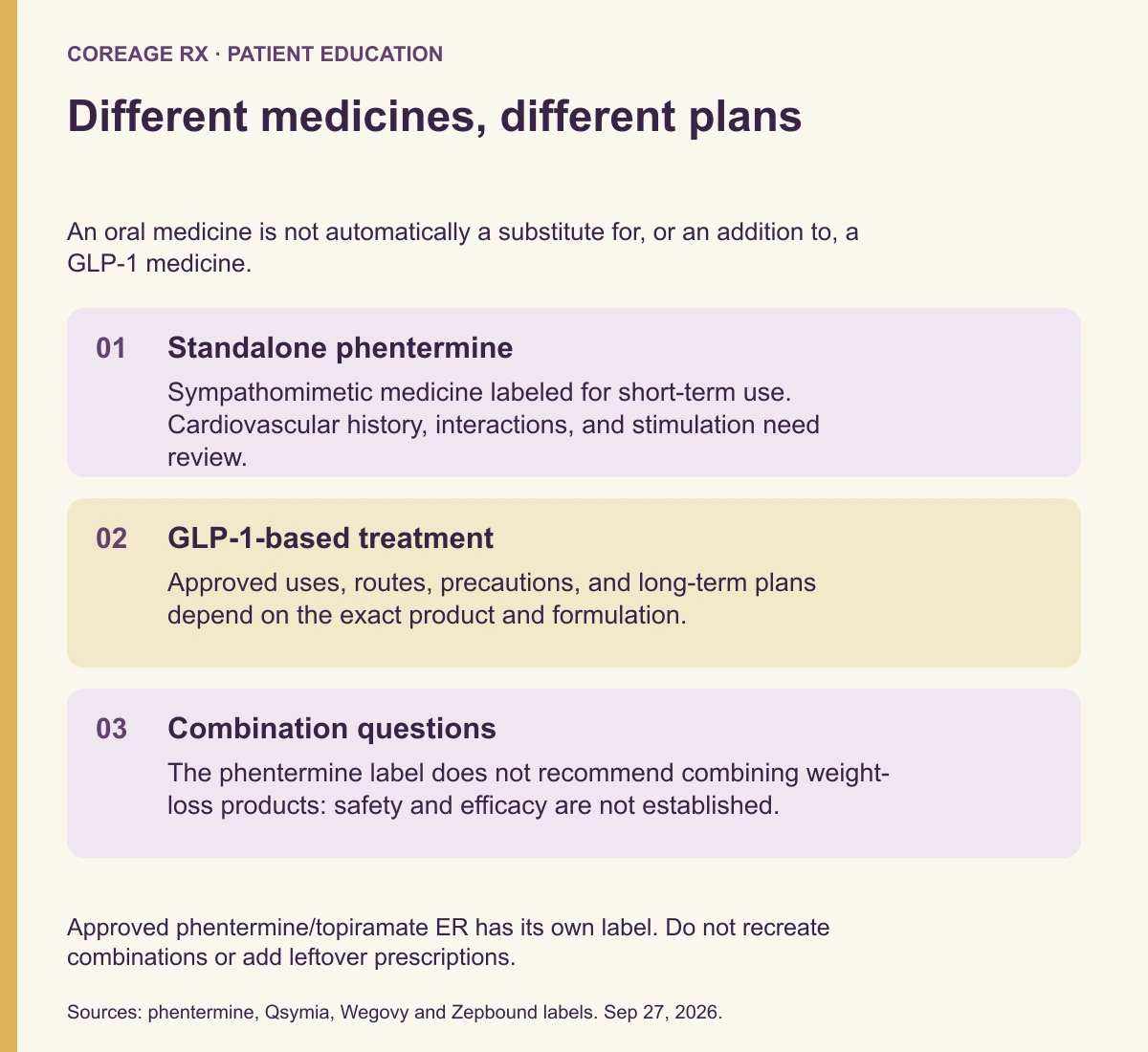
Phentermine is not a GLP-1 medicine. It is a sympathomimetic drug used in short-term weight-management treatment under its U.S. label. Medicines such as Wegovy and Saxenda act at the GLP-1 receptor, while tirzepatide, the ingredient in Zepbound, acts at both GIP and GLP-1 receptors.
These distinctions affect approved uses, treatment duration, side effects, monitoring, and combination questions. A medicine being available as a tablet or having a lower advertised price does not establish that it is the right substitute for an injection—or an appropriate addition to it.
How are they different?
| Feature | Standalone phentermine | Selected GLP-1-based weight-management medicines |
|---|---|---|
| Drug type | Sympathomimetic amine; classified as an anorectic | GLP-1 receptor agonists, or dual GIP/GLP-1 activity with tirzepatide |
| Labeled treatment duration | Short-term adjunct, described as a few weeks | Certain approved products support long-term weight reduction and maintenance |
| Route | Oral, with presentation-specific instructions | Depends on product: daily or weekly injection, or a daily tablet |
| Important review areas | Cardiovascular history, blood pressure, stimulation, sleep, interactions, and misuse risk | Product-specific digestive effects, medical history, interactions, and other labeled warnings |
| Adding another weight-loss drug | The standalone label does not recommend coadministration because safety and efficacy are not established | Do not assume a separate medicine can be added without a new clinical assessment |
Sources: phentermine prescribing information, Wegovy label, Zepbound label, and Saxenda label. The chart summarizes broad differences; it does not cover every product or replace its full instructions.
What does phentermine’s mechanism mean?
Phentermine belongs to a class with sympathomimetic activity, meaning it can produce effects associated with stimulation of the sympathetic nervous system. Its label describes central nervous system stimulation and possible elevation of blood pressure among the relevant pharmacologic effects.
The label also cautions against oversimplifying its mechanism as a single proven appetite-suppression pathway. It is prescribed within a weight-management regimen, but describing it as a natural GLP-1 booster or a tablet version of semaglutide would be inaccurate. Source: phentermine clinical pharmacology.
Our explanation of GLP-1 medicines provides the separate receptor-based background. Similar goals do not make different medicines interchangeable milligram for milligram.
What is standalone phentermine approved for?
The label describes phentermine as a short-term adjunct to a regimen involving exercise, behavior changes, and calorie restriction. Its adult screening context includes an initial BMI of at least 30, or at least 27 with other risk factors such as controlled hypertension, diabetes, or high cholesterol.
Those numbers do not approve a person for treatment by themselves. The clinician must also review contraindications, other medicines, kidney function where relevant, and the risks and benefits of the proposed plan. A person’s blood-pressure history deserves particular attention: controlled hypertension in an indication example does not erase the label’s cardiovascular contraindications and precautions.
The weight-loss medication overview from NIDDK provides broader context. Treatment should be tied to a health assessment and follow-up, not simply an online BMI result or a request for the least expensive appetite suppressant.
Are GLP-1 medicines always injections?
No. Current weight-management options include different routes and routines. Wegovy has injection and tablet formulations, and Foundayo is a daily oral GLP-1 receptor agonist containing orforglipron. Their administration requirements and approved populations differ.
A tablet can still have significant adverse effects, interactions, and monitoring needs. It also may require a particular routine that does not fit every person. Route preference is a useful part of the discussion, but it does not settle clinical suitability.
See our oral semaglutide versus injections guide and the current Foundayo label. Do not use the milligrams printed on one product to estimate an equivalent dose of another.
Which option produces more weight loss?
There is no sound way to answer an individual treatment question by placing unrelated study percentages side by side. Trial duration, patient population, dose, background lifestyle support, and how missing data were handled can change the results.
A short-term phentermine label should not be compared with a much longer obesity trial as though both measured the same experience. Likewise, evidence from a product containing phentermine plus another ingredient cannot be assigned to phentermine alone.
Our guide to choosing a GLP-1 medicine explains how evidence fits into a clinical decision. Discuss the intended health outcomes, what would count as a meaningful response, and when the plan would be reassessed instead of treating the largest advertised percentage as a personal prediction.

Can phentermine be taken with a GLP-1 medicine?
The standalone phentermine label states that the safety and efficacy of combining it with other weight-loss drug products have not been established and that coadministration is not recommended. Its warning includes prescription medicines, over-the-counter products, herbal preparations, and certain serotonergic medicines. Source: phentermine warning on combination use.
An individual off-label prescribing decision requires a clinician to assess the specific drugs, health history, interactions, potential benefit, and monitoring. The existence of an online anecdote or a clinic’s combination offering does not establish that the combination is FDA-approved or suitable for someone else.
Do not add leftover phentermine because appetite returns before an injection or because weight has plateaued. Our semaglutide plateau guide and tirzepatide plateau guide explain why those situations need a broader review.
Is phentermine/topiramate the same thing?
No. Qsymia is an approved extended-release combination of phentermine and topiramate for specified long-term weight-management use. It has its own dose plan, response assessments, contraindications, and precautions. That approval does not extend to every separately assembled combination containing phentermine.
Qsymia’s label includes fetal-harm concerns, pregnancy testing and contraception requirements for people who can become pregnant, and a restricted safety program. It also has mood, cognitive, eye, metabolic, and other considerations. Its highest-dose discontinuation instructions include gradual withdrawal to reduce seizure risk. Source: Qsymia prescribing information.
Our topiramate and weight-loss guide explains the distinction between standalone use and the approved combination. Do not recreate a combination or change its stopping plan using separate pills without explicit prescribing instructions.
Who may be unable to use phentermine?
The standalone label lists contraindications including a history of cardiovascular disease, uncontrolled hypertension, recent monoamine oxidase inhibitor use, hyperthyroidism, glaucoma, agitated states, a history of drug abuse, pregnancy, nursing, and relevant hypersensitivity.
It also advises caution even with mild hypertension and describes abuse and dependence risks. These issues should be discussed openly and without judgment. A complete history helps the clinician evaluate suitability; leaving out a medicine or diagnosis can make that assessment less reliable.
GLP-1-based treatments have their own contraindications and precautions. Someone unable to use phentermine is not automatically eligible for another drug. Our Zepbound side-effects guide and Wegovy side-effects guide introduce those separate safety discussions.
What side effects should be reviewed?
With phentermine, ask about blood pressure, palpitations, restlessness, sleep disruption, dry mouth, and any symptoms affecting daily functioning. The medication list should include other prescriptions, stimulant-containing products, over-the-counter medicines, supplements, and alcohol use.
The label directs prompt assessment of new unexplained shortness of breath, chest pain, fainting, or lower-extremity swelling because of potentially serious cardiopulmonary concerns. Severe symptoms warrant urgent care rather than waiting for a routine refill conversation. Source: phentermine warnings and precautions.
For GLP-1 medicines, digestive symptoms, dehydration, and other product-specific warnings require their own plan. The fact that the side-effect profiles differ does not establish that one class is universally safe or universally easier to tolerate.
What if the appetite effect seems to wear off?
Phentermine’s label notes that tolerance can develop and says not to exceed the recommended dose in response. Contact the prescribing team rather than increasing the amount, taking extra doses, or adding another appetite-suppressing product.
Ask how the initial treatment period was intended to end and what follow-up options were planned. A sustainable strategy also considers meals, activity, sleep, medical conditions, access, and support. Appetite changes alone cannot diagnose why progress has slowed.
If considering CoreAge Rx’s tirzepatide care information, clarify the actual preparation and clinical assessment involved. A change of care program does not establish an equivalent dose or make combining prescriptions appropriate.

The treatment goal may extend beyond weight
Some GLP-1-based products have additional approved uses in defined populations. Wegovy has a cardiovascular-risk-reduction indication for specified adults, and Zepbound has an indication for moderate to severe obstructive sleep apnea in adults with obesity. Those uses should not be generalized to every medicine that affects appetite. Sources: Wegovy and Zepbound prescribing information.
Tell the clinician which health conditions are being treated and which outcomes matter most. Improved energy, less hunger, and a change on the scale are not interchangeable with evidence about cardiovascular events or sleep apnea. A product-specific indication may influence the treatment choice alongside tolerability, cost, and access.
Questions to bring to the appointment
Ask which condition the medicine is intended to address, why that product fits your history, how long the proposed treatment lasts, and how benefit and adverse effects will be monitored. Clarify who handles concerns between visits and how any change or discontinuation will be managed.
Finally, review the actual cost and coverage alongside the clinical decision. Our GLP-1 insurance guide explains why a covered medicine, an advertised cash offer, and a suitable long-term care plan are different questions.
Educational information for adults; individual treatment decisions require a qualified clinician. Sources checked September 27, 2026. Original AI-generated article illustrations depict fictional people and objects, not patient outcomes. Other editorial images are illustrative. Graphics summarize the cited sources.