
GLP-1 stands for glucagon-like peptide-1, a hormone involved in the body’s response to food. It helps coordinate insulin and glucagon signaling, influences stomach emptying, and participates in appetite regulation. Medicines that act on the GLP-1 receptor use that biology to treat particular conditions, including type 2 diabetes and, for certain products, obesity.
That explains why the same term appears in discussions of blood sugar, weight management, digestion, and supplements. It does not mean that all products described as “GLP-1” are the same. The hormone, a prescription medicine, and a supplement marketed to support GLP-1 are three different things.
What does GLP-1 do after a meal?
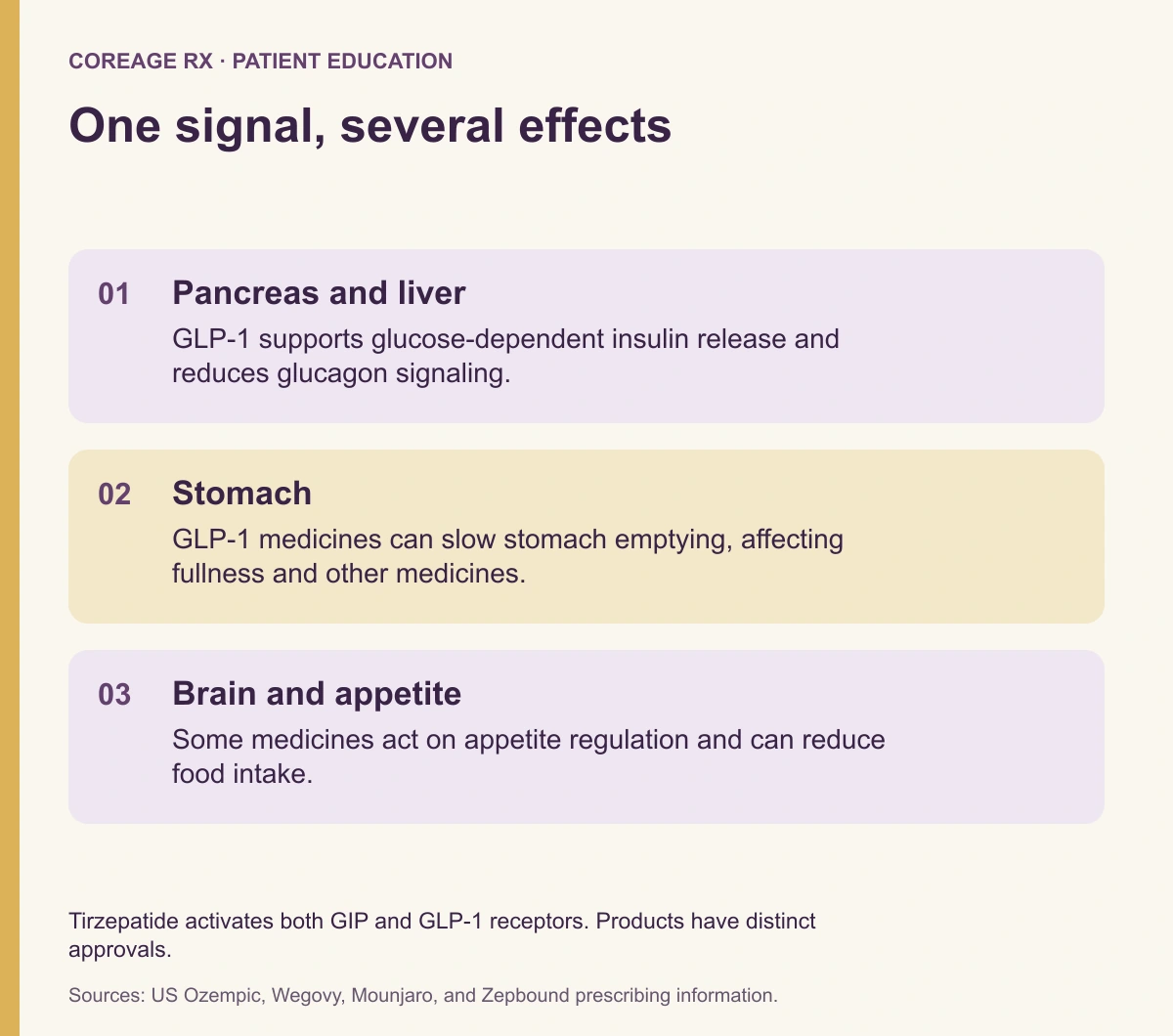
A helpful way to picture GLP-1 is as one of the body’s meal-related signals. The signal contributes to several coordinated responses rather than performing a single job.
| Where the effect matters | Plain-language explanation |
|---|---|
| Pancreas | GLP-1 receptor activity supports insulin release in a glucose-dependent way. |
| Glucagon signaling | It helps reduce the signal that promotes glucose release when that reduction is appropriate. |
| Stomach | GLP-1 medicines can slow gastric emptying, changing how quickly food leaves the stomach. |
| Brain and appetite | Some treatments affect appetite regulation and can reduce food intake. |
These are simplified descriptions. The effects of a specific medicine depend on its pharmacology, formulation, and dose. The Ozempic and Wegovy labels describe semaglutide’s mechanism; the Mounjaro and Zepbound labels explain tirzepatide’s dual-receptor activity.
GLP-1 biology is not a moral explanation for hunger or weight. Appetite is influenced by many signals, habits, sleep, stress, medicines, and health conditions. Our hunger guide and food-noise article explore those experiences without reducing them to willpower.
What is a GLP-1 receptor agonist?
A receptor is a structure that responds to a signal. An agonist activates that receptor. A GLP-1 receptor agonist is therefore a medicine that activates GLP-1 receptors to produce particular effects.
Semaglutide and liraglutide are examples. Tirzepatide acts at both the GLP-1 receptor and the GIP receptor, so it is more precisely described as a dual GIP/GLP-1 receptor agonist. People often group it under “GLP-1 medicines” in casual conversation, but the distinction is useful when understanding product names and research.
The ingredient name does not tell you everything about the prescription. The brand, formulation, route, dose, approved indication, and instructions all matter. A tablet, a weekly pen, and a compounded vial should not be treated as interchangeable simply because related words appear on their labels.
Which medicines belong in the conversation?
The examples below illustrate the landscape, not every available diabetes or weight-management medicine.
| Medicine or ingredient | How to understand it |
|---|---|
| Ozempic injection: semaglutide | A GLP-1 medicine with type 2 diabetes and specific cardiovascular and kidney indications in defined adult populations. |
| Wegovy: semaglutide | A product with weight-management and other specific labeled indications; oral and injectable presentations have different instructions and uses. |
| Mounjaro: tirzepatide | A dual GIP/GLP-1 medicine for type 2 diabetes, with an additional adult cardiovascular indication in the current label. |
| Zepbound: tirzepatide | A dual GIP/GLP-1 medicine for eligible adults seeking weight management and for moderate to severe sleep apnea in adults with obesity. |
| Foundayo: orforglipron | A once-daily oral GLP-1 medicine approved in 2026 for long-term weight management in eligible adults. |
| Liraglutide products | Another GLP-1 ingredient; the specific brand and approved use matter. |
The FDA’s Foundayo approval announcement and current product labels are better sources for current approvals than an old list of “all GLP-1 drugs.” This area has changed, including the availability of oral options. If avoiding injections is important to you, ask about approved formulations rather than assuming that every pill or drop advertised online has equivalent evidence.
For more detail, see oral semaglutide versus injections and tirzepatide versus semaglutide results.
Are GLP-1 medicines only for weight loss?
No. Many people use these medicines for type 2 diabetes, and particular products have additional indications supported by specific trials. A cardiovascular, kidney, or sleep-apnea benefit approved for one product and population does not automatically apply to every medicine in the class or every person.
For example, the current Ozempic injection label includes kidney-related outcomes in adults with type 2 diabetes and chronic kidney disease. Zepbound has an indication for moderate to severe obstructive sleep apnea in adults with obesity. Those are different decisions involving different clinical histories.
If a medicine is prescribed, ask what problem it is intended to treat and what measures will show whether it is helping. A person may need glucose monitoring, an eye-care plan, sleep-apnea follow-up, or another condition-specific assessment in addition to weight measurements.
To interpret how common treatment is, read our guide to Ozempic and GLP-1 use statistics. It separates dated class surveys, diabetes populations, all adults, current use and brand-specific counts.
Who might be considered for weight-management treatment?
For adults, a commonly used threshold for chronic weight-management medicines is a BMI of at least 30, or at least 27 with a weight-related health condition. BMI is a screening tool; it does not by itself establish that a medicine is appropriate, available, or covered by insurance. The exact product label and a clinical assessment still apply. Source: NIDDK’s prescription weight-management overview.
The consultation should consider health history, current medicines, pregnancy plans, eating patterns, prior treatment, symptoms, goals, and the ability to maintain follow-up. It should also identify reasons a particular medicine may be unsuitable.
Our BMI and waist-measurement guide explains the limits of screening measurements. The first weight-management consultation article can help you prepare useful information.

What might treatment feel like?
Some people describe getting full sooner, thinking about food less often, or finding portions easier to manage. Others notice digestive symptoms before a clear change in appetite. Early experiences vary, and a dramatic feeling after the first dose is not required for treatment to be effective.
Most product schedules introduce treatment gradually. A low starting dose is not a reason to accelerate the schedule yourself. Response is evaluated over time alongside tolerance, nutrition, and the intended health outcomes.
Our guides to the first month on semaglutide and first month on tirzepatide describe useful observations. Neither provides a guarantee of a certain number of pounds lost by a particular date.
What side effects and risks matter?
Nausea, vomiting, diarrhea, constipation, and abdominal discomfort are common concerns with several GLP-1 medicines. The frequency differs by product, dose, population, and study. Slow escalation and individualized support can help, but significant symptoms need medical review.
Important warnings for the products discussed here include severe digestive reactions, dehydration-related kidney injury, pancreatitis, gallbladder problems, serious allergic reactions, and low blood sugar in some medication combinations. Specific eye, pregnancy, contraception, and anesthesia precautions also apply. Several products have boxed thyroid C-cell tumor warnings and are contraindicated with a personal or family history of medullary thyroid carcinoma or MEN2.
Read the label and guidance for the actual prescription. Our Ozempic side-effects guide, Zepbound side-effects guide, and Mounjaro side-effects guide keep their trial data and warnings separate.
Severe persistent abdominal pain, inability to keep fluids down, a sudden major vision change, or signs of a serious allergic reaction should not be managed by waiting for a routine online check-in.
Why food, strength, sleep, and follow-up still matter
A medication can change appetite without automatically creating a balanced eating pattern. If portions become smaller, the remaining meals still need to support nutrition. Strength and physical function deserve attention during weight change.
The joint nutrition advisory recommends integrating nutritional assessment, individualized food guidance, activity, and follow-up into care. Supplements may have a role for a specific gap, but they are not a replacement for meals or strength training.
Start with practical resources such as balanced meals, strength training for beginners, and sleep and weight management. The best routine is one that fits your health needs, resources, and daily life well enough to continue.
Can foods or supplements “boost GLP-1” instead?
Food is part of the body’s natural hormone signaling. That does not establish that a particular food or supplement produces the same magnitude, duration, or clinical outcome as a prescription receptor agonist. A laboratory signal, an animal experiment, and a trial showing meaningful human health outcomes answer different questions.
When evaluating a supplement, ask what exact product was studied, in whom, for how long, and with what results. A broad claim such as “supports GLP-1” may not answer any of those questions. Read our GLP-1 support supplement guide and supplements during prescription treatment article for the two distinct decisions.
The same standard applies to CoreAge Rx GLP-1 Support. It is a supplement product to evaluate on its own label and evidence, not an FDA-approved replacement for prescription diabetes or obesity treatment.

Approved medicines, compounded products, and online care
An approved medicine has undergone FDA review for its specific formulation, uses, and labeling. Compounded drugs have not undergone that same approval process. FDA advises that compounded GLP-1 drugs should be used only when a patient’s medical needs cannot be met by an approved drug. Concentration, measurement, storage, and product-quality issues deserve explicit discussion. Source: FDA’s current GLP-1 guidance.
Before using an online service, identify the prescriber, dispensing pharmacy, exact product, total recurring cost, follow-up process, and what to do if a problem occurs. A familiar ingredient name or a large number of reviews is not a complete quality assessment.
You can review CoreAge Rx semaglutide and tirzepatide product information as part of that process. Ask the team to explain the preparation and care plan rather than assuming a product page establishes eligibility or a guaranteed result.
Frequently asked questions
Is GLP-1 the same as insulin?
No. GLP-1 is a hormone involved in meal-related signaling, including effects on insulin release. A GLP-1 medicine is not interchangeable with insulin. People using both need a coordinated prescription and monitoring plan.
Is tirzepatide a GLP-1 medicine?
It activates GLP-1 receptors and GIP receptors. The dual mechanism is why its description is more specific than the casual umbrella term.
Will I have to take treatment forever?
There is no single answer. These conditions can require long-term management, and stopping medication may lead to weight regain or changes in glucose control. Review benefit, tolerance, cost, and a maintenance plan with the clinician. See stopping semaglutide and stopping tirzepatide.
What is the best first step if I am curious?
Clarify your health goal and arrange a clinical assessment. Bring your medicine list, relevant history, previous treatment experience, and questions about cost and follow-up. Learning the terminology helps you ask better questions; it does not replace that assessment.
Educational information for adults; individual treatment decisions require a qualified clinician. Sources checked September 26, 2026. Original AI-generated article illustrations depict fictional people and objects, not patient outcomes. Other editorial images are illustrative. Graphics summarize the cited sources.