
The first month on tirzepatide is a period for learning the treatment routine and assessing appetite, symptoms, nutrition, and function. There is no universal number of pounds everyone should lose in week one or month one. For branded Zepbound, the labeled 2.5 mg weekly dose is used for the first four weeks to initiate treatment; it is not an approved maintenance dose. Review early changes with your clinician before judging the whole treatment or changing the schedule.
This guide focuses on adult Zepbound initiation and practical first-month questions. Mounjaro contains the same ingredient but has its own approved uses and instructions. Compounded preparations also need their own clearly identified instructions and should not be assumed equivalent to a branded product.
Before the first injection: confirm what you received
Check the exact product, strength, presentation, and prescribed schedule. Current Zepbound presentations include different pens and vials, so instructions from another person’s device or an older video may not match yours. The current Zepbound label calls for training appropriate to the actual presentation, including new training if the presentation changes.
Ask the pharmacist how to recognize completion, which supplies are needed, how to store the product, and how to dispose of used sharps. If the strength, concentration, label, or directions differ from what you expected, resolve that before use. A total amount in a multidose vial or pen is not necessarily the amount for one injection.
The clinician should review the treatment purpose, other medicines, pregnancy plans, severe digestive problems, serious allergies, and relevant thyroid-cancer history. The label includes contraindications related to a personal or family history of medullary thyroid carcinoma and MEN 2, as well as serious hypersensitivity. A proper review is more useful than a checklist copied from someone else’s treatment.
Our tirzepatide questions guide explains the broader assessment. Bring the actual packaging to the discussion when possible.
What does the 2.5 mg starter dose mean?
Zepbound’s labeled starting dose is 2.5 mg once weekly for four weeks. The prescribing information identifies that dose as initiation, rather than an approved maintenance dose. Its escalation schedule is intended to reduce gastrointestinal adverse-reaction risk and guide later maintenance selection according to response and tolerability.
This does not mean that you should feel a particular appetite change on a particular day. It also does not mean that the first month is wasted if the scale changes little. Initiation and maintenance are different parts of a treatment plan.
Ask in advance what the end-of-month review will cover. If nausea, vomiting, constipation, or limited intake is already a problem, contact the prescriber before the next planned increase. Do not accelerate because someone else advanced faster or because a starter-dose price is temporary.
Mounjaro has a different treatment-purpose discussion. Its current label includes type 2 diabetes glycemic control and a specific adult cardiovascular-risk indication. Follow the actual prescription rather than transferring every Zepbound statement to another product.
What should you expect after week one?
Some people notice changes in fullness or snacking early; others describe a gradual or less obvious response. Sleep, stress, activity, meals, and previous treatment can affect how the first days feel. An appetite sensation twenty-four hours after injection is not a validated test of long-term success.
Look for practical changes: Can you eat comfortably? Are portions manageable? Are food thoughts less disruptive? Are symptoms interfering with work or sleep? A useful effect does not require never feeling hungry.
If appetite is so reduced that you repeatedly miss meals, describe that to the care team. Eating as little as possible is not a demonstration that the medicine is working well. The goal includes tolerable treatment and adequate nutrition, rather than discomfort as a target.
The food noise guide separates hunger, cravings, and persistent food thoughts. A change in one does not establish the whole treatment outcome.
How much weight should you lose in the first month?
There is no single first-month target established for every patient. The label’s major weight-management studies assessed longer treatment periods with defined populations, dose escalation, and lifestyle support. Dividing a long-term average by the number of months does not create a valid prediction for week one or month one.
Starting weight, diabetes status, previous medicines, intake, symptoms, and other health factors can influence the course. A friend’s early change or a social-media photograph cannot tell you what your own response should be.
If weight monitoring is part of your plan, use reasonably comparable conditions and consider the trend with your clinician. Fluid, bowel contents, and other daily changes can move a reading independently of body-fat change. Our pooping and weight guide explains that distinction.
Do not take an extra dose, sharply restrict food, or add a cleanse after an unchanged reading. The tirzepatide plateau guide addresses a sustained leveling during established treatment; a few days at initiation is a different question.
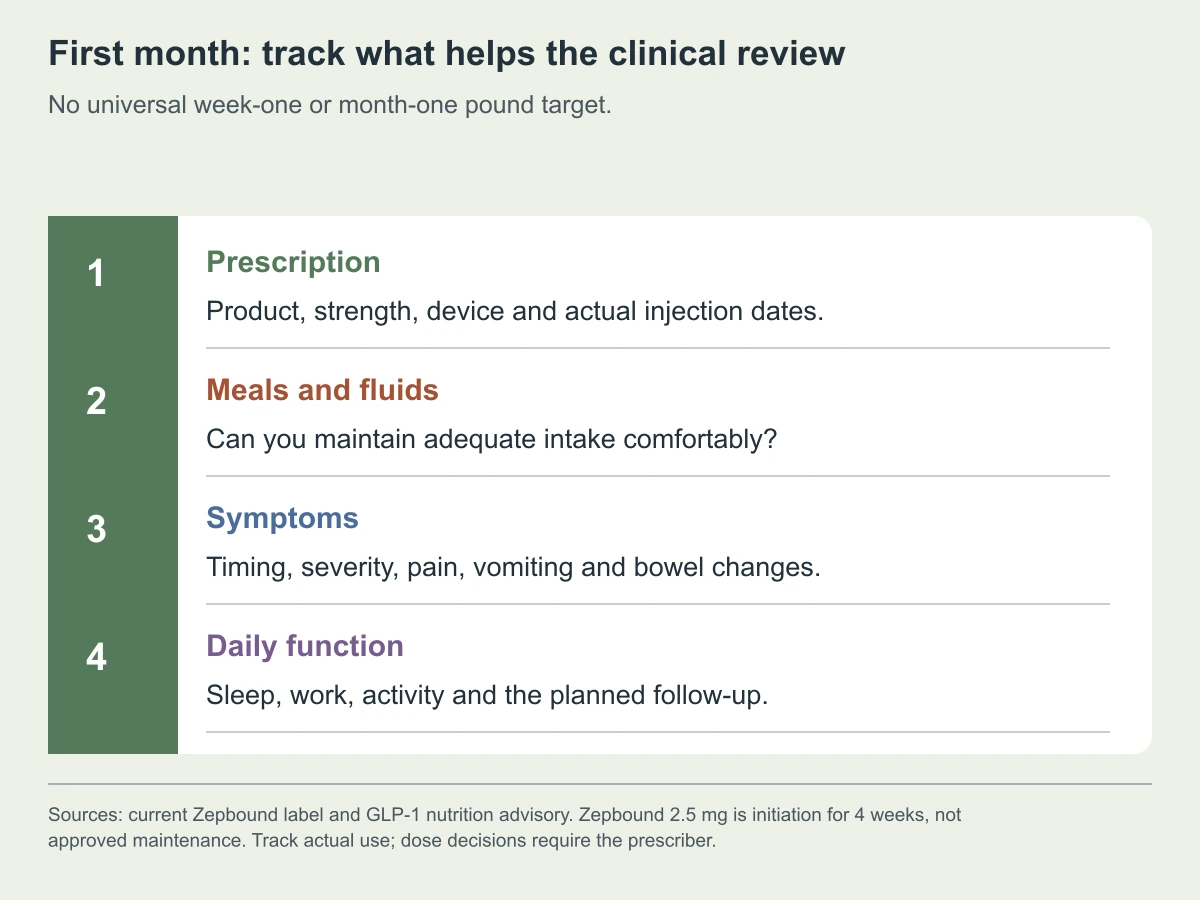
What is useful to track?
A short record can support a good review without turning every meal or hunger sensation into a test.
| Area | Useful information | How it helps the review |
|---|---|---|
| Prescription | Product, prescribed strength, actual injection dates, and presentation | Establishes what was taken |
| Appetite and meals | Ability to eat regularly and comfortably | Identifies inadequate intake or a helpful pattern |
| Symptoms | Start, duration, severity, vomiting, pain, reflux, and bowel changes | Helps assess tolerance and other possible causes |
| Daily function | Sleep, work, activity, and strength concerns | Keeps the focus beyond a scale reading |
| Requested monitoring | Glucose, blood pressure, or other measures the clinician requested | Supports condition-specific decisions |
Record missed doses or uncertain delivery separately. “Nausea began Tuesday and I vomited twice” is more useful than “the medicine feels strong.” If another concentration or device is dispensed, bring the new label to the review.
How can you plan meals with less hunger?
Have manageable foods available so a smaller appetite does not become accidental under-eating. Include suitable protein foods and other foods that supply energy, fiber, and micronutrients. Smaller eating opportunities may be more practical than waiting until you can face a large dinner.
Examples include yogurt with fruit, eggs with toast, tofu with a grain and vegetables, or a lentil dish. These are flexible ideas rather than one compulsory meal plan. Your kidney health, allergies, preferences, and other medical needs can change the appropriate choices.
The GLP-1 nutrition advisory supports individualized nutritional assessment and attention to intake and function. Ask for dietitian help if intake is limited, restrictions are substantial, or you have frailty, kidney disease, or a history of disordered eating. A generic high-protein target or supplement bundle cannot replace that assessment.
Our balanced meal guide and tirzepatide protein and muscle guide provide additional questions. Strong Suit creatine is a separate muscle-support supplement; it does not replace protein foods, adequate meals, activity, or a clinical nutrition plan.

Mild nausea, reflux, constipation, and diarrhea
Eating slowly, using manageable portions, and avoiding a very large meal when already full may help with mild symptoms. Notice whether rich meals or lying down soon afterward worsen your experience. The gastrointestinal expert consensus discusses tailored eating habits and review of persistent or troublesome symptoms.
Do not respond by eliminating more and more foods without checking whether the remaining intake is adequate. Avoid adding several OTC medicines at once, which can introduce adverse effects and make the pattern harder to interpret. The Dramamine guide explains why a motion-sickness product does not establish a preventive routine for GLP-1 nausea.
For specific symptoms, see tirzepatide nausea and reflux, GLP-1 constipation, and Zepbound diarrhea. Medicine-related symptoms can overlap with infection, food intolerance, or another digestive problem; timing alone does not prove the cause.
Full House is a fiber-focused supplement, rather than an automatic answer to every bowel symptom. Review the actual fiber amount, water and swallowing instructions, and medication timing before adding it, particularly during an unresolved digestive problem.
Birth control belongs in the first-month plan
Tirzepatide can affect absorption of oral hormonal contraception. The Zepbound label advises switching to a nonoral method or adding a barrier method for four weeks after initiation and for four weeks after each dose escalation. Starting treatment and later increasing the dose can therefore create separate four-week windows.
Do not assume that taking a contraceptive pill at another time removes the issue. Review the method with the prescribing clinician, pharmacist, or reproductive-health professional. Vomiting, severe diarrhea, or missed pills can require additional method-specific advice.
The tirzepatide birth-control guide explains those questions. Pregnancy planning and an unexpected pregnancy also need prompt discussion; Zepbound labeling directs discontinuation when pregnancy is recognized. A weight-management drug is not a pregnancy weight-control plan.
What if you miss a dose?
For branded Zepbound, the label describes taking a missed dose within four days, or 96 hours. If more than four days have passed, the label says to skip it and use the next regularly scheduled dose. A change in weekly administration day requires at least three days, or 72 hours, between doses.
These instructions should be read with the actual prescription and device information. A longer interruption and restarting after it are separate questions for the care team. Do not double up to catch up, or assume that an online schedule covers every preparation.
The tirzepatide missed-dose and restart guide explains the distinctions. Keep actual dates available when asking for help; remembering “sometime last week” may not resolve the spacing question.
What if the device did not seem to work?
An uncertain delivery is not the same as a dose that was definitely never administered. Do not automatically repeat the injection because you did not feel an effect or cannot tell what happened.
Keep the device and packaging, record what you observed and when, and contact the pharmacist or manufacturer for presentation-specific guidance. Completion indicators differ between presentations. The clinician also needs to know if a dose may have been partially delivered.
If you receive a different device at refill, get the appropriate training. A switch from a single-dose pen to a vial or multidose presentation should not rely on instructions for the old package.
Symptoms that need faster care
Severe or persistent abdominal pain, repeated vomiting, inability to retain fluids, fainting, or very little urine requires prompt assessment. The label includes pancreatitis, gallbladder, severe gastrointestinal, and volume-depletion kidney injury warnings. Breathing difficulty or swelling of the face or throat needs emergency help.
People taking insulin or a sulfonylurea need the agreed low-glucose plan. NIDDK’s hypoglycemia guidance explains why medicine combinations and changes in intake matter. Severe confusion, collapse, seizure, or inability to swallow safely are emergencies. Do not independently reduce another prescription based on an online article.
Report meaningful vision changes, particularly if you have diabetes-related eye disease. Tell clinicians about tirzepatide before a procedure involving anesthesia or deep sedation, since the label includes an aspiration warning. The procedural team should give the plan; this article does not establish a universal stopping interval.
Type 1 diabetes adds specific insulin and ketone concerns. The type 1 diabetes and GLP-1 guide discusses the evidence and why specialist coordination matters.

What should the first follow-up accomplish?
Review the actual prescription history, intended benefits, symptoms, food and fluid intake, and ability to maintain daily activities. Ask whether the next planned dose is appropriate, which measures will be followed, and when the next review should occur.
Confirm refill arrangements and the anticipated price before the supply runs out. The Zepbound cost guide and GLP-1 insurance guide explain why introductory prices, authorization windows, and continuing costs need separate checks.
A useful first month may include noticeable benefit, a need to modify the plan, or recognition that another option fits better. The next decision should come from a clear record and clinical discussion, rather than pressure to match someone else’s early result.
CoreAge Rx’s tirzepatide information describes a compounded offering. Compounded medicines are not FDA-approved, and branded Zepbound or Mounjaro evidence does not establish the same safety, effectiveness, or approved uses for a compounded preparation. Review the exact concentration, directions, sourcing, and follow-up; see FDA’s compounded GLP-1 concerns.
Should you take Zepbound in the morning or at night?
The current U.S. Zepbound label permits weekly administration at any time of day, with or without meals. It does not establish morning or evening as a universally superior time for weight loss. Choose a routine you can follow with your prescribing team. If changing the weekly administration day, at least 72 hours must separate doses; this is not permission for an extra injection or a self-directed restart after a long gap. Other medicines and daily tablets have their own instructions. Zepbound U.S. prescribing information.
Frequently asked questions
Should I lose weight after the first injection?
There is no universal first-injection weight requirement. Early scale changes may reflect several influences, and the treatment is assessed over time with clinical follow-up.
Does no appetite change in week one mean treatment failed?
No. A particular early sensation is not a validated long-term response test. Discuss the actual pattern, prescription use, and tolerability at follow-up.
Is 2.5 mg a maintenance dose for Zepbound?
No. The label identifies it as a four-week initiation dose. Subsequent decisions belong with the prescriber, especially if symptoms or limited intake are present.
Should I increase sooner to get better results?
Do not accelerate the schedule independently. The escalation plan addresses tolerability, and the clinician should review response and adverse effects together.
What if I cannot eat enough?
Tell the care team. Low appetite does not eliminate nutritional needs, and persistent inability to eat or drink deserves assessment rather than celebration as a treatment result.
Can I use someone else’s device instructions?
Only instructions for the actual presentation apply. Get training for the product you received, especially if the device changes at refill.
Educational information for adults; individual treatment decisions require a qualified clinician. Sources reviewed October 1, 2026. Original AI-generated article images depict fictional people and objects, not patient outcomes. Other editorial images are illustrative. Graphics summarize the cited sources.