
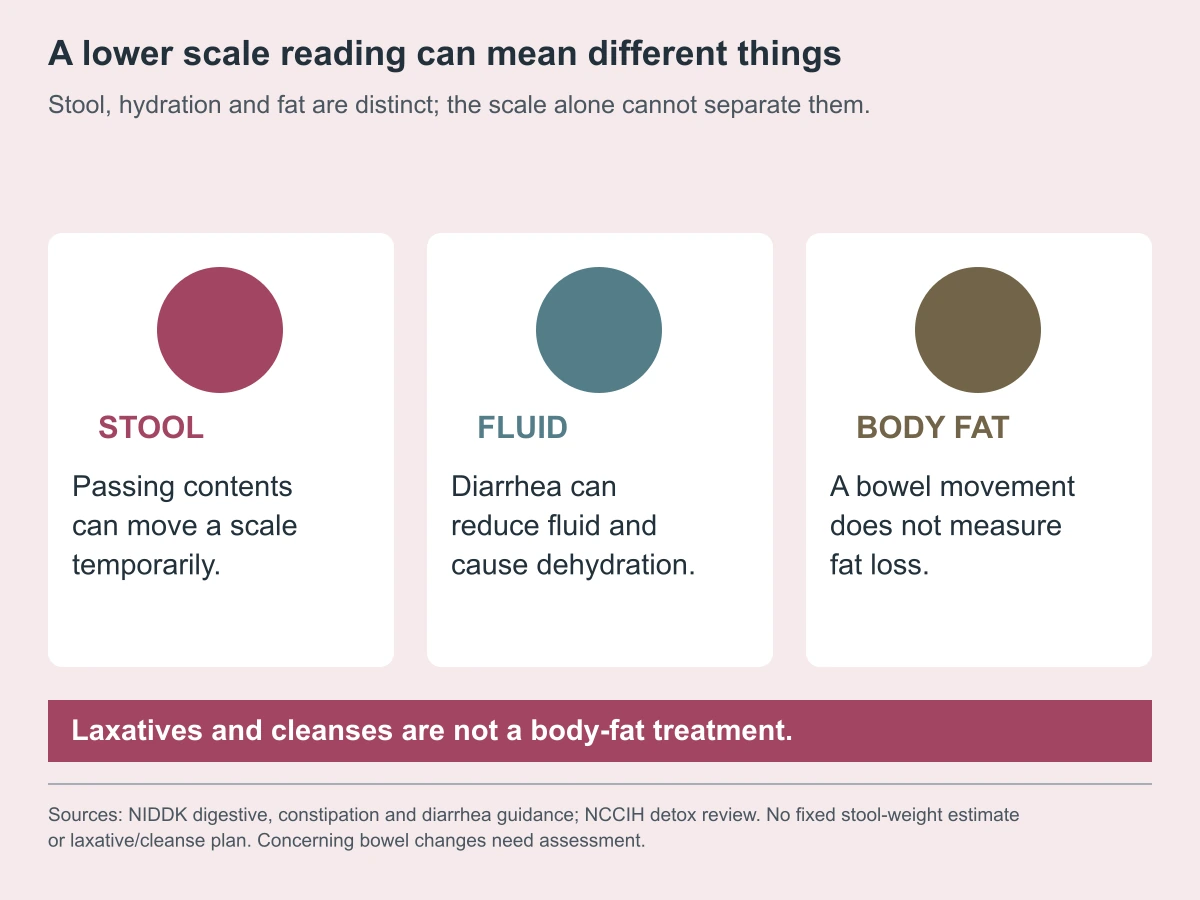
Your scale can show a lower number after a bowel movement because stool and some fluid have left the body. That is different from losing body fat. More frequent bowel movements, diarrhea, laxatives, and cleanses are not reliable or safe methods for fat loss. The useful goals are comfortable bowel function, adequate nutrition, and a longer-term health plan rather than a lower number after every bathroom visit.
A temporary change in abdominal fullness can also affect how you feel or how clothes fit. It cannot tell you how much fat has changed. Looking at bowel symptoms and weight trends as separate questions helps avoid confusing ordinary variation with treatment success.
What actually leaves the body when you poop?
NIDDK’s explanation of digestion describes how food is broken down and nutrients are absorbed, mainly through the small intestine. The large intestine absorbs water, and the remaining material becomes stool. That stool includes undigested material, fluid, and cells from the digestive tract.
Passing stool removes some material that was physically inside the body. A scale measures total body weight, so this can change its reading. It does not mean a bowel movement has directly removed an equivalent amount of stored body fat.
Food does not remain entirely unabsorbed until you use the bathroom. By the time material reaches the colon, much nutrient absorption has already happened. That is why trying to force a bowel movement after eating is not a dependable way to undo the meal.
| Change | What may be involved | What the scale cannot tell you alone |
|---|---|---|
| Lower number after a bowel movement | Stool and fluid leaving | How much body fat changed |
| Higher number during constipation | Retained contents and other daily variation | Whether fat has increased |
| Lower number during diarrhea | Fluid loss and illness-related changes | Whether the change is healthy or sustainable |
| Gradual trend across weeks | Many influences, including the overall treatment plan | The exact cause without more context |
How much weight do you lose after a bowel movement?
There is no single reliable amount for everyone. Stool amount, fluid, food intake, bowel timing, the scale, and the circumstances of weighing all vary. A dramatic number from another person’s experience is not a prediction for you.
If you weigh yourself, comparing measurements under reasonably similar conditions can make a trend easier to understand. That does not require repeatedly weighing before and after bathroom visits. Frequent checking may create more noise and make normal variation seem alarming.
One reading cannot separate stool, hydration, fat, muscle, and other components. Nor can it diagnose constipation or a digestive condition. The pattern of symptoms and the longer-term health picture are more useful than trying to assign every ounce to one cause.
Our walking and weight-management guide discusses a sustainable activity option without promising a precise scale result. Weight management works better as a longer-term plan than a sequence of bathroom-related measurements.
Does constipation make you gain fat?
Constipation can involve retained stool and a feeling of fullness, but those are not the same as increased fat tissue. Other changes in intake, hydration, medicines, and activity can also occur at the same time, so a higher reading should not be given one automatic explanation.
NIDDK’s constipation symptoms guidance describes hard or lumpy stools, difficult or painful passage, a sense that stool has not fully passed, and fewer than three bowel movements per week. Frequency is only one part of the description. Someone who passes stool daily can still have difficult or incomplete bowel movements.
Address the bowel problem for comfort and health, rather than trying to reduce a target amount of weight. Persistent symptoms need assessment. The cause can involve medicines, changes in routine or food, dehydration, pelvic-floor problems, or other health conditions.
Our constipation on GLP-1 medicines guide explains practical questions about semaglutide, tirzepatide, and other prescriptions. It also discusses why a laxative choice depends on the situation rather than the scale.
Do you have to poop every day?
A daily bowel movement is not a universal health requirement. Your usual pattern, stool consistency, comfort, and any change from baseline matter. Counting visits without those details can miss a problem or create concern where there is no symptom.
For example, hard stool and straining deserve attention even if frequency seems normal. A new, persistent change in bowel habits also deserves discussion, especially if you have pain, bleeding, or unintended weight loss.
Keep a simple record if a clinician asks: when stools occur, whether they are hard or watery, whether passage hurts, and what medicines or routine changes happened recently. A detailed symptom description is more useful than “I need to poop more to lose weight.”
Do not ignore the urge to go in order to control weigh-in timing. Bathroom access, travel, work, and changes in daily routine can affect bowel habits; the constipation guidance includes those factors among relevant causes.
Why diarrhea is not a weight-loss strategy
Diarrhea can cause dehydration, and chronic diarrhea can involve malabsorption or another health problem. A falling scale during illness is not a useful goal. Replacing lost fluid and finding the cause matter more than preserving the lower reading.
NIDDK’s diarrhea guidance describes symptoms such as extreme thirst, dry mouth, reduced urination, dark urine, dizziness, and fatigue as possible signs of dehydration. Severe pain, blood or black stools, repeated vomiting, and a change in mental state also warrant prompt assessment.
Adults should contact a doctor promptly for diarrhea lasting more than two days, high fever, six or more loose stools per day, or the more concerning symptoms above. Older adults, pregnant people, people taking antibiotics, and those with weakened immune systems may need particular attention.
If you take a GLP-1-based medicine, diarrhea can be an adverse effect, but timing alone does not establish the cause. Infections, intolerances, other medicines, and digestive conditions remain possible. Our Ozempic diarrhea guide, Zepbound diarrhea guide, and Mounjaro diarrhea guide help organize medicine-specific questions.

Why laxatives and cleanses do not burn body fat
A laxative treats a particular bowel problem when used appropriately; it is not a fat-loss medicine. Forcing stool or fluid out may move a scale temporarily while leaving the underlying weight-management question unchanged.
NCCIH’s detox and cleanse review discusses limited evidence and potential harms, including problems associated with laxative-containing regimens. Repeated use to manipulate weight can also cause a cycle in which normal eating or normal bowel changes feel unacceptable.
If you are using laxatives to compensate for eating, feel compelled to empty your body, or repeatedly check weight around bowel movements, tell a clinician. NIMH’s eating-disorder information describes compensatory behaviors and emphasizes that effective treatment is available. One behavior does not establish a diagnosis, but it is a valid reason to seek support.
A clinician can address both digestive symptoms and the distress around food or weight. You do not need to wait until the behavior feels severe enough to deserve help.
If your constipation treatment includes Linzess, our Linzess and weight-change questions guide distinguishes its labeled digestive uses, stool and fluid changes, and severe-diarrhea precautions from fat loss. A prescribed constipation medicine is not an obesity treatment.
What can support comfortable bowel function?
The right plan depends on the cause and your health. Food fiber, appropriate fluids, physical activity, and a regular opportunity to use the bathroom can be part of a discussion. That is different from rapidly adding large quantities of fiber or water to force a change.
For meal ideas, use the balanced meals guide and food fiber versus supplements guide. Fiber comes from varied foods, and a supplement does not replace all their nutrients. A sudden change can be uncomfortable for some people; the starting fiber gradually guide explains what to ask.
Fluid advice should match your medical situation. People with heart or kidney conditions may have particular instructions. Fiber products can also have swallowing and medication-timing requirements, so the actual label and pharmacist review matter.
Full House is a fiber-focused supplement. If you are considering it, review the actual fiber grams, ingredients, water instructions, and other medicines with a professional. It is not a cleanse, an emergency constipation treatment, or a way to remove fat through bowel movements. Green Scene is a separate greens powder; do not assume a greens blend supplies a particular therapeutic fiber amount.
GLP-1 treatment can complicate the scale picture
Semaglutide and tirzepatide can change appetite, intake, and bowel habits. In the first weeks, the scale may reflect several things at once, including fluid and bowel contents. Neither constipation-related fullness nor a drop during diarrhea is a direct measure of medication benefit.
Use the semaglutide first-month guide or tirzepatide first-month guide to track useful changes: whether meals are manageable, symptoms are tolerable, and activity or function is being maintained. Tell the care team if you cannot eat enough, cannot keep liquids down, or have persistent symptoms.
Do not increase a prescription or add another product because a few days of constipation obscure a hoped-for weight change. Follow-up should consider the treatment goal, nutrition, symptoms, and longer-term pattern.
CoreAge Rx’s tirzepatide information is a separate clinical-assessment starting point. It does not make diarrhea, laxative use, or frequent bowel movements a desirable treatment outcome.
When bowel changes need urgent attention
Seek prompt medical assessment for constipation with constant abdominal pain, vomiting, inability to pass gas, fever, blood in stool, or unintended weight loss. The NIDDK constipation guidance identifies these as concerning combinations.
For diarrhea, severe dehydration, repeated vomiting, severe abdominal or rectal pain, blood or black stools, and changes in mental state also need prompt care. Do not use an over-the-counter product or a cleanse to delay that assessment.
A person with type 1 diabetes who has nausea, vomiting, or abdominal pain also needs to consider the established glucose and ketone emergency plan. The type 1 diabetes and GLP-1 guide explains why those symptoms cannot automatically be assigned to a digestive side effect.

A better way to judge progress
Look at health and function alongside any weight trend. Can you follow a tolerable eating routine? Are you getting enough nourishment? Is activity more manageable? Are bowel movements comfortable? Are symptoms interfering with daily life?
NIDDK’s successful weight-management guidance emphasizes support, realistic goals, and maintenance. An appropriate program can adapt to your medical needs and preferences, rather than rewarding dehydration or a temporary empty-bowel reading.
If weighing repeatedly increases distress, discuss a different monitoring approach with your care team. You can work on health without turning every bathroom visit into a test.
Frequently asked questions
Do you lose weight when you poop?
The scale may fall because stool and fluid leave the body. That does not measure an equivalent amount of body fat loss.
Does pooping more mean a faster metabolism?
Bowel frequency alone cannot establish metabolic rate. Food, fluid, medicines, routine, and digestive conditions all affect bowel patterns.
Can constipation hide weight-loss progress?
Retained contents can affect a reading, but the scale alone cannot prove what is happening to fat or muscle. Address constipation and discuss a longer-term pattern instead of trying to calculate a fixed “hidden” amount.
Should I take a laxative before weighing?
No. That would manipulate bowel contents or fluid rather than assess body fat. Use laxatives only for an appropriate bowel indication under the relevant label or professional guidance.
Is diarrhea after a GLP-1 dose a good sign?
No. It is a symptom to assess, particularly if persistent or associated with dehydration or pain. Adverse effects are not required evidence that a treatment is working.
What if my weight keeps falling without trying?
Unintended weight loss with bowel changes deserves medical assessment. Do not assume that it represents a desirable result from digestion or a prescription.
Educational information for adults; individual treatment decisions require a qualified clinician. Sources reviewed October 1, 2026. Original AI-generated article images depict fictional people and objects, not patient outcomes. Other editorial images are illustrative. Graphics summarize the cited sources.