
Walking two miles a day can be a useful way to build regular movement, but it does not guarantee a particular amount of weight loss. The time it takes depends on pace, terrain, breaks, and personal ability. The health value also depends on effort and consistency, not simply on reaching the same mileage as someone else.
You can start with less than two miles, divide movement into shorter sessions, or choose another accessible activity. A useful plan fits your current health, environment, and schedule. This guide explains the distance-and-time arithmetic, weekly activity guidance, and practical ways to build a routine without treating steps or calorie estimates as a daily verdict.
How long does walking two miles take?
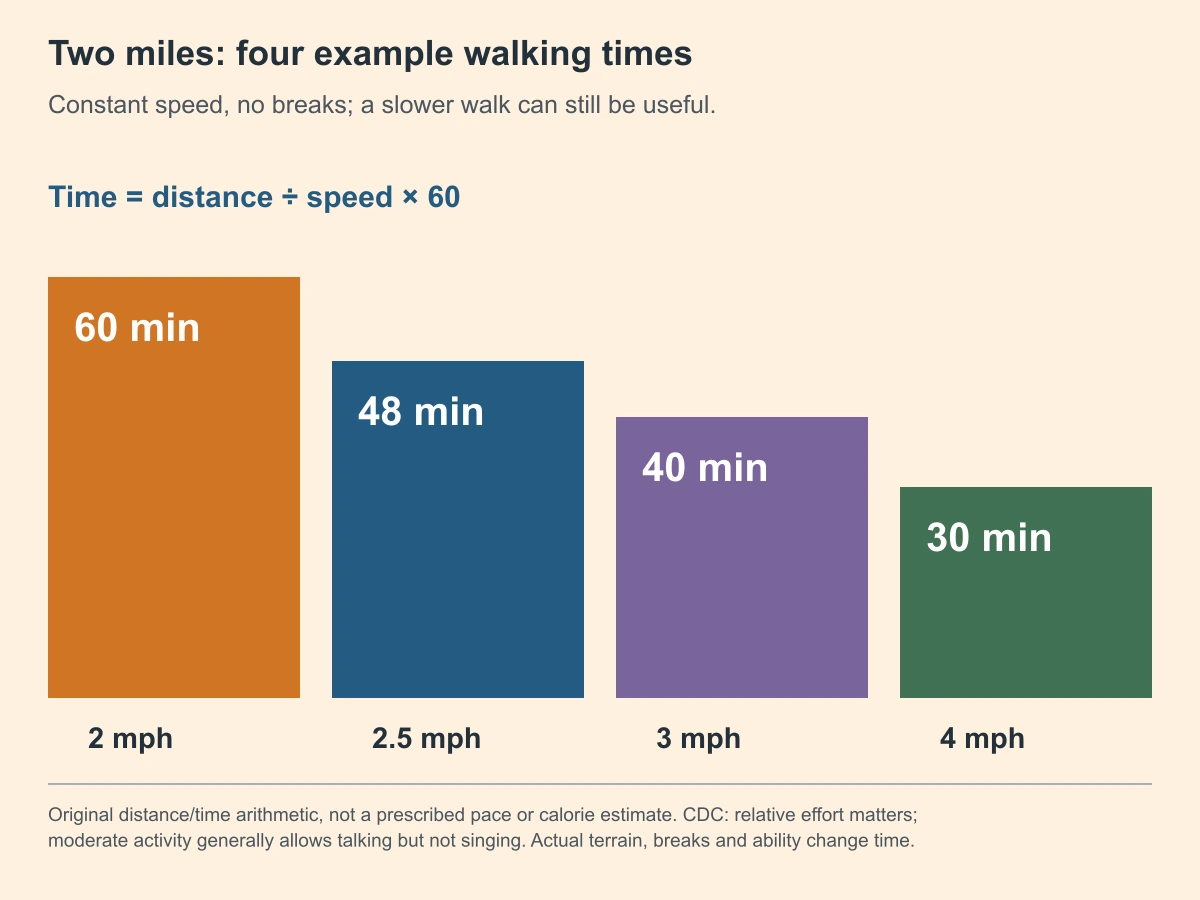
For uninterrupted walking at a constant speed, time equals distance divided by speed. The examples below are arithmetic, not a prescribed pace or a prediction of how your actual route will feel.
| Constant example speed | Calculated time for two miles | What may change the real time |
|---|---|---|
| 2 miles per hour | 60 minutes | Breaks, terrain, crossings, symptoms |
| 2.5 miles per hour | 48 minutes | The same practical factors |
| 3 miles per hour | 40 minutes | The same practical factors |
| 4 miles per hour | 30 minutes | The same practical factors |
A hilly route, hot weather, a mobility aid, traffic lights, or walking with another person may change the time. A slower route is not automatically an unsuccessful one. Choose a speed that is appropriate for your ability and symptoms.
If a distance target helps, use it as one planning option. If it creates pressure, minutes or a familiar short route may work better. The first goal is repeatable movement, not matching a chart.
Is walking two miles every day good for weight loss?
Walking uses energy and can contribute to a broader weight-management routine. Actual weight change also depends on food intake, other activity, sleep, medicines, health, and the ability to sustain the plan. A distance alone cannot predict pounds lost per week or month.
Physical activity also has value beyond the scale. CDC describes benefits for physical and mental health and emphasizes that some activity is better than none. A plan can improve endurance or reduce time spent sitting even when weight changes slowly. CDC adult activity guidance
Define the outcome you want: easier everyday tasks, a reliable break from sitting, time outdoors, or a shared activity. These goals can make the routine worthwhile without a guaranteed weight forecast.
Our realistic weight-loss goals guide explains how to choose useful measures. Walking should support your health and routine rather than function as punishment for eating.
Does two miles tell you how many calories you burn?
Not reliably by itself. Body size, pace, terrain, movement efficiency, and individual factors affect energy use. A device’s estimate is not a precise measurement of fat loss or an automatic allowance to eat a particular amount.
Avoid calculations that promise a fixed calorie deficit from every two-mile walk and then convert that into exact pounds lost. The body’s response and the rest of the day can change the result. A route can remain useful even if its estimated calories are modest.
If you track activity calories, treat them as approximate information. Consider whether the estimate helps you make a repeatable plan or creates an unnecessary obligation. You can track minutes, effort, symptoms, and consistency instead.
For food context, read our balanced-meal guide and calorie-intake article. An exercise estimate should not replace an assessment of adequate nutrition, appetite, and medical needs.
How does walking fit the weekly guideline?
CDC recommends at least 150 minutes of moderate-intensity aerobic activity per week for adults, or an equivalent vigorous-intensity combination, plus muscle strengthening on at least two days. The aerobic activity can be spread across the week and accumulated in shorter sessions. Adult activity recommendations
If someone walked two miles at a constant three miles per hour on all seven days, the arithmetic would be 40 minutes times seven, or 280 minutes. Whether those minutes meet a moderate-intensity goal depends on the person’s actual effort. The calculation does not make that schedule mandatory.
Someone beginning from little activity may need a much smaller starting amount. A regular short walk can be a useful foundation. A person already active may include walking alongside cycling, swimming, work activity, or another routine.
The guideline is a direction for health, not a rule that makes smaller amounts worthless. Progress should fit your capacity, comfort, and clinical circumstances.
Use effort rather than another person’s speed
CDC describes moderate effort using a talk test: you can talk but not comfortably sing. The same speed can feel different depending on fitness, terrain, temperature, and health. A pace that is easy for one person may be demanding for another. CDC intensity guidance
The talk test is a general aid, not a reason to ignore concerning symptoms. Some medicines and conditions affect exercise responses, so ask your clinician how to judge effort if ordinary guidance does not fit your situation.
You can start at an easier effort while establishing a routine. If the walk feels comfortable and sustainable, a later adjustment in time, days, or pace may be appropriate. There is no need to increase all three at once.
Progress can mean fewer breaks, better confidence, or an easier trip to the store. It does not have to mean setting a faster pace every week.

Start with your actual routine
Notice your current movement before adding a target. A physically active job and a mostly seated day create different starting points. Also consider fatigue, pain, balance, recent illness, recovery, and any clinical exercise restrictions.
Choose a modest action you can repeat: a brief walk during a predictable break, a comfortable indoor route, or a short outing with another person. If even a short walk is difficult, that is useful information about whether clinical or rehabilitation support would help.
The first week can be an experiment. After each session, note how it felt during the walk and later that day. Was the timing practical? Did pain occur? Was recovery comfortable? Adjust the plan based on those observations.
Our sustainable habits guide offers a similar approach to repeatable changes. A plan designed around real barriers is more useful than an ambitious schedule that depends on having a perfect day.
Choose a route you can actually use
Think about surfaces, lighting, crossings, traffic, bathrooms, benches, weather, and whether you feel comfortable alone. A convenient route may be more repeatable than a scenic one that requires a long drive.
Indoor corridors, a community facility, a shopping center, or an accessible home routine can provide alternatives. If the neighborhood is unsafe or inaccessible, acknowledge that as a real constraint. The plan should not assume everyone can step outside at any time.
For a two-mile goal, consider whether a shorter loop repeated when appropriate is easier to manage than a long out-and-back route. A route with a comfortable exit or rest option can reduce pressure to continue despite symptoms.
Walking is one option, not the only valid movement. If it is painful or inaccessible, ask about another activity suited to your needs. The broader goal is useful movement and function.
Increase one part at a time
You can add time, another day, or a little pace when appropriate. Changing everything at once makes it harder to identify what caused fatigue or discomfort. There is no universal weekly percentage increase that fits every adult.
If a change makes the routine difficult to repeat, return to a manageable level and reassess. Illness, pain, recovery, and other activity may call for a slower progression. A missed day does not require a compensating long walk.
Make a backup for weather or schedule changes. A shorter indoor option or another accessible activity can keep the habit flexible. Heat, poor air quality, ice, or severe weather may make the original route unsuitable.
Plan the backup before you need it. “I will use my comfortable indoor option” is easier to follow than inventing a new workout during a difficult day.
Our guide to walking after meals reviews the actual short-term glucose studies and distinguishes those outcomes from long-term weight change.
Do short walks count?
Yes. CDC explains that activity does not have to happen all at once. You can divide it into manageable sessions. A morning walk and a later short break can contribute to the weekly pattern. Shorter activity sessions
The intensity and duration still matter to the specific guideline, but small amounts can provide a starting point. Do not let a two-mile target prevent you from taking a shorter walk that fits the day.
If you use a step counter, compare it with your own usual pattern. Step totals do not fully describe effort, terrain, symptoms, or activities such as swimming. Ten thousand steps is not a mandatory starting requirement or a weight-loss guarantee.
You can track the number of comfortable sessions, minutes, or how an everyday task feels. Choose information that helps you adapt the plan instead of scoring your worth or discipline.
Pair walking with strength and adequate food
Walking and muscle-strengthening activity serve different parts of a routine. CDC includes both. Our beginner strength-training guide offers a complementary starting point focused on function and gradual learning. Aerobic and strength guidance
Make room for adequate food and fluids. A longer walk combined with missed meals may leave you feeling poorly; that is not a useful measure of fat loss. Our protein-at-breakfast guide can help organize meals without making one food mandatory.
CoreAge Rx’s Strong Suit product page describes creatine monohydrate. It is a different category from a protein food and does not replace walking, strength practice, or sufficient meals. Current Strong Suit product identity Any supplement choice should have a defined purpose and fit your medical circumstances.
If you are taking a GLP-1 medicine and struggling with intake or recovery, discuss that with the prescribing team. Our semaglutide and muscle guide and tirzepatide and muscle guide address related nutrition and function questions.

When should you get clinical guidance?
Ask for advice when pain, balance problems, significant breathlessness, recent illness, or medical restrictions make starting unclear. Stop and seek appropriate care for concerning symptoms such as chest pain, fainting, or severe unexpected breathing difficulty rather than pushing through to finish a mileage goal.
A clinician or rehabilitation professional can help adapt activity around a condition or recovery. Needing that support does not make movement goals less valid. The plan should fit the person.
Common two-mile walking questions
Must I walk every day?
No. Weekly activity can be organized in different ways. Start with a schedule you can sustain and adapt to your health and other activity.
Is a slow walk pointless?
No. It can support a routine and reduce sitting. Whether it reaches moderate intensity depends on your relative effort.
How quickly will I lose weight?
A distance cannot provide a personal forecast. Review the broader plan and track useful outcomes beyond weight alone.
What if I dislike walking?
Choose another enjoyable, accessible activity. A workable routine is more useful than forcing a specific form of movement solely because it appears in a headline.
Educational information for adults; individual treatment decisions require a qualified clinician. Sources reviewed October 1, 2026. Original AI-generated article images depict fictional people and objects, not patient outcomes. Other editorial images are illustrative. Graphics summarize the cited sources.