
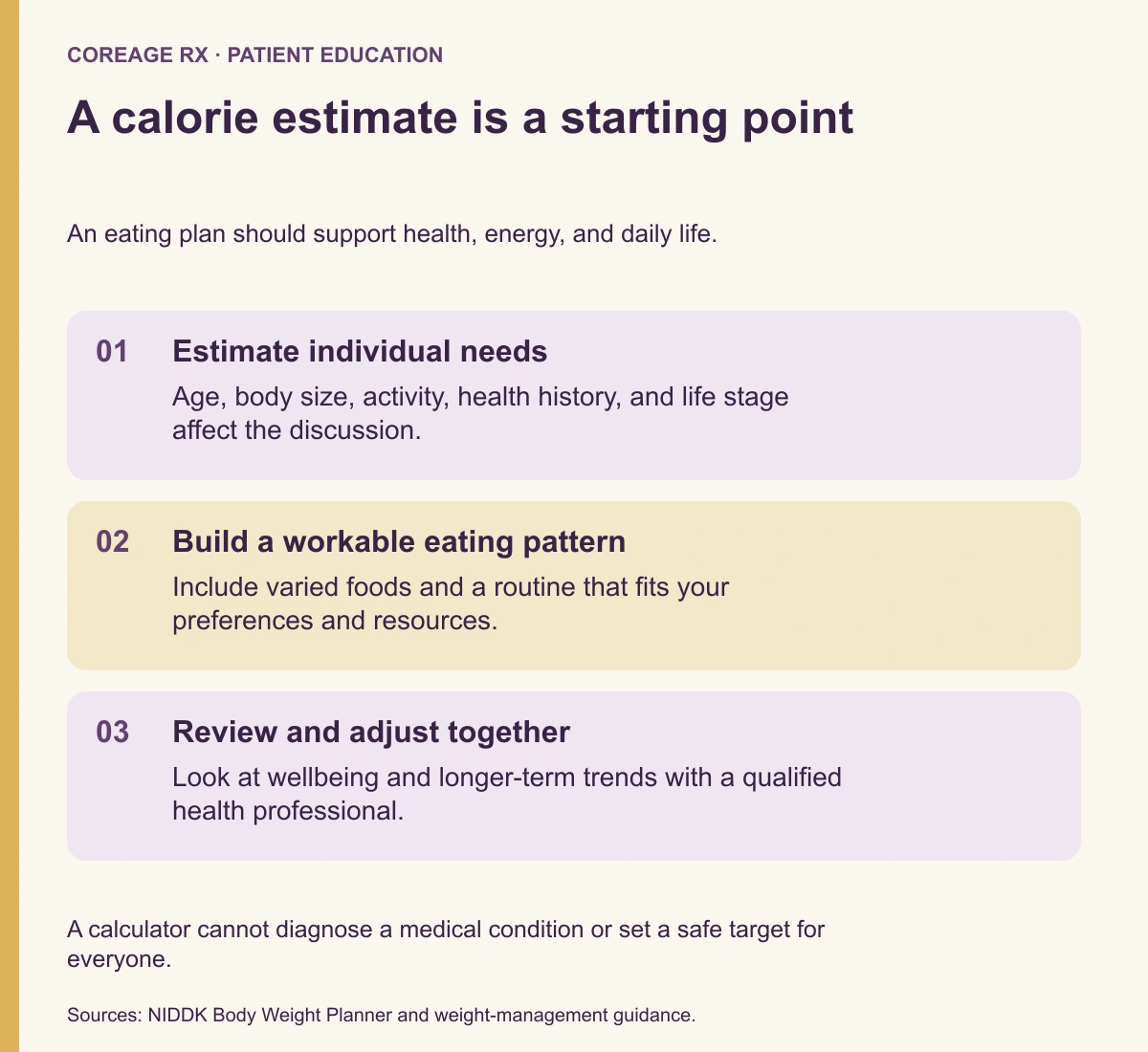
A calorie-intake estimate can help start a weight-management conversation, but it cannot tell every person exactly what to eat. Energy needs vary with body size, activity, age, health, life stage, and changes over time. A workable plan also needs to provide enough nourishment and fit everyday life.
For adults pursuing weight loss with clinical guidance, the goal is a sustainable eating pattern that supports health. A calculator result is a starting estimate to review, not a test of willpower or a universal prescription. This guide explains how to interpret estimates and when to seek more individualized support.
What does calorie intake mean?
Calories describe the energy supplied by food and drinks. The body uses energy for basic functions, digestion, movement, and other demands. Over time, the relationship between energy intake and expenditure influences body weight, but neither side of that relationship is perfectly constant or easy to measure at home.
“Maintenance calories” is shorthand for an estimated intake associated with keeping weight relatively stable under particular conditions. An estimate depends on assumptions about activity and other factors. It should not be interpreted as an exact daily number that remains correct indefinitely.
The NIDDK Body Weight Planner offers personalized planning for adults, including both reaching and maintaining a weight goal. NIDDK explicitly states that it is not intended for people under 18 or for pregnant or breastfeeding people, and that it does not replace medical advice.
Why two calculators can give different answers
Calculators may use different equations, activity categories, and assumptions. A broadly worded choice such as “moderately active” can also mean different things to different users. That uncertainty carries into the result.
Daily routines vary too. A physically demanding shift, illness, a recovery period, or a change in training can make a static estimate less representative. Food records and activity trackers also involve estimation. A neat number on a screen should not create false precision.
Use a result as something to discuss with a clinician or registered dietitian. They can consider whether intentional weight loss is appropriate, what medical issues matter, and how to build an eating pattern that supplies adequate nutrition. If tracking numbers increases anxiety or rigid behavior, another planning approach may fit better.
A useful estimate needs context
| Information to consider | Why it changes the discussion |
|---|---|
| Usual activity and work | Energy needs depend partly on how daily life is spent, not only planned exercise. |
| Medical conditions and medicines | These can affect appetite, weight, food tolerance, or the safety of dietary changes. |
| Life stage | Pregnancy, breastfeeding, adolescence, and other circumstances need appropriate specialist guidance. |
| Current eating pattern | Skipping meals, limited variety, or poor appetite may make nutritional adequacy the immediate priority. |
| Preferences and resources | Culture, budget, access, cooking facilities, and schedule affect what can be sustained. |
| History with dieting | Repeated restriction or distress around food can call for a different form of support. |
Bring this context to an appointment rather than arriving with only an app’s target. The most useful plan is one you can explain and maintain, including how it will be reviewed if your needs or circumstances change.
A deficit should not mean eating as little as possible
A calorie deficit describes taking in less energy than the body uses over time. It does not specify a safe amount of food for a particular person. Making the deficit larger is not automatically a better or more sustainable approach.
An overly restrictive plan can make it harder to get enough protein, essential nutrients, and energy for daily functioning. Hunger, fatigue, food preoccupation, or difficulty maintaining ordinary activities are reasons to reassess the plan with a qualified professional, not proof that you need more discipline.
NIDDK’s guide to choosing a weight-management program emphasizes a healthy eating plan tailored to the person’s needs and preferences, ongoing support, and a strategy for maintaining results. It also cautions against programs promising dramatic losses in very short periods.
For a specific food example, our guide to salami portions and meal planning uses a named nutrition reference and explains sodium, saturated fat, recipe variation and complete meals.
Build meals around nourishment and practicality
A plan can include familiar foods and ordinary meals. Variety matters because foods provide different nutrients, and satisfaction matters because an eating pattern has to be livable. Planning should account for allergies, medical requirements, cultural preferences, and what is affordable and available.
Protein-containing foods, vegetables and fruit, fiber-rich foods, and appropriate sources of dietary fat can all have a place. The right portions and combinations depend on the person. There is no requirement that every meal look like a social-media photograph or use a special diet product.
If breakfast is difficult, our protein breakfast ideas offers practical starting points. If you are sorting through claims that certain foods imitate medication, the natural GLP-1 article explains the difference between normal physiology and proven treatment outcomes.
Food logging is optional, and precision has limits
Some people find a brief food record useful for noticing patterns: long gaps between meals, limited variety, or situations in which eating becomes difficult. Others find numerical tracking burdensome or stressful. A dietitian can help choose an approach that supports the goal without making food the focus of every decision.
A record does not have to become a permanent accounting system. Notes about hunger, fullness, symptoms, energy, and the circumstances around meals may be more informative than trying to measure every ingredient perfectly. The purpose is to understand the routine and identify helpful changes.
If you do use an app, remember that its totals depend on the foods and amounts entered. Avoid interpreting small differences as precise biological findings. Review the broader pattern and how you feel rather than reacting to every daily number.

Why the scale does not move in a straight line
Short-term body-weight changes can reflect more than changes in body fat. Hydration, stored fuel, digestive contents, and other physiological factors can affect the reading. A few measurements cannot identify the cause of a change with certainty.
That makes a single day a poor basis for drastically changing food intake. If monitoring weight is useful for you, discuss an appropriate way to review longer-term patterns with the care team. Weight is one piece of information alongside medical measures, strength, symptoms, nourishment, and wellbeing.
Our three-day water-fast article explains why rapid scale changes should not be confused with evidence of lasting benefit. Returning to regular nourishment after restriction is not a personal failure, even if the scale changes.
When progress feels different from the estimate
If an expected trend does not occur, pause before assuming that eating less is the answer. The estimate may not match your routine, the observation period may be too short, or another factor may need attention. Weight management also involves appetite, sleep, medications, health conditions, and access to support.
Bring the question back to the clinician or dietitian with a description of your usual meals, activity, symptoms, and any changes in health or medication. The review should consider both the plan’s effectiveness and whether it is meeting nutritional needs.
NIDDK recommends that a weight-management program review medical issues and medicines that may affect weight, provide ongoing feedback, and help address barriers. A plan should be adjustable without turning every change into blame or a stricter rule.
Calorie needs during GLP-1 treatment
Reduced appetite does not remove the body’s nutritional needs. People taking GLP-1 medicines may need help maintaining adequate intake, especially when nausea, early fullness, or other digestive symptoms make eating difficult.
The joint nutrition advisory on GLP-1 therapy emphasizes nutrition assessment, adequate dietary intake, and support for preserving muscle and function. A prescription should not be treated as a reason to skip meals indefinitely or combine treatment with extreme restriction.
Our semaglutide protein and muscle guide and tirzepatide nutrition guide discuss those priorities. Tell the prescriber if appetite suppression or symptoms prevent regular nourishment; the treatment plan may need review.
Exercise is more than a way to change a calorie total
Physical activity can support health even when the scale changes little. NIDDK’s program guidance emphasizes matching activity to health and ability and recognizes benefits beyond weight loss.
A workable routine might include movement you enjoy and appropriate strength-building activity, with modifications for pain, disability, or medical limitations. It does not need to become a punishment for eating or an obligation to “earn” meals.
Discuss activity with your clinician when a health condition, recovery, or medication makes the choice uncertain. The plan should support daily function and be something you can continue, rather than a short burst of exercise that leaves you exhausted or injured.
Our guide to endometriosis, bloating and weight-change questions explains why abdominal swelling and a sustained scale trend need different descriptions. Symptoms and treatment context deserve assessment rather than an automatic calorie restriction.
When a generic calorie plan is the wrong tool
Seek individualized guidance if you are pregnant or breastfeeding, under 18, have a condition that changes nutritional requirements, or take medicines that can make reduced food intake risky. People with diabetes, kidney disease, significant gastrointestinal symptoms, or other ongoing medical concerns may need specific assessment.
If food tracking or weight-loss efforts bring intense guilt, fear, compulsive restriction, or repeated loss of control around eating, tell a health professional. A supportive clinician or dietitian can help address those concerns and consider whether weight-focused tracking is useful at all.
Persistent weakness, fainting, repeated vomiting, or inability to maintain food or fluids needs medical attention. Those symptoms should not be treated as expected signs that a restrictive plan is working.

Will a 400-calorie deficit cause weight loss?
A true sustained deficit is different from subtracting 400 from an uncertain estimate or counting an exercise display. A calculation does not guarantee a fixed weekly loss. Adequate total food intake, protein, micronutrients, activity, health conditions and the weight trend still need review. Do not interpret the number as a recommendation to eat only 400 calories a day or to compensate for a meal with restriction.
Is 1,900 calories enough, or will it cause weight loss?
The number alone cannot answer either question. For one adult it may be a deficit, for another maintenance, and for someone else insufficient intake. Body size, activity, health, life stage, food quality and the observed trend all matter. A calculator target does not guarantee a fixed weekly loss or establish adequate protein and micronutrients. Review the context rather than treating 1,900 as a universal daily prescription.
Frequently asked questions
Will eating 1,600 or 1,700 calories a day cause weight loss?
Neither number establishes a calorie deficit for every adult. The relationship between intake and energy needs depends on the person, activity and clinical context, and a calculator remains an estimate. Review the complete eating pattern, symptoms, nutritional adequacy and longer-term trend rather than promising a result from one daily number. NIDDK’s Body Weight Planner supports personalized adult planning and is not intended for people under 18, pregnant or breastfeeding. If appetite is very low during treatment or tracking is difficult, ask the care team or a dietitian for an appropriate plan rather than repeatedly cutting intake. About the Body Weight Planner – NIDDK.
Will eating 1,300 calories a day cause weight loss?
An intake of 1,300 calories does not establish the same energy deficit or weight-change rate for every adult. Energy needs, health, activity, intake accuracy and treatment context matter, and this amount may be too restrictive for some people. A lower target is not automatically better. Review adequate protein, food variety, fluids, energy and daily function with a clinician or registered dietitian. NIDDK describes individualized adult planning and excludes younger people and pregnant or breastfeeding women from its Body Weight Planner. Use an appropriate personal plan rather than treating 1,300 as a universal prescription. NIDDK Body Weight Planner overview.
Will eating 1,400 calories a day cause weight loss?
A 1,400-calorie intake does not establish the same deficit or rate of weight change for every adult. Individual energy needs, health, activity, intake accuracy and treatment context matter. It may be too restrictive for some people, and a lower target is not automatically a better plan. Assess whether meals provide adequate protein, varied foods and enough energy for daily function. NIDDK describes personalized adult planning and excludes pregnant or breastfeeding women and younger people from its Body Weight Planner. Ask a clinician or registered dietitian for an appropriate target rather than using 1,400 as a universal prescription. NIDDK Body Weight Planner overview.
Is there one calorie target that works for everyone?
No. Needs differ, and a number that fits one person can be unsuitable for another. An adult planning tool can provide an estimate, but health history, nutritional adequacy, and follow-up still matter.
Do I have to count calories to improve my eating pattern?
No. Some people use structured meals, changes to food availability, meal planning, or support from a dietitian instead. The approach should help you meet health needs and fit your life without creating unnecessary distress.
Should I eat less after a higher-intake day?
A single day does not require a compensatory fast or punishment. Returning to a regular, nourishing routine is generally a more useful starting point. Discuss recurrent difficulties or distress around eating with a qualified professional.
Can a weight-management medicine replace nutrition planning?
No. Appropriate treatment includes attention to nutrition and follow-up. If you explore CoreAge Rx’s semaglutide or tirzepatide services, ask how the team assesses intake, digestive symptoms, and your individual treatment needs.
Use estimates to support a plan you can live with
The useful question is not the smallest calorie number an app will display. It is what eating pattern supports your health, provides adequate nourishment, and can be reviewed as your needs change. A qualified clinician or dietitian can help turn an estimate into that kind of plan.
Put estimates into a practical plan
- Macros and meal planning — Connect protein, carbohydrate, and fat amounts with food quality and optional tracking.
- Weight-loss timelines and calculators — Understand changing energy needs, uncertain inputs, and review checkpoints.
Separate medication-related fluid changes from fat loss
- Spironolactone and weight changes — Understand the prescription purpose, potassium monitoring, and why a diuretic effect does not establish fat loss.
Our guide to omeprazole and weight changes distinguishes common trial reactions, voluntary reports and a small observational PPI study, with reflux and appetite warning signs.
Review unexplained weight changes during other treatments
- Skyrizi weight gain and weight loss questions — Separate current label findings, inflammatory disease symptoms and the need for specialist assessment.
- Accutane and isotretinoin weight-change questions — Understand reported events, monitoring, other medicines and the current iPLEDGE implementation timeline.
Is a 1,100-calorie deficit the same as eating 1,100 calories?
No. Intake is the energy you consume; a deficit is the estimated difference between energy use and intake. Eating 1,100 calories does not establish a 1,100-calorie deficit, and a wearable estimate is not a precise personal measurement of energy use. A large proposed deficit can make it harder to meet nutrition needs and is not a universal plan. Ask a qualified clinician or registered dietitian to assess adequacy, medical needs, medicines and follow-up. Neither number can promise a fixed number of pounds lost each week. The body planner’s adult scope also excludes pregnancy and breastfeeding. About the Body Weight Planner – NIDDK.
Interpret activity estimates and weight-change timing
- Burning 400, 600, 700 or 800 exercise calories — Separate activity estimates from total daily expenditure and avoid fixed pounds-per-workout forecasts.
- Fat-loss timing and progress measurements — Distinguish scale, body-composition and functional changes when reviewing a plan.
Educational information for adults; individual treatment decisions require a qualified clinician. Sources checked September 26, 2026. Original AI-generated article illustrations depict fictional people and objects, not patient outcomes. Other editorial images are illustrative. Graphics summarize the cited sources.