
Salami can be part of a meal, but it is not a weight-loss treatment or a food with one universal calorie count. The product, portion, and rest of the meal matter. Its protein content can be useful, while sodium and saturated fat deserve attention when comparing options and planning the overall eating pattern.
Instead of labeling salami simply good or bad, look at the actual package or deli nutrition information. This guide uses one named manufacturer’s reference to show how to read a portion. The numbers do not apply to every salami or to the illustrative photographs in this article.
Start with the exact salami and portion
Salami varies by recipe, meat blend, processing, slice thickness, and portion size. A handful of thin slices is not a consistent unit. A deli sandwich, a snack plate, and a larger charcuterie spread may contain different amounts even when they look similar.
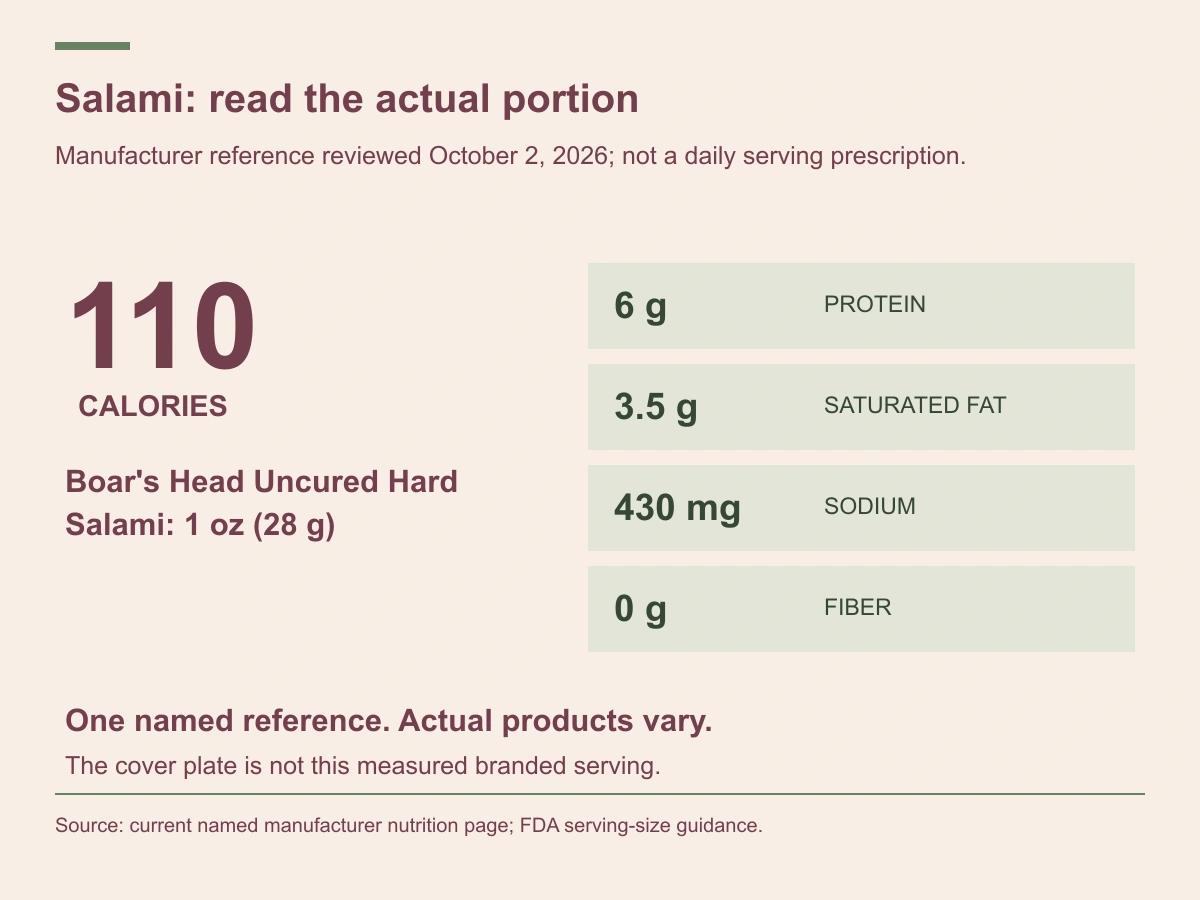
For a concrete reference, Boar’s Head’s Uncured Hard Salami nutrition page lists a 1-ounce, 28-gram serving with 110 calories, 6 grams of protein, 9 grams of total fat, 3.5 grams of saturated fat, 430 milligrams of sodium, 1 gram of carbohydrate, and 0 grams of dietary fiber. This is a dated reference for that named product, reviewed October 2, 2026.
Check the information for the product you actually buy because recipes and labels can change. The manufacturer reference does not prove the amount in a deli worker’s slice or a restaurant sandwich. Ask for the current product information when the packaging is not available.
The FDA’s label-reading guide explains that a labeled serving size describes the reference amount, not a recommendation of how much you should eat. A 28-gram reference is useful for comparison; it is not a personal daily salami allowance.
What happens when the portion changes?
The reference makes portion arithmetic easier to understand. If the same product and recipe are used, twice the reference amount supplies twice the listed calories and nutrients. That arithmetic does not make twice the amount appropriate for every person.
| Named product reference | 1 ounce, 28 grams | Twice that reference amount |
|---|---|---|
| Calories | 110 | 220 |
| Protein | 6 grams | 12 grams |
| Saturated fat | 3.5 grams | 7 grams |
| Sodium | 430 milligrams | 860 milligrams |
The right column is calculated from the manufacturer’s stated reference, not separately measured nutrition testing. It is included to illustrate the effect of portion size. The cover image is not this branded serving, and no nutrient values are assigned to the pictured plate.
This is particularly relevant when salami is served with cheese, crackers, olives, spreads, and dressing. Those foods add their own energy and nutrients. Counting only the salami can underestimate the meal, while concentrating only on calories can overlook meal variety and sodium.
Our calorie-intake guide explains why daily needs vary. There is no particular number of salami slices that creates the same calorie deficit or weight change for everyone. A useful plan considers the full day and the person’s circumstances.
Protein is one part of the comparison
The named product supplies protein, but protein does not cancel the rest of its nutrition profile. Compare foods using the same reference amount and ask what role each would serve in a meal. A protein-containing snack is not automatically a complete lunch.
You might compare the actual labels for lean meat, fish, eggs, yogurt, tofu, beans, or other options you enjoy. These alternatives have different preparation requirements, nutrients, and personal suitability. This article does not assign one universal ranking or promise that replacing salami with a specific food will produce weight loss.
If you are using a weight-management medicine, ask how meals will maintain adequate intake when appetite changes. The semaglutide protein and muscle guide and tirzepatide nutrition and function guide discuss the broader care conversation. Neither means salami alone can meet a person’s nutritional needs.
Think about function as well as a nutrient total: whether meals sustain your day, whether you can eat enough variety, and whether a smaller appetite is making eating difficult. Ongoing weakness or poor intake deserves review rather than another restrictive food rule.
Sodium and saturated fat need context
FDA identifies sodium and saturated fat as nutrients many people should get less of within the overall diet. Its current label guide uses Daily Values of 2,300 milligrams for sodium and 20 grams for saturated fat as general reference amounts, not individualized prescriptions. Your clinician may recommend different goals based on health needs. FDA Nutrition Facts guidance.
The absolute amounts in the named salami reference are more useful than assuming it is low in sodium because the portion looks small. If you compare two products, use equivalent portions and their current labels. A claim about one nutrient does not describe every other nutrient.
Consider other salty foods in the same meal and across the day. Bread, cheese, condiments, and prepared side dishes may contribute sodium too. Likewise, the saturated-fat total depends on the whole meal, not one ingredient in isolation.
If you have high blood pressure, heart-related concerns, kidney disease, or an individualized dietary restriction, bring the actual label to your clinician or dietitian. Avoid using general Daily Values to override a personal plan. Weight change and blood-pressure or kidney-care goals can be related while still needing distinct assessment.
What does “uncured” mean for a weight-loss decision?
Front-of-package descriptions do not establish that a food is low calorie, low sodium, or better for weight loss. The reviewed manufacturer’s page names the product Uncured Hard Salami and states that no nitrates or nitrites are added except those naturally occurring in sea salt and cultured celery juice. It also describes the product’s processing. Manufacturer product description.
Those statements should be read alongside the actual Nutrition Facts information. An uncured claim does not erase the listed sodium, saturated fat, or calories. Similarly, a gluten-free or low-carbohydrate claim addresses a particular feature rather than proving complete nutritional suitability.
If an ingredient matters because of an allergy or medical restriction, check the current package and ask the manufacturer or deli for clarification. Do not use a general category article as an allergen guarantee for a product you have not identified.
For weight-management planning, the practical question is how the food fits your full meal and needs. A descriptive claim can be relevant without being a reason to eat an unlimited amount or treat the product as a health intervention.
Build the meal around more than the salami
An illustrative meal might include a portion of salami alongside vegetables and a whole-grain food, or use salami as one ingredient in a mixed dish. These are food ideas, not tested recipes or prescribed portions. Adjust them for your preferences, appetite, allergies, and medical plan.
NIDDK’s healthy-living guidance describes meal planning that includes nutrient-rich foods, portions, and attention to sodium and saturated fat. For people with diabetes, carbohydrate intake, medicines, meal timing, and activity also matter. Salami’s low carbohydrate content does not make the complete sandwich carbohydrate-free.
Our lunch calorie and meal guide discusses planning the whole meal. The protein-shake meal guide provides another example of looking beyond one protein-containing item. A sustainable eating pattern should leave room for foods you enjoy while meeting practical nutritional needs.
If the full meal feels too large during treatment, discuss tolerability and adequate intake with the care team. Removing every accompaniment may make the meal less varied without solving the underlying symptom problem. A dietitian can help find a workable approach.
Salami during GLP-1 treatment
There is no universal rule that everyone taking semaglutide or tirzepatide must avoid salami. Individual digestive tolerance, portion, recipe, and health needs can affect the decision. A food that causes discomfort for one person may not cause the same symptoms in another.
If nausea, reflux, or fullness follows a meal, record what you ate, the amount, when symptoms started, and any recent treatment changes. Do not assume salami alone caused it or that the medicine is definitely responsible. Persistent or severe symptoms need clinical assessment.
The semaglutide nausea and vomiting guide explains useful reporting and warning signs. If you are exploring a service, the CoreAge Rx semaglutide page and tirzepatide page provide product information to discuss with the team. Neither makes a particular meal plan appropriate or establishes personal prescription eligibility.
Do not skip adequate meals to compensate for eating salami or interpret vomiting as a successful calorie-control strategy. Seek help if restriction, guilt, or symptoms are interfering with eating and daily function.

A useful shopping and meal checklist
- Identify the exact product rather than relying on a generic calorie search.
- Read the serving amount in grams and the amount you expect to eat.
- Compare sodium, saturated fat, protein, and energy using equivalent portions.
- Include bread, cheese, sauces, and other meal ingredients in the comparison.
- Check ingredients and allergens for the current product.
- Consider your own health plan, appetite, preferences, and practical food budget.
You can use these steps without making every meal a detailed calculation. The goal is to understand a product and make a workable choice, not to impose one food allowance on everyone. If tracking becomes distressing or overly restrictive, ask for support with a less burdensome plan.
Frequently asked questions
Is salami good for weight loss?
It may fit a meal, but it does not independently cause weight loss. The actual portion, complete eating pattern, energy needs, and health circumstances matter. Its protein content should be considered alongside sodium and saturated fat.
How many calories are in one slice?
A slice has no universal weight or calorie count. Use the exact product’s reference and the actual amount. The named example in this article gives values for 28 grams, not for every slice.
Is uncured salami automatically healthier or lower calorie?
No. Read what the claim means and then check the Nutrition Facts and ingredients. The reviewed uncured product still lists sodium, saturated fat, and calories; the claim does not create a weight-loss benefit.
Can I eat it every day?
There is no universal daily allowance in this guide. Consider portions, overall dietary variety, sodium and saturated-fat goals, preferences, and any individual medical recommendations. A dietitian can help if you need a specific plan.
Is salami enough protein for a whole meal?
That depends on the amount and the person’s needs, but a single nutrient does not make a meal complete. Include adequate food variety and assess the overall day. Persistent low intake during treatment needs review rather than relying on one easy-to-eat item.
Educational information for adults; individual treatment decisions require a qualified clinician. Sources reviewed October 2, 2026. Original AI-generated article images depict fictional people and objects, not patient outcomes. Other editorial images are illustrative. Graphics summarize the cited sources.