Chia seeds can be used in prepared foods such as pudding, oatmeal, or yogurt-based mixtures. They are not a proven shortcut to weight loss, and drinking chia water does not create a universal weight-loss regimen. Preparation, the complete meal, portion, and your ability to tolerate and swallow the food matter more than a viral recipe.
This guide gives practical food ideas and separates two different randomized study findings. It also explains why swallowing dry chia seeds is a poor experiment, especially for someone with a history of swallowing problems.
Prepare the seeds to expand before eating
Chia seeds absorb liquid and change texture. Follow the actual package or a suitable recipe’s preparation directions, using sufficient liquid and allowing the seeds to fully expand before eating. Stirring seeds briefly into a drink and swallowing immediately is not the same as preparing a hydrated food.
The American College of Gastroenterology’s chia impaction report describes a swallowing hazard and advises against consuming dry chia seeds. It particularly cautions people with difficulty swallowing or known narrowing of the esophagus. This is case-based safety guidance, not a population estimate of how often the problem occurs.
Do not swallow a spoonful of dry seeds and then chase it with water. If you have a swallowing condition, ask your clinician whether chia and a particular texture are suitable at all. Hydration directions do not replace an individualized swallowing assessment.
Difficulty swallowing food or liquid needs medical attention. Inability to swallow your own saliva can indicate a complete blockage and requires urgent evaluation. Do not try to force more food or drink down to clear it. The important response is assessment, not another preparation trick.
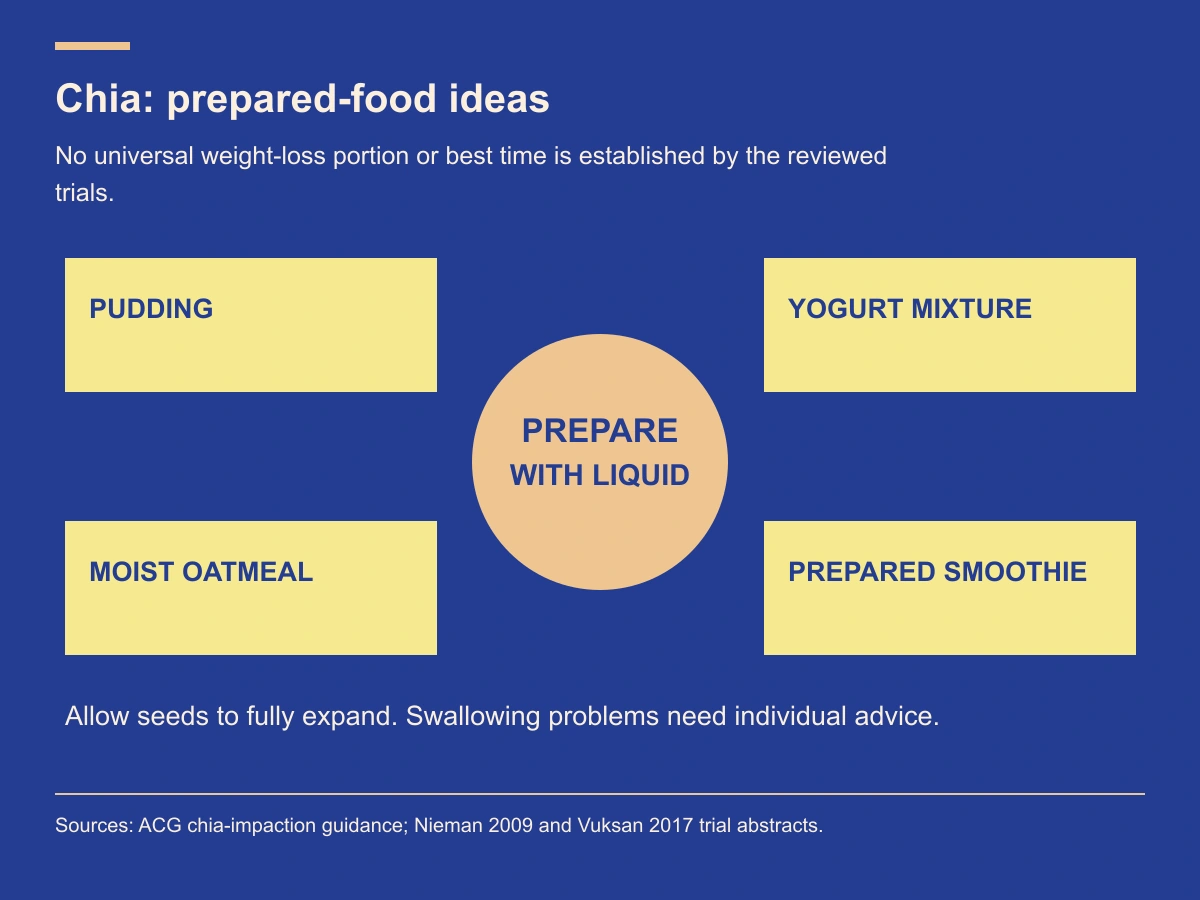
Five ways to use prepared chia in ordinary meals
These are meal ideas rather than tested recipes or guaranteed preparation ratios. Use a reliable recipe or the product instructions to determine adequate liquid and preparation time. Adjust the finished food to your preferences, medical needs, and swallowing advice.
| Food idea | Practical approach | What to keep in mind |
|---|---|---|
| Chia pudding | Prepare with enough suitable liquid and let the seeds fully expand | Sweeteners, toppings, and total portion change nutrition |
| Oatmeal | Mix prepared chia into moist cooked oats | Keep adequate moisture and follow the recipe |
| Yogurt-based bowl | Use properly hydrated chia in a yogurt mixture with fruit | Thick yogurt alone is not proof the seeds have fully expanded |
| Smoothie | Add fully prepared chia to a suitable blended mixture | A blended drink is not automatically a complete meal |
| Fruit-and-chia mixture | Use a suitable recipe that provides enough moisture for expansion | Do not assign every homemade mixture the same nutrient count |
Consider the whole meal. A yogurt bowl may also include fruit and other foods, while a smoothie may need an additional food component to meet your needs. The protein-shake meal guide explains the same principle: one ingredient does not settle whether a meal is adequate.
The image in this article is an illustrative food scene. It does not demonstrate a tested recipe, a prescribed amount, or the exact mixture used in a clinical study. Do not infer preparation instructions from a photograph.
Can chia seeds help with weight loss?
Two randomized trial abstracts show why the answer needs context. They studied different participants, foods, durations, and background diets. Their results should not be merged into a promise that chia causes the same outcome for everyone.
In a 2009 trial, 90 adults with overweight or obesity were recruited and 76 completed the study. The investigators compared chia supplementation with placebo for 12 weeks. The abstract reported no between-group benefit for body mass or body composition. Nieman and colleagues’ primary abstract.
In a 2017 trial, 77 adults with overweight or obesity and type 2 diabetes were studied for six months. Both groups followed a calorie-restricted diet; one received Salba-chia and the other an oat-bran-based control. The abstract reported greater average weight reduction with Salba-chia, about 1.9 kilograms versus 0.3 kilograms. Vuksan and colleagues’ primary abstract.
That second result concerns a specific intervention in a diabetes population alongside a calorie-restricted diet. It is not evidence that any chia drink works the same way, that the seeds alone caused all change, or that someone without diabetes should copy the study regimen. The abstracts are not a personal food-dose recommendation.
The practical conclusion is modest: chia may be a food you enjoy within an appropriate eating plan, while weight outcomes depend on more than adding it. Do not replace adequate meals or prescribed diabetes care with a chia experiment.
Why chia water is not a special weight-loss treatment
Water with prepared chia is still a beverage containing a food ingredient. Calling it a detox, appetite reset, or fat-burning drink does not establish a clinical effect. The trials above did not verify every internet recipe or demonstrate a universally superior time to drink it.
Hydration, portions, ingredients, and the rest of your eating pattern remain relevant. Adding honey, juice, or other ingredients changes the finished drink; a glass size alone does not tell you its nutrition. A large volume also does not prove that the seeds were adequately prepared.
NIDDK’s healthy-living guidance says there is no clear proof that specific foods, herbs, or supplements can manage diabetes in place of an appropriate care plan. If you have diabetes, discuss changes in meals, medicines, and activity with the team rather than using a beverage as a drug replacement.
Our Mounjaro ingredients and natural-drink guide explains why a kitchen beverage is not equivalent to a prescription medicine. Chia water likewise has no established equivalence to semaglutide or tirzepatide.

How much chia should you eat?
There is no universal chia amount that guarantees weight loss. A clinical trial’s supplement quantity is part of a research protocol, not a suitable target for every reader. The labeled food serving is also a reference amount, not a prescription.
Use the actual product information and a properly prepared food recipe. Consider whether the amount fits the full meal, whether you tolerate it, and whether swallowing advice applies. A registered dietitian can help when you need an individualized plan for diabetes, digestive symptoms, or restricted intake.
The FDA label guide explains serving references and why total nutrition changes with the amount consumed. Check the chia product’s current label for energy, fiber, and other nutrients instead of using a generic number from an unrelated product. This article does not assign an unverified universal nutrient count to chia.
Our calorie-intake guide provides context for daily energy needs. Adding a food does not independently establish a calorie deficit, and removing other meals to compensate may reduce adequacy or make the plan difficult to sustain.
Fiber, digestive tolerance, and a changing appetite
Higher-fiber foods can affect digestive symptoms. Some people experience more gas or bloating with certain foods or a substantial change in their eating pattern. NIDDK’s gas guidance explains that undigested carbohydrates, including some fiber, can contribute to intestinal gas.
If symptoms develop, note the preparation, portion, other meal ingredients, and timing. A yogurt mixture may involve lactose, while a smoothie can include several fruits or sweeteners. Do not assume chia is the only possible factor, and avoid changing many foods at once when trying to understand a pattern.
Persistent symptoms, abdominal pain, ongoing vomiting, unexplained weight loss, or difficulty eating warrant clinical review. Do not accept significant discomfort because a food is marketed as healthy. If your appetite is already reduced by treatment, a filling drink should not displace the nutrition you need.
Our semaglutide nausea and vomiting guide and protein and muscle guide explain questions to bring to the care team. An individualized food plan can include preferences while maintaining adequate intake and function.
Best time: breakfast, before meals, or at night?
The reviewed evidence does not establish a universal best time to eat chia for weight loss. A study’s scheduled supplement intake is not proof that the same timing improves an ordinary meal’s effect. Choose a routine that fits your actual food preparation, appetite, and care plan.
For people using insulin or certain other diabetes medicines, meal timing and skipped meals may affect glucose management. NIDDK’s meal-planning guidance recommends discussing suitable meal timing with the health care team. Do not move or omit a meal solely to follow a chia-water trend.
The breakfast planning guide explains how daily needs and preferences affect breakfast. A chia-containing breakfast can be one option, but it does not need to be consumed before every meal or at a special hour to qualify as a useful food choice.
For prescription medicines, follow the product’s own instructions. For example, daily oral semaglutide has specific administration requirements that are different from weekly injections. A food timing trend should not override those directions. See the oral semaglutide guide.
When your question is about treatment rather than one food
If hunger, glucose care, or a weight-related condition is the concern, bring the larger question to a qualified clinician. NIDDK’s medication guidance describes assessing diagnosis, expected benefits, risks, other medicines, and costs. A food trend cannot perform that assessment.
The CoreAge Rx semaglutide page and tirzepatide page introduce service information to discuss with the team. Ask about the exact preparation, suitability, pharmacy, nutrition support, and follow-up. These pages do not establish personal eligibility or make chia an equivalent treatment.
Frequently asked questions
Can I put chia seeds in yogurt?
You can consider a suitable yogurt-based preparation, but ensure the seeds have sufficient liquid and time to fully expand. Do not assume any thick yogurt instantly hydrates them. Follow reliable preparation instructions and your swallowing advice.
Can I swallow dry chia seeds and drink water afterward?
Do not use that approach. The ACG case guidance warns about expansion and possible esophageal impaction, especially with swallowing problems. Prepare the seeds before eating; ask a clinician about suitability if you have a swallowing condition.
How much chia should I take each day to lose weight?
No universal daily weight-loss dose is established here. Research quantities, food-label servings, and an appropriate personal meal portion are different things. Consider adequate preparation, the overall eating pattern, tolerance, and individual needs.
Is chia water better than chia in food?
The reviewed trials do not establish that comparison for every preparation. A suitable prepared food can be a practical option. A drink is not inherently more effective or a substitute for meals or prescribed treatment.
Does adding lemon water make chia a proven weight-loss drink?
The reviewed trials do not establish that specific recipe or prove that online reviews predict your outcome. Lemon, chia, water, and any added sweetener form a particular beverage; they do not create a drug-equivalent treatment. Use adequate preparation and consider the complete eating pattern rather than treating testimonials as controlled evidence.
Will chia reduce belly fat?
Do not expect a guaranteed change in one body area. One trial found no body-composition benefit, while another in a specific diabetes population reported group-average outcomes within a broader diet intervention. Neither supports a universal targeted-fat claim.
Is morning or nighttime best?
No universal best time is established by the reviewed studies. Use a practical meal routine that fits safe preparation, nutritional needs, digestive tolerance, and any medicine-specific directions.
Educational information for adults; individual treatment decisions require a qualified clinician. Sources reviewed October 2, 2026. Original AI-generated article images depict fictional people and objects, not patient outcomes. Other editorial images are illustrative. Graphics summarize the cited sources.