
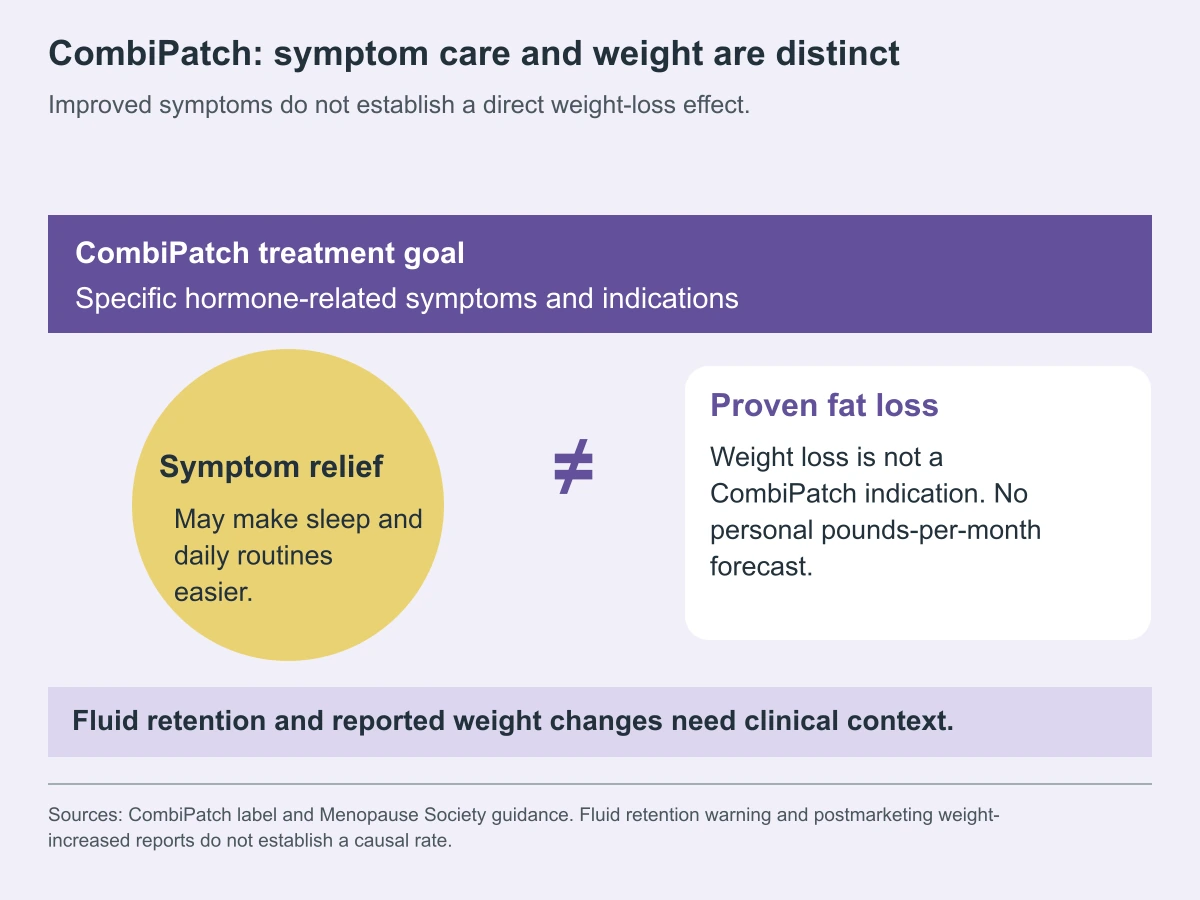
CombiPatch is not a weight-loss medicine. It is a prescription patch containing estradiol and norethindrone acetate, used for specified hormone-related indications. Treating hot flashes or other menopausal symptoms may make sleep and daily routines easier, but that is different from proving that the patch causes fat loss.
Weight can also change for reasons unrelated to treatment, and the CombiPatch label warns about fluid retention. If the scale changes after starting a patch, look at the timing, symptoms, and overall pattern with your clinician. A single number cannot tell you whether the change reflects body fat, fluid, or another problem.
What is CombiPatch prescribed to treat?
CombiPatch combines an estrogen, estradiol, with a progestogen, norethindrone acetate. Its label describes use in women with a uterus for moderate to severe menopausal vasomotor symptoms, such as hot flashes; specified moderate to severe vulvar and vaginal symptoms; and certain hypoestrogenism conditions. It does not list weight loss as an indication. CombiPatch prescribing information
If vaginal symptoms are the only treatment concern, the label says local vaginal products should be considered. A systemic combination patch and a local vaginal treatment are different approaches. The right choice depends on what needs treatment and the person’s medical history.
The presence of a uterus matters because estrogen and progestogen roles differ. Progestogen is used with systemic estrogen in appropriate patients to help protect the uterine lining. Someone who has had a hysterectomy may need a different assessment rather than automatically receiving the same combined product. Menopause Society hormone-therapy guidance
For a broader starting point, read questions before starting HRT and HRT after hysterectomy. Those guides help frame a consultation; they do not establish that CombiPatch is suitable for you.
Why does weight often change during midlife?
Menopause happens alongside aging and changes in sleep, activity, health, and daily responsibilities. Hormonal changes can contribute to a shift toward abdominal fat, while age-related changes also affect body composition. It is too simple to attribute every change to estrogen alone. Menopause Society weight-gain handout
For example, someone may sleep poorly because of night sweats, feel less able to exercise, and eat differently during a stressful period. Another person may maintain the same weight while noticing a different waist fit or reduced strength. Those are different patterns and need not have the same explanation.
A useful assessment separates overall weight, fat distribution, muscle function, and symptom burden. A change in clothing fit does not automatically identify the amount of visceral fat. Likewise, a scale cannot directly measure whether muscle has been preserved.
Our HRT and body-composition guide discusses these distinctions. If sleep is the main problem, the hot flashes and sleep article may be the more relevant next read than a promise about pounds lost.
Could better symptom control indirectly help a routine?
It can make practical sense that fewer disruptive symptoms would make regular activity or meal planning easier. A person who sleeps better may find it easier to keep a walking appointment or prepare breakfast. That possibility is not the same as a direct drug effect that guarantees weight loss.
Menopause guidance treats hormone therapy as symptom care rather than a primary weight-loss treatment. Possible effects on fat distribution or body composition should not be turned into a CombiPatch-specific weight-loss rate, especially when the evidence comes from different hormone formulations. Hormone therapy and weight context
Set the treatment goal around the actual indication: the frequency and burden of hot flashes, sleep disrupted by symptoms, or another documented concern. Weight management can be addressed alongside that goal using its own assessment.
This keeps follow-up useful. “My night sweats are less disruptive, but my weight is unchanged” can represent symptom improvement. It does not automatically mean that hormone treatment has failed. Conversely, rapid unexplained weight loss should not be accepted as a desirable patch effect without assessment.
Can CombiPatch cause weight gain or fluid retention?
The product label warns that estrogens plus progestins can cause some degree of fluid retention. It calls for careful observation in people whose cardiac or kidney conditions may be affected. The label also lists increased weight among postmarketing reports. CombiPatch fluid-retention and adverse-reaction information
Postmarketing reports do not provide a reliable frequency or prove that the patch caused every reported event. They are also not a reason to dismiss a new symptom. A general statement that hormone therapy does not usually cause weight gain should not erase the particular product’s fluid-retention warning.
Fluid and fat are different. Swelling, a rapid change over a short period, or a new change in breathing requires a different assessment from a gradual weight trend over months. Constipation, changes in eating, and other medicines may also complicate the scale reading.
Do not respond by taking a water pill, drastically restricting fluids, or changing the patch schedule on your own. Contact the prescribing clinician and explain the timing, amount of change, any swelling, and other symptoms. Serious symptoms require urgent care rather than an experiment with the dose.

What should you track after starting treatment?
A brief record is usually more useful than repeated weighing throughout the day. Track the symptom being treated, the date the product was started or changed, and any new adverse effects. If weight is part of the discussion, use a consistent measurement routine rather than comparing different scales or times of day.
| Observation | Why it may help the conversation | What it cannot establish alone |
|---|---|---|
| Hot-flash frequency and sleep disruption | Helps assess the actual symptom-treatment goal | Amount of body fat lost |
| Weight trend under similar conditions | Shows whether a change is persistent | Whether the patch caused it |
| Swelling or a sudden change in breathing | May identify a need for prompt assessment | A safe reason to self-treat fluid retention |
| Bleeding pattern | Helps evaluate treatment and uterine concerns | That all bleeding is harmless |
| Strength, activity, and recovery | Adds context about daily function | A precise muscle measurement |
Bring the record to the planned follow-up. Our HRT monitoring guide explains why symptoms, bleeding, and relevant clinical information belong together. A hormone number by itself does not explain every weight change.
Avoid turning tracking into a daily verdict about success. A treatment can relieve an indicated symptom while leaving weight unchanged. Your clinician can help distinguish expected follow-up questions from symptoms that need earlier review.
What are the important safety considerations?
CombiPatch is not appropriate for every person. Its label lists contraindications including unexplained genital bleeding, specified cancers or cancer history, certain clotting and cardiovascular conditions, liver dysfunction or disease, known thrombophilic disorders, pregnancy, and serious hypersensitivity. Review the complete list with the prescriber. CombiPatch contraindications and warnings
Risk assessment should include personal history, age, time since menopause, uterus status, medicines, and the reason for treatment. Being a patch does not make a product free of systemic risk. Nor should risk numbers from a study of a different oral hormone combination automatically be presented as CombiPatch-specific results.
Seek urgent help for symptoms suggesting a serious problem, such as sudden chest pain or breathing difficulty, stroke-like symptoms, sudden vision changes, or a painful swollen leg. New or persistent unexpected vaginal bleeding also deserves medical evaluation. Do not explain these away as ordinary weight changes.
For a balanced overview of treatment decisions, see HRT risks and benefits. A consultation should explain both the likely symptom benefit and the risks relevant to your circumstances.
Does a patch mean the hormones act only on the skin?
No. CombiPatch is a systemic transdermal treatment: the patch delivers hormones through the skin for effects beyond the application site. A product applied to the skin is not necessarily a purely local skin treatment. Systemic and local hormone therapy
This matters when comparing it with a cosmetic cream, a local vaginal treatment, or a compounded hormone preparation. The ingredient, dose, route, and approved indication all matter. The word “hormone” does not make those products interchangeable.
Follow the actual product’s application and storage directions. The current CombiPatch manufacturer label specifies refrigerated storage at 2–8°C; older online instructions should not override the current package information. Ask the pharmacist about travel or handling questions instead of transferring directions from another patch. Current CombiPatch handling information
A good follow-up question is: “Which symptoms is this formulation intended to treat, and which symptoms would need another approach?” That is clearer than assuming a patch should improve every change associated with midlife.
How can weight management fit alongside menopausal symptom care?
Start with sustainable food, movement, sleep, and strength routines suited to your health and circumstances. The Menopause Society’s weight guidance emphasizes a broader approach rather than using hormone therapy as a weight-loss prescription. Midlife weight-management context
Our balanced-meal guide and walking guide offer practical starting points. Add beginner strength training when appropriate, with an emphasis on function and repeatable activity rather than punishing exercise.
If you are considering a supplement, identify its actual purpose. CoreAge Rx’s Strong Suit product page describes creatine monohydrate; it is not a hormone patch or a complete weight-management plan. Current Strong Suit product identity Product choice should follow a defined need and an interaction review, especially if other treatments are involved.
Some people may benefit from a separate clinical assessment for weight-management medication. That assessment is distinct from deciding whether to use HRT. Our online prescription guide explains what a legitimate evaluation should cover. Do not assume that any particular clinic dispenses CombiPatch because it discusses hormones or weight.
Common CombiPatch and weight questions
How much weight will I lose on CombiPatch?
There is no supported personal weight-loss forecast. Weight loss is not an approved indication, and symptom improvement should not be converted into a pounds-per-month promise.
Does gaining weight mean the patch is wrong for me?
It calls for context, especially if the change is rapid or accompanied by swelling. The clinician can assess the timing, medical history, symptoms, and other causes. Do not change treatment solely from a scale reading.
Could HRT reduce menopausal belly fat?
General body-composition findings do not establish that this specific patch will reduce a particular person’s abdominal fat. Discuss the overall pattern and appropriate goals without treating HRT as a targeted fat-loss product.
Can I use CombiPatch just to help with weight?
Its prescription should be based on an appropriate indication and an individual benefit-risk assessment. Ask about weight management as a separate concern. The clearest plan identifies what each treatment is for and how its results will be reviewed.
Educational information for adults; individual treatment decisions require a qualified clinician. Sources reviewed October 1, 2026. Original AI-generated article images depict fictional people and objects, not patient outcomes. Other editorial images are illustrative. Graphics summarize the cited sources.