An online weight-loss prescription should begin with a medical assessment and end with a clear plan for dispensing, monitoring, and follow-up. A website’s ability to accept payment does not establish that a particular medicine is appropriate, available, covered by insurance, or supplied by a legitimate pharmacy.
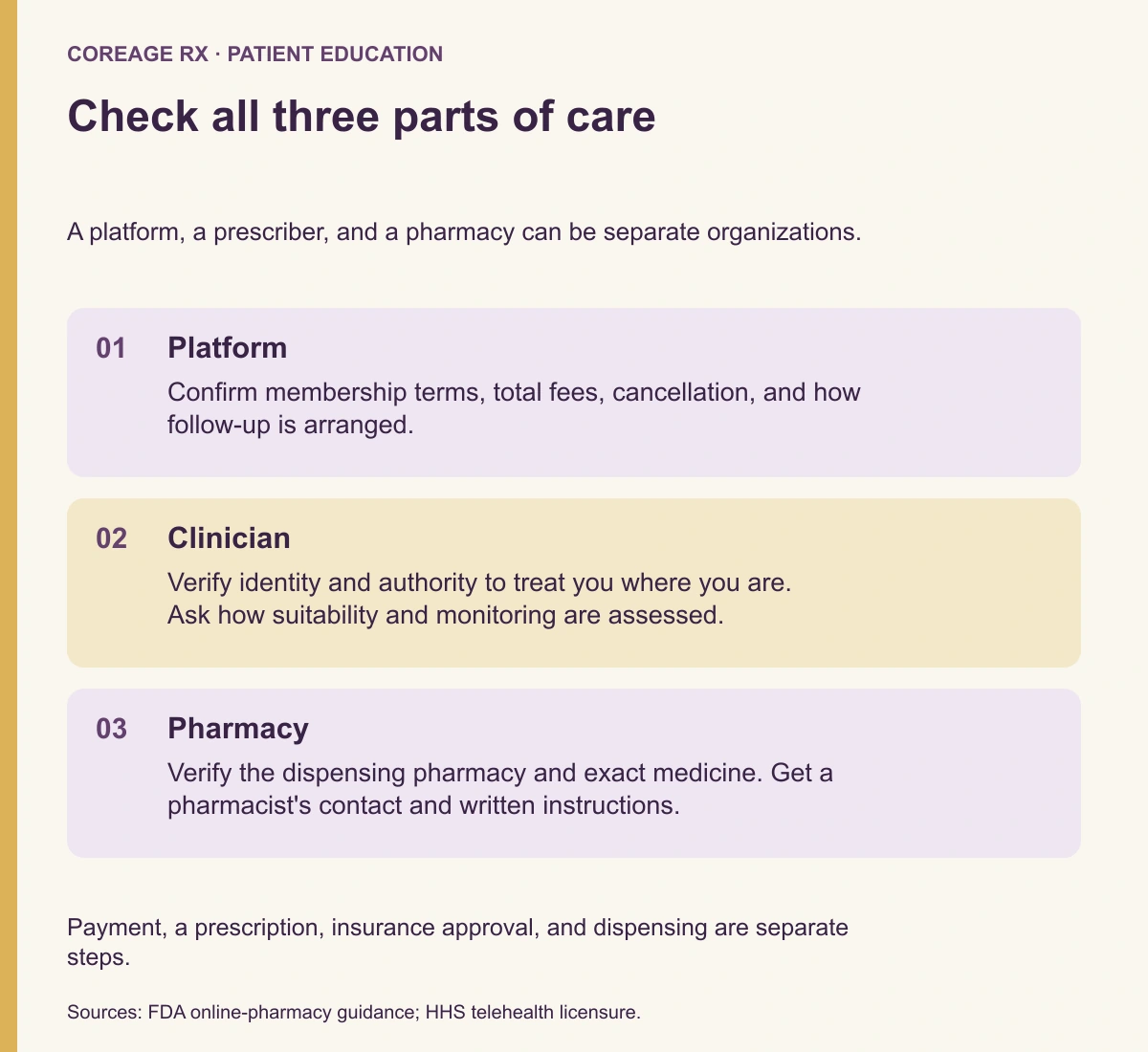
It helps to separate three services: the platform arranging care, the clinician deciding whether to prescribe, and the pharmacy dispensing the medicine. They may belong to different organizations, and each should be identifiable. This guide explains what to check before an appointment, before paying, and when the medication arrives.
Can a clinician prescribe weight-loss medicine online?
Telehealth can be a way to assess and manage some patients, but the clinician must decide whether the available information is sufficient. A questionnaire alone does not guarantee that the requested treatment is appropriate. Depending on the situation, the clinician may need a conversation, medical records, measurements, laboratory testing, or an in-person examination.
The clinician also needs the appropriate authority to treat you where you are located. HHS explains that state requirements vary and may involve a state license, a compact, registration, reciprocity, or a specific exception. Tell the service your actual location at the time of the visit, including if you are traveling. See HHS guidance on cross-state telehealth licensing.
Ask for the treating professional’s name and credentials. Verify the relevant license or authorization through the appropriate licensing body. A platform operating nationally does not independently establish that every clinician on it can treat every patient in every state.
Start with the health problem, not a guaranteed brand
People often search for “Ozempic online” when their main goal is weight management. Ozempic injection is approved for specified uses in adults with type 2 diabetes, including particular cardiovascular and kidney outcomes. Wegovy and Zepbound have weight-management indications for specified patients. A clinician should distinguish the diagnosis, treatment objective, and exact product rather than treating the brand names as interchangeable.
An off-label prescription is a separate clinical decision; it does not change a medicine’s FDA-approved indication or guarantee insurance coverage. Our guide to qualifying for Ozempic explains the difference between a clinical assessment and a promise of access. The current Ozempic, Wegovy, and Zepbound labels provide the approved indications.
It is reasonable to arrive with a preference. It is also reasonable for the clinician to recommend a different treatment, request more information, or decide not to prescribe. A consultation fee should not be presented as a purchase of a guaranteed prescription.
What information should you prepare?
Bring an accurate medication list, including over-the-counter products and supplements. Include the exact product, dose, and last dose if you have used a GLP-1 medicine before. A previous prescription does not automatically establish an appropriate restart plan after a gap.
Be ready to discuss your weight history, medical diagnoses, prior treatment response, allergies, and any recent symptoms. Relevant history can include diabetes treatment, kidney problems, pancreatitis, gallbladder disease, severe digestive symptoms, retinopathy, and a personal or family history of medullary thyroid carcinoma or MEN2. The importance of each item depends on the proposed medicine.
Discuss pregnancy, breastfeeding, and pregnancy plans. Also mention planned surgery or procedures requiring anesthesia or deep sedation. These topics can change the treatment conversation even when the appointment is primarily about weight.
Do not alter answers to satisfy an advertised eligibility screen. The purpose of the assessment is to find an appropriate plan, including recognizing when another form of care is needed.
Know which organization does what
| Part of the process | Questions to ask |
|---|---|
| Platform or membership service | What does the fee cover, how is care arranged, and how do cancellations work? |
| Prescribing clinician | Who reviews my history, orders any needed testing, chooses treatment, and handles changes? |
| Dispensing pharmacy | What is its legal name, where is it licensed, and how can I reach a pharmacist? |
| Follow-up service | Who responds between visits, how quickly, and what requires urgent local care? |
A service can be convenient while still leaving gaps in one of these areas. For example, an initial consultation may be easy to book, but a refill may require another appointment and fee. A pharmacy may ship the medicine but have no role in deciding whether a dose increase is appropriate.
If you are comparing a marketplace model, our Push Health review explains why platform fees, independent clinicians, pharmacy costs, and follow-up need separate questions.

How to check the online pharmacy
FDA recommends using an online pharmacy that requires a valid prescription, has a U.S. address and telephone number, provides access to a licensed pharmacist, and is licensed through the appropriate state board. Verify the details in the board’s database rather than relying exclusively on a logo or a claim on the website. See FDA’s online-pharmacy guidance.
Red flags include offers to supply prescription medicine without a prescription, an unidentifiable pharmacy, unclear or damaged packaging, and products that arrive looking different from what was ordered. Unexpected charges or requests for information unrelated to care also deserve scrutiny.
A very low advertised price is a reason to examine the terms, not proof by itself that a service is illegitimate. Likewise, an expensive membership is not proof of quality. Look for verifiable information about the actual clinician, medicine, and pharmacy.
Before sending payment, confirm that the name on the dispensing label will match the pharmacy you have checked. If a platform changes pharmacies, repeat the verification for the new dispenser.
Ask whether the medicine is approved or compounded
The words “semaglutide program” or “tirzepatide treatment” do not tell you whether the offer includes an FDA-approved branded product or a compounded preparation. Ask for the exact formulation and dispensing details.
Compounded medicines are not FDA-approved generic versions of the brands. Their legal conditions, clinical rationale, ingredients, concentration, and handling require a separate review. Added vitamins do not automatically establish greater effectiveness or fewer side effects. Our compounded GLP-1 medication guide explains the current concerns.
FDA warns about misleading online promotion of unapproved GLP-1 products, including claims implying equivalence to approved products. A seller quoting a branded trial does not establish that the preparation it supplies has been studied in the same way. Review the FDA’s GLP-1 concerns if the proposed medicine is compounded or its identity is unclear.
Compare the whole cost of care
Ask for a written breakdown covering the initial assessment, recurring membership, medicine, supplies, laboratory testing if needed, shipping, and follow-up visits. Clarify whether the introductory price changes with later doses or after the first month.
For insurance, a prescription, a submitted prior authorization, and an approved claim are different steps. Confirm the exact product and indication the plan covers, any documentation required, and the likely out-of-pocket cost at the dispensing pharmacy. A clinician’s decision to prescribe does not guarantee that the insurer will pay.
For self-pay care, ask how refills, interrupted shipments, cancellation, and unused membership time are handled. Avoid comparing a visit-only fee with another service’s medication-inclusive fee as though they cover the same things.
Our Ozempic cost guide and tirzepatide versus semaglutide cost comparison provide a framework for organizing these questions. Confirm current terms directly before committing, because offers and eligibility can change.
Establish follow-up before the first dose
A useful plan identifies how you will report side effects and how response will be assessed. Ask whether dose changes require clinician review, when the next appointment should occur, and what information to collect between visits.
There should be a clear route for questions about persistent nausea, a missed dose, uncertainty about a device, or an interruption in supply. Automatic billing or automatic shipping does not replace clinical reassessment. The semaglutide questions guide and tirzepatide questions guide can help you prepare a list.
Ask what happens if you move or travel to a location the clinician cannot serve. Also ask whether records can be shared with your usual clinician. Coordinating care matters when several professionals prescribe medicines that affect blood glucose, blood pressure, or appetite.
Routine messaging should not be your only plan for an emergency. Severe abdominal pain, repeated vomiting with inability to drink, fainting, or serious allergic symptoms require timely local assessment rather than waiting in a standard support queue.

What to check when the package arrives
Confirm your name, the medicine, strength or concentration, dispensing pharmacy, and written directions. Check the packaging and storage instructions before the first use. If a vial is supplied, ask the pharmacist to reconcile the prescribed milligrams with the supplied syringe and concentration; do not rely on an online units chart.
FDA advises against using injectable GLP-1 medicines that arrive warm or inadequately refrigerated. Contact the pharmacy to resolve the shipment. Re-cooling it does not prove that it was handled correctly. Our semaglutide storage guide explains why branded-device and compounded-vial instructions differ.
Keep the packaging and order details until any discrepancy is resolved. If the medication does not match the prescription or its identity is uncertain, do not use it while waiting for clarification.
A useful appointment ends with clear next steps
Before ending the visit, summarize the plan back to the clinician: the diagnosis being treated, the proposed medicine, any tests or records still needed, the pharmacy, the expected costs, and the follow-up contact. This helps catch misunderstandings before a shipment or refill.
You can explore CoreAge Rx’s semaglutide care information and tirzepatide care information to prepare for an assessment. Treatment suitability and the exact prescription still require a qualified clinician’s review. The value of online care is access to a clear, accountable care process that continues after the first order.
Understand service billing before enrolling
- Lemonaid membership, medication and cancellation costs — Separate introductory and recurring charges from upfront commitments and refund terms.
Our dated MEDVI tirzepatide document review compares public offers, provider and pharmacy roles, cancellation terms, and FDA correspondence without inventing patient experience.
Review specific offers and proposed add-ons
- RemedyMeds prices and subscription questions — Separate introductory and ongoing charges, billing intervals and conditional warranty terms.
- Lipo-C ingredient and evidence questions — Identify the actual compounded blend and clinical rationale before considering an additional injection.
Educational information for adults; individual treatment decisions require a qualified clinician. Sources checked September 27, 2026. Original AI-generated article illustrations depict fictional people and objects, not patient outcomes. Other editorial images are illustrative. Graphics summarize the cited sources.