Push Health is a platform that connects patients with independent licensed medical providers. It is not itself a pharmacy, and a fee paid through the platform is not automatically the price of the medication. Those two distinctions explain much of what people need to understand before requesting care.
This review examines Push Health’s public service information, fees, prescribing process, and cancellation terms. It is based on the company’s published materials, not a personal treatment experience or a fabricated rating. Information was checked September 26, 2026; the actual provider, prescription, location, and terms shown before payment still matter.
How does Push Health work?
According to its official FAQ, Push Health supplies software through which patients and independent doctors, nurse practitioners, and physician assistants can communicate and request services. A medical provider reviews the request and decides whether treatment is appropriate. When a prescription is written, it can be routed electronically to the patient’s selected pharmacy.
The platform also supports certain laboratory orders through Quest Diagnostics. Lab availability and the ordering provider’s scope need confirmation for the patient’s location. A list of services on a website does not establish that every provider offers every service to every patient.
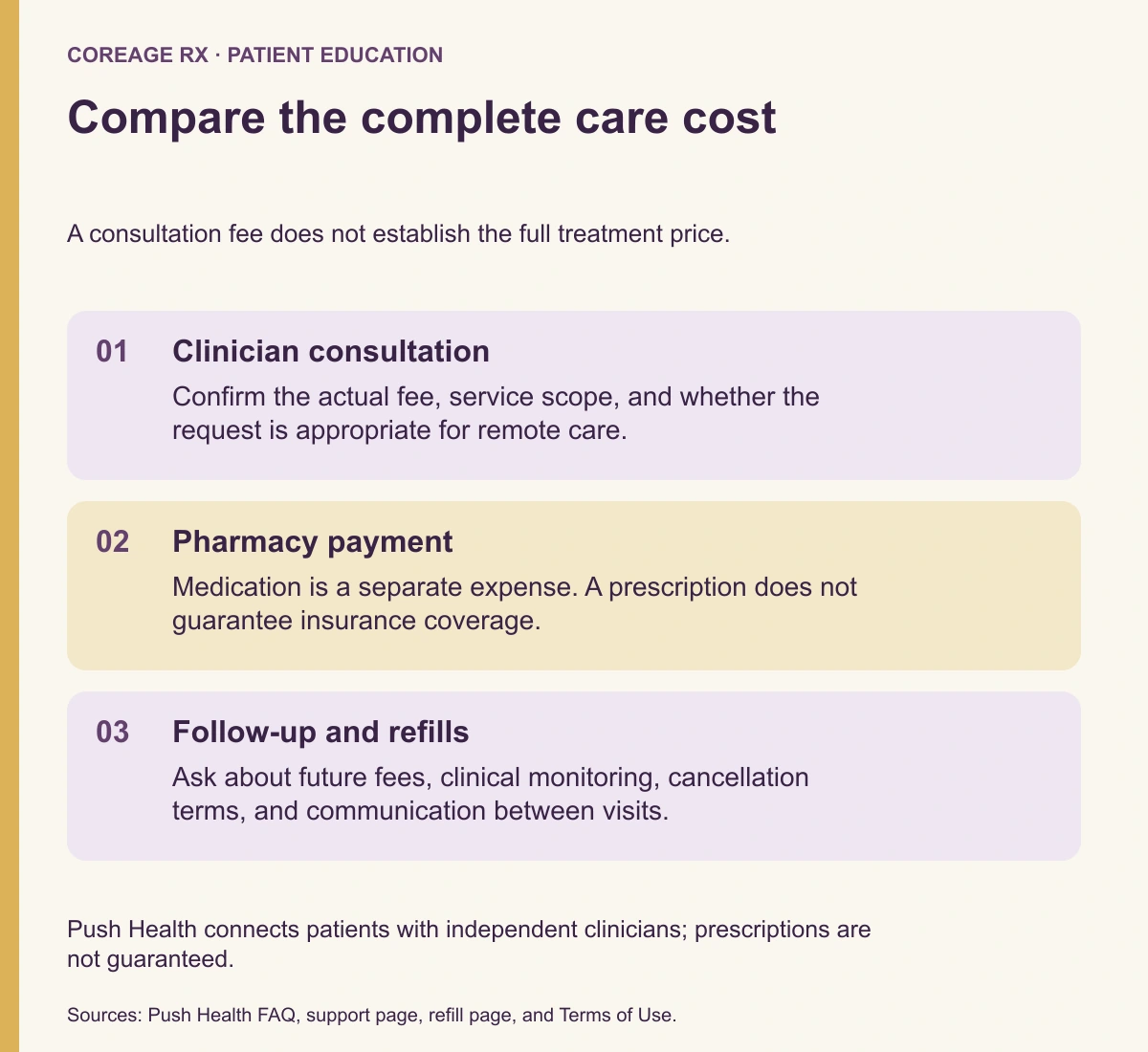
Push Health says it does not sell or ship medicines. Patients need to coordinate medication availability, dispensing, and payment with the pharmacy. That distinction matters when an advertised consultation price appears much lower than the total cost of ongoing treatment.
Do you need an invitation or an existing doctor?
Some older-looking public pages describe an invitation-based model. Push Health’s how-it-works support article also describes a request process that can connect a patient with a provider, and its prescription-refill page, updated August 20, 2026, describes help connecting people seeking appropriate refills.
The practical question is whether a suitable licensed provider is accepting the request in your location. Confirm this through the current service flow rather than assuming that an older description applies universally. Registration or submission of information does not guarantee that a particular medicine will be prescribed.
Before entering payment information, identify who will review the request and how follow-up questions are handled. If you need an ongoing care relationship, ask whether the same clinician can provide it and what happens when that clinician is unavailable.
How much does Push Health cost?
The support explanation describes a typical initial consultation range of $64.99 to $80 in most states. This is a published example of initial service pricing, not a universal quote or a promise about future visits. The FAQ says fees vary, and independent providers can set professional fees.
Ask to see the actual charge before accepting the service. Clarify whether the request covers one consultation, a prescription decision, a refill, or ongoing support. Do not assume the initial fee will remain the same or cover every later administrative task.
| Cost category | What to confirm |
|---|---|
| Clinical service | The provider’s fee, platform processing charges, and what the specific request includes |
| Medication | The pharmacy’s price, quantity, insurance decision, and any applicable savings terms |
| Laboratory work | Which tests are ordered, where they are performed, and the separate price if applicable |
| Ongoing care | Refill fees, appointments, dose reviews, messages, and any recurring service terms |
An unknown cost is not zero. Request enough detail to compare a realistic period of treatment rather than only the cheapest advertised starting point.
Does the consultation fee include the medicine?
The FAQ says fees paid through Push Health are service fees. The selected pharmacy may charge separately for medication, and the patient is responsible for arranging fulfillment. A prescription being sent electronically does not guarantee stock, insurance coverage, or a particular cash price.
This is especially relevant to GLP-1 medicines. Our Ozempic cost guide, Wegovy cost guide, and Zepbound cost guide separate product, presentation, coverage, and manufacturer-offer questions. A consultation fee should not be compared directly with a price that includes medication unless the scope is made explicit.
Ask which exact medicine, formulation, and quantity would be prescribed if clinically appropriate. The brand, route, and indication can affect both treatment and access. “A weight-loss prescription” is not specific enough to establish either the expected bill or what product will arrive.
Can Push Health prescribe semaglutide or tirzepatide?
Its current refill information lists products including Ozempic, Wegovy, Mounjaro, and Zepbound among examples that may be eligible for an appropriate evaluation. That is not a guarantee that a particular provider will prescribe or refill one for you.
Eligibility depends on a clinical assessment, the relevant product, medical history, and the provider’s judgment. The site’s materials say Push Health does not direct independent clinicians’ prescribing decisions. It also says controlled medications cannot be prescribed through the platform, so do not assume it can provide testosterone merely because it offers other prescription services.
Our semaglutide questions guide and tirzepatide questions guide explain what an evaluation should address. A prescription request should include discussion of safety and follow-up, not just the name of a desired medicine.

A refill is different from a complete long-term care plan
Push Health’s refill page explains that short-term refill care does not replace having a regular medical provider for ongoing management. Someone who needs a brief bridge for an established medication may have different needs from someone starting a new treatment with dose changes and monitoring.
Ask who will assess benefit, tolerability, laboratory results when needed, and changes in other medicines. For a GLP-1 medicine, also ask how to report repeated vomiting, inadequate food or fluid intake, and a prolonged interruption. Sending another prescription is not the same task as deciding whether the treatment remains suitable.
If a clinician recommends in-person assessment or declines the request, that may reflect the limits of telehealth for the situation. An online service cannot safely replace every examination, urgent-care visit, or specialist evaluation.
What do insurance and prior authorization involve?
Push Health says insurance is not required to use its platform. Its support information describes many providers as out of network. The clinical service and the pharmacy benefit are separate questions: paying cash for an online consultation does not settle whether insurance covers the resulting prescription.
Ask the provider whether prior-authorization work is offered, whether it has an additional charge, and what information the insurer may require. A completed request does not guarantee approval. The payer decides coverage under the applicable benefit and criteria.
Our Blue Cross Blue Shield coverage guide illustrates why the specific plan, indication, and formulary matter. Use the insurer’s current response for your own prescription rather than another patient’s online report.
How quickly will a provider respond?
The FAQ says many requests are reviewed within 24 hours or less, while making clear that timing depends on the provider. Treat that as a general description, not a guaranteed response time or pharmacy pickup promise.
Ask what happens if there is no response, whether a request can be reassigned, and how to contact platform support for administrative issues. Clinical questions and technical support are different functions; a support representative cannot necessarily change a prescription or make a medical decision.
For urgent symptoms, seek appropriate urgent or emergency care. Do not wait on a message thread for serious breathing difficulty, fainting, severe persistent abdominal pain, or another potential emergency simply because the medication was originally obtained online.
What is the refund or cancellation policy?
Read the terms that apply before paying. The FAQ describes cancellation before a provider writes a prescription and states that a refund is not available after the patient approves the recommended prescription. Its laboratory explanation distinguishes refundable laboratory/platform fees from professional fees.
The linked Terms of Use use broader language stating that associated fees are nonrefundable once a provider acts on an order or request. Because the public wording uses different stages, do not assume that not collecting a medicine from the pharmacy automatically creates a refund right. Confirm the applicable terms and request status directly.
The terms also address subscription-based products or services when purchased. Check whether your particular transaction is one-time or recurring, the renewal date, and the cancellation process. Do not infer either a mandatory universal subscription or the absence of all recurring charges from one patient’s experience.

How should online reviews be interpreted?
Reviews can reveal useful questions about communication, unexpected charges, refill arrangements, or pharmacy coordination. They do not prove how every provider behaves or whether treatment was medically appropriate. A complaint about a denied prescription, for example, cannot establish poor clinical care without the underlying medical information.
Look for the date, the specific service, the provider relationship, and the stage where a problem occurred. Separate platform billing or technical issues from the pharmacy’s stock, an insurer’s denial, and a clinician’s decision. Those are different problems with different routes to resolution.
This article does not assign a star rating because we have not independently measured patient outcomes or experienced the service. The useful comparison is whether the available care and written terms fit your actual needs.
Questions to ask when comparing services
Start with the same questions for every provider:
- Who makes the medical decision and provides follow-up?
- What exact medicine and pharmacy would be involved if treatment is appropriate?
- What does the initial charge include, and what costs recur?
- How are side effects, missed doses, and refills handled?
- What are the cancellation terms before and after a clinician acts?
Our TrimRx review uses a similar approach to another service. For CoreAge Rx semaglutide information or tirzepatide information, apply the same questions, including whether the proposed preparation is compounded. FDA explains why compounded products should not be described as approved generics or assumed equivalent to branded trial products.
The best next step is a clear clinical and financial picture: a suitable provider, a specific treatment plan, a total cost you understand, and a reliable way to obtain help after the first request.
Educational information for adults; individual treatment decisions require a qualified clinician. Sources checked September 26, 2026. Original AI-generated article illustrations depict fictional people and objects, not patient outcomes. Other editorial images are illustrative. Graphics summarize the cited sources.