Ozempic does not have one universal monthly price. Your bill depends on the prescribed formulation and dose, insurance coverage, pharmacy, and eligibility for a specific offer. The price shown in a headline may apply only to an introductory supply or a particular group of patients.
This guide uses U.S. manufacturer information checked September 26, 2026. Prices and program terms can change. Confirm the amount for your actual prescription before paying, and ask what happens at the next refill—not just at checkout today.
Current manufacturer offers: what the numbers mean
The examples below come from the NovoCare Ozempic savings page. They are program offers with eligibility rules, not guaranteed prices at every pharmacy.
| Offer shown by the manufacturer | Key qualification or limitation |
|---|---|
| As little as $25 per month with commercial insurance | The plan must cover Ozempic; savings are capped at $100 per month, and eligibility restrictions apply. Government-program beneficiaries are excluded from this savings-card offer. |
| $199 per month for an introductory Ozempic pen offer | For patients new to the Ozempic Savings Offer or NovoCare Pharmacy, covering two monthly fills of 0.25 mg or 0.5 mg through December 31, 2026, subject to terms. |
| $349 per month after the pen introductory offer | The current terms list this self-pay amount for 0.25 mg, 0.5 mg, or 1 mg. |
| $499 per month for the 2 mg pen | The current self-pay terms list a separate price for this dose. |
| Oral Ozempic starting at $149 per month | The advertised starting figure applies to the 1.5 mg tablet dose; oral pricing varies by dose and must be checked separately. |
The manufacturer defines a month for the pen offer as one box containing one pen. The terms state that the program may be changed or canceled. Introductory prices should therefore be recorded with the product, dose, duration, and date checked.
The 1.5 mg Ozempic tablet is an initiation dose, not a maintenance-dose price comparison. Tablets and pens have different dosing instructions and are not interchangeable based on the milligram number. See the oral semaglutide label and our oral versus injectable semaglutide guide.
Why “as little as $25” may not be your copay
An offer with a maximum savings amount does not reduce every possible pharmacy bill to the advertised minimum. If the plan leaves a larger amount for you to pay, the cap can matter.
For example, using a hypothetical covered prescription with a $250 patient share, a maximum $100 reduction would leave $150. That arithmetic illustrates why the ceiling matters; it is not a quote for your claim or a complete interpretation of program rules. The pharmacy must process the actual prescription and offer to determine the result.
The manufacturer’s coverage page states that coverage depends on the plan’s formulary and may involve prior authorization or step therapy. An insurance card by itself does not establish coverage, savings-card eligibility, or the final price.
Diagnosis and coverage are separate decisions
A clinician first decides whether a medicine is appropriate. The insurer then applies its benefit rules to the prescription. Those decisions can lead to different outcomes: a clinically appropriate prescription may still require documentation, an appeal, or another coverage discussion.
Ozempic is not simply a brand name for every semaglutide weight-management treatment. Its approved indications differ from those of Wegovy. BMI criteria used for some obesity medicines should not be treated as universal Ozempic coverage rules.
Our Ozempic eligibility guide explains that distinction. When calling an insurer, ask about the exact product, route, indication, prescribed dose, and quantity. “Do you cover weight-loss injections?” is often too broad to answer the relevant question.
Questions for the insurance company
Have the prescription information and benefit details ready. A useful call or written inquiry covers:
- Is this exact Ozempic formulation on my current formulary?
- Which diagnosis and documentation are required?
- Is prior authorization or step therapy necessary?
- Does a deductible apply before the quoted copay or coinsurance?
- Must I use a preferred pharmacy or mail-order service?
- Does the quantity supplied change the patient cost?
- If coverage is denied, what is the stated reason and review process?
Keep the response and date. If the pharmacy quote conflicts with the benefit explanation, ask which part of the claim caused the difference. The issue might be the pharmacy network, quantity, coverage approval, or savings-card processing rather than the medicine’s base price.
Self-pay requires a refill budget
A two-fill introductory offer is not an annual treatment price. Ask which dose the current quote covers and what the next eligible fill would cost after the offer ends. Do not assume every person follows the same dose schedule or qualifies for the same program.
One way to organize the comparison is to record three separate amounts: the first fill, the first refill after the introductory period, and a refill at the dose your clinician currently expects to use. The expected dose can change, so this is a planning exercise rather than a promise.
The Ozempic dosage chart explains why initiation and maintenance are different stages. A lower starting price should not influence a decision to remain at an unsuitable dose or increase treatment prematurely.

What about Medicare or Medicaid?
Do not apply a commercial-insurance coupon automatically to a government health program. The manufacturer’s $25 savings-card offer excludes government-program beneficiaries. Coverage and patient costs under Medicare or Medicaid depend on the applicable plan and rules.
The current Ozempic coverage page also describes self-pay options for Medicare Part D and Medicaid beneficiaries. It states that purchases through those self-pay offers occur outside insurance and cannot be submitted for reimbursement or counted toward the insurance deductible or out-of-pocket limit.
That distinction can change the overall comparison. Ask the plan and dispensing pharmacy to explain both the immediate payment and how the purchase affects benefit accounting. Do not assume that the smallest cash price produces the smallest total expense across the year.
Patient assistance is different from a savings card
Manufacturer patient-assistance programs have their own eligibility and documentation requirements. They are separate from a commercial savings card and from a cash-pay offer. The manufacturer describes assistance for qualifying individuals, but eligibility should be checked using the current application and terms.
Ask which program is being discussed, whether it covers the exact product, how long an approval lasts, and what documents are needed. Do not pay an unfamiliar third party merely because it claims to guarantee acceptance into a manufacturer program.
If affordability is preventing treatment, tell the prescribing team before running out. A clinician may be able to review an appropriate alternative, and staff may be able to help identify the relevant coverage or assistance process. Our Mounjaro alternatives article discusses how treatment goals and access shape medicine comparisons more broadly.
Add the care costs to the medication price
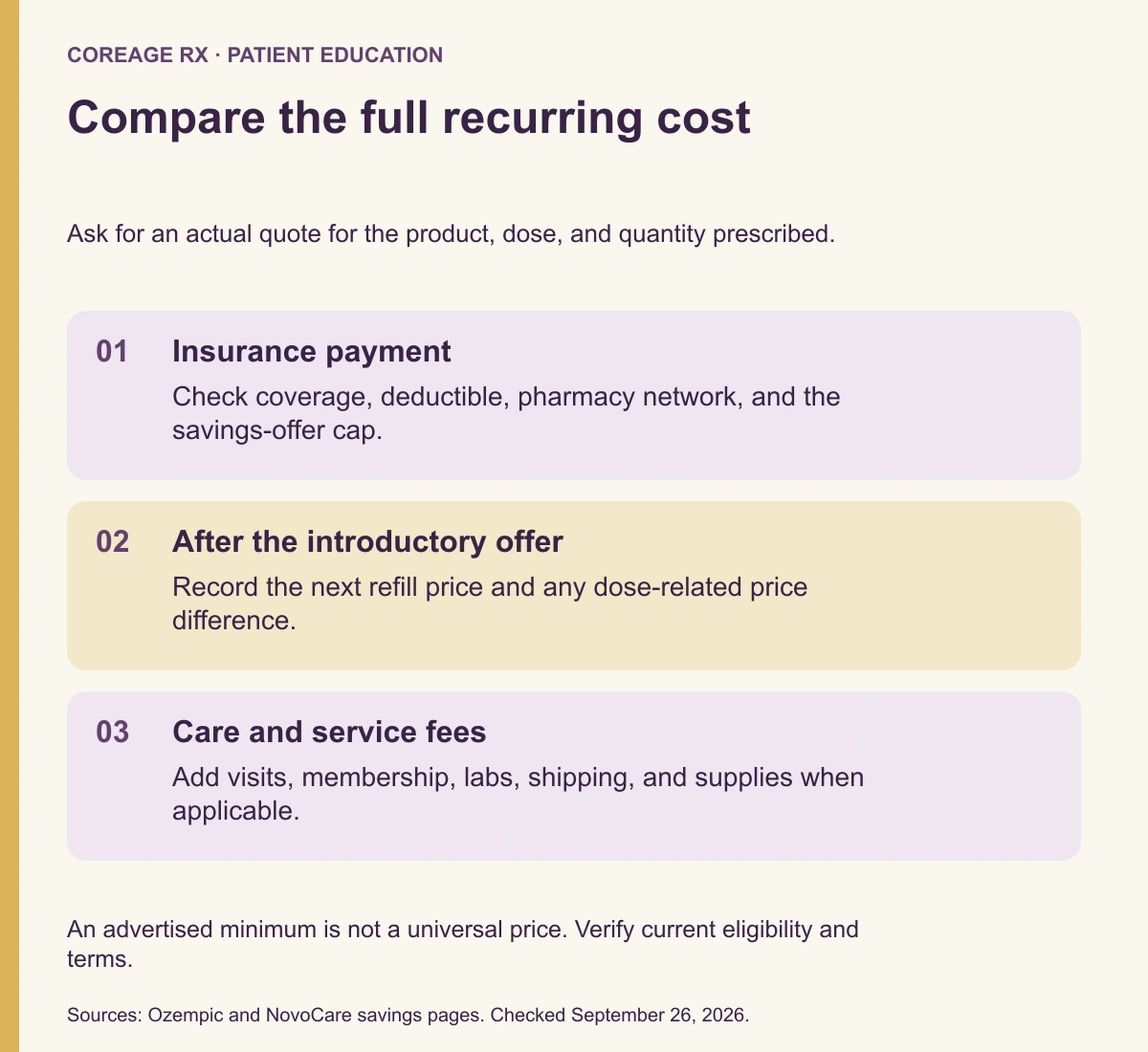
The pharmacy amount is only one part of some programs. A telehealth or in-person service may charge separately for visits, membership, laboratory testing, shipping, supplies, or follow-up. Other services include some of these costs. Ask for the itemized terms.
| Cost question | What to get in writing |
|---|---|
| Initial assessment | Visit fee and whether payment guarantees only an assessment, not a prescription. |
| Follow-up care | Frequency, included messaging or visits, and charges for additional appointments. |
| Medication | Exact product, formulation, dose, quantity, pharmacy, and whether it is included. |
| Additional charges | Any required laboratory, shipping, supply, or membership fees. |
| Renewals and cancellation | Billing interval, renewal amount, cancellation deadline, and refund conditions. |
Our TrimRx review uses a similar framework for comparing online programs. Apply the same questions to CoreAge Rx and any other provider rather than comparing only the largest number in an advertisement.
Compounded semaglutide is a different comparison
A compounded preparation containing semaglutide is not FDA-approved Ozempic, and it should not be described as an approved generic equivalent. Its price may cover a different preparation, service arrangement, quantity, or set of fees.
FDA recommends compounded drugs only when an individual patient’s medical needs cannot be met by an approved medicine. The agency has raised concerns about dosing errors, fraudulent labeling, storage, and some ingredient forms in unapproved GLP-1 products. A price comparison should preserve these differences. Source: FDA unapproved GLP-1 guidance.
If you review CoreAge Rx’s semaglutide service, ask the team to identify the exact preparation, pharmacy, clinical rationale, total recurring cost, and follow-up process. Read semaglutide versus Ozempic before assuming that a shared ingredient name means identical products.

Avoid saving money by changing the medicine yourself
Sharing a pen, counting clicks to improvise a dose, extracting leftover liquid, or changing the interval can introduce safety problems. The Ozempic Instructions for Use warn against sharing pens even after changing the needle and against setting doses by counting clicks. The pen guide explains device and packaging questions.
If the prescribed plan is unaffordable, ask for a different clinical plan before changing how you use the medicine. Also avoid sellers that provide prescription drugs without a legitimate prescription or offer products labeled only for research. A low price does not establish authenticity.
Frequently asked questions
Why does my friend’s Ozempic cost less?
Different insurance benefits, deductibles, pharmacies, dose presentations, or program eligibility can produce different amounts. Compare the actual circumstances before concluding that your quote is wrong.
Does a prescription guarantee insurance approval?
No. A prescription and an insurance coverage decision are separate. Ask what documentation or benefit requirements remain outstanding.
Is the first pen always a one-month supply?
The offer uses its own one-box definition. The number of injections a pen supplies depends on the prescribed schedule and presentation. The introductory multidose pen can be used differently from a pen supplying maintenance doses; confirm the pharmacy’s days-supply entry and refill timing.
Our guide to Ozempic cost at Costco reviews a dated selected-pen quote alongside member-program terms, insurance and manufacturer offers. The package, quantity, eligibility and next-fill cost all need to match.
Our guide to Ozempic quotes at CVS explains prescription details, benefit processing, current offer limits and the complete refill budget.
Where should I verify a price before paying?
Use the dispensing pharmacy for the actual claim or cash quote, the insurer for benefit rules, and the manufacturer’s current page for offer terms. Keep the product, dose, quantity, eligibility assumptions, and quote date together so the comparison stays meaningful.
Compare a specific coupon and payment route
- Ozempic GoodRx prices, insurance and deductible questions — Match the prescription and pharmacy quote, and separate coupons from dated manufacturer offers.
Educational information for adults; individual treatment decisions require a qualified clinician. Sources checked September 26, 2026. Original AI-generated article illustrations depict fictional people and objects, not patient outcomes. Other editorial images are illustrative. Graphics summarize the cited sources.