
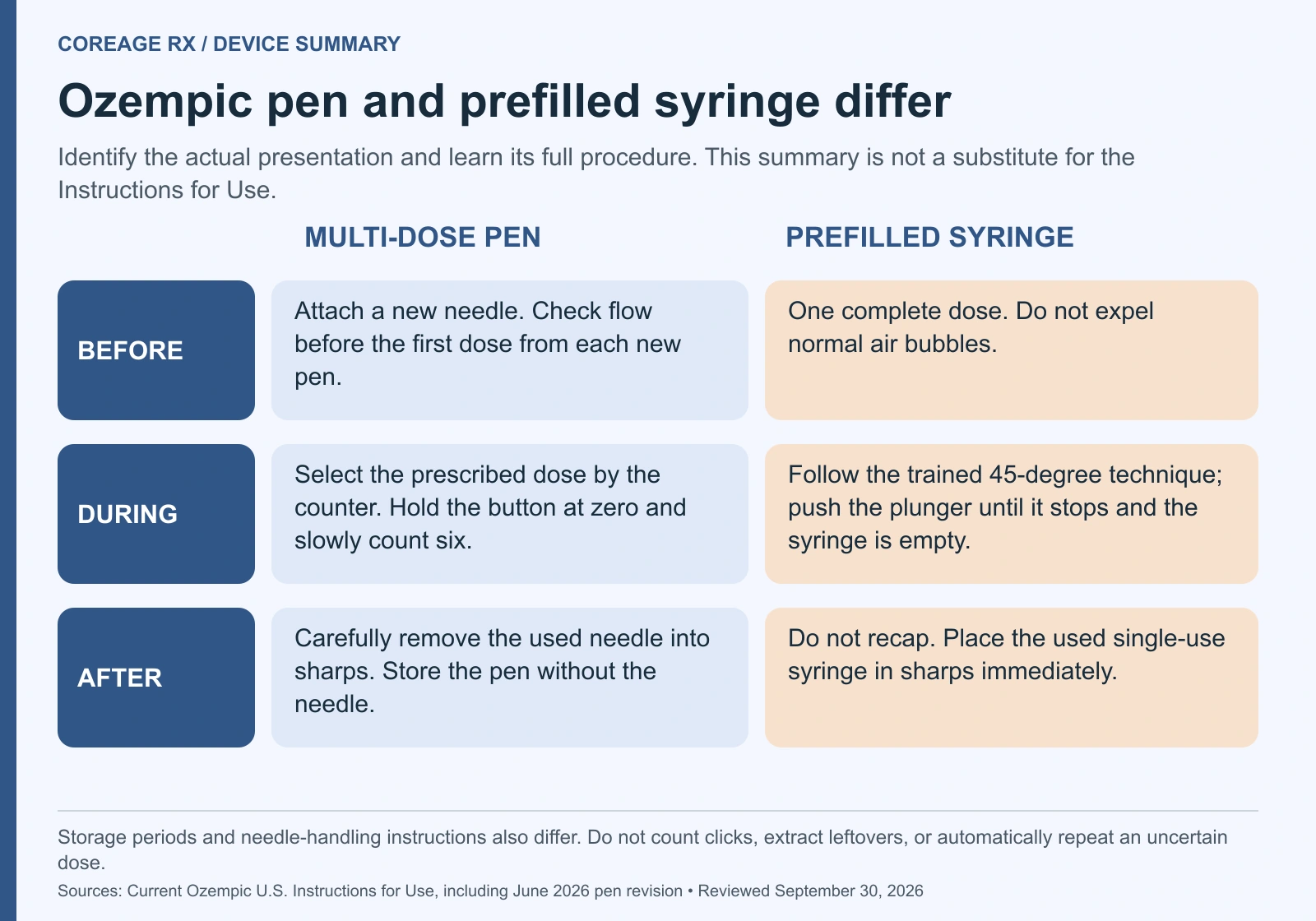
How you use Ozempic depends on the presentation supplied. A multi-dose pen and a single-dose prefilled syringe have different preparation, injection, completion, storage, and disposal instructions. Identify the actual product and learn its procedure from your healthcare professional before starting.
This guide summarizes current U.S. Ozempic labeling and Instructions for Use checked September 30, 2026, including the pen instructions revised in June 2026. Keep the complete instructions with your supplies. If a refill changes the device, ask for matching training rather than copying a familiar routine.
Check the medicine, dose, and presentation first
Read the carton and pharmacy label together. Confirm that the product is Ozempic injection, identify whether it is a pen or prefilled syringe, and check the prescribed weekly dose. Oral medicines containing semaglutide have different administration instructions and should not be confused with these injection products.
The current U.S. label describes Ozempic injection for adults with specified type 2 diabetes, cardiovascular, and kidney indications. It is not an FDA-approved weight-management product simply because weight can change during diabetes treatment. Our semaglutide brand comparison explains the distinctions.
Do not choose the dose from a package’s total contents. If the prescription, device, and instructions do not agree or are unclear, ask the pharmacist before injecting.
How many pens or syringes are in an Ozempic box?
The current U.S. label lists one multi-dose pen per carton: the 2 mg/3 mL presentation includes six NovoFine Plus needles, while the 4 mg/3 mL and 8 mg/3 mL presentations each include four. Those carton contents differ from the number of prescribed doses available in the pen. The labeled single-dose prefilled-syringe cartons contain four syringes for each listed 0.25 mg, 0.5 mg or 1 mg presentation.
Source: current Ozempic prescribing information, section 16. Check the exact presentation and current carton with the pharmacist. A total pen strength is not a dose instruction, and needle counts are not permission to count clicks, reuse supplies or transfer medicine into a syringe.
What do the pen strengths mean?
Current U.S. multi-dose pens have the following contents and selectable doses. The contents are the total medicine in the pen, not the amount to administer every week.
| Pen contents | Labeled doses delivered | Supply described in the instructions |
|---|---|---|
| 2 mg in 3 mL | 0.25 or 0.5 mg | Four 0.25 mg doses plus two 0.5 mg doses, or four 0.5 mg doses. |
| 4 mg in 3 mL | 1 mg | Four 1 mg doses. |
| 8 mg in 3 mL | 2 mg | Four 2 mg doses. |
An 8 mg pen does not mean an 8 mg weekly injection. The Ozempic dosage guide explains the labeled dose schedule and why a package cannot decide when treatment should increase.
The current prefilled syringes contain one complete 0.25 mg, 0.5 mg, or 1 mg dose. They are not multi-dose pens, and their instructions do not use the pen’s dose selector or flow-check routine.
What should be ready before a pen injection?
Have the correct pen, a new compatible needle, an alcohol swab, gauze or cotton, and a suitable sharps container available. Wash your hands. Check the product name and inspect the medicine through the pen window; the instructions require clear, colorless liquid and advise against use when it is cloudy or contains particles.
Attach a new needle only when ready for the injection, following the supplied instructions. Remove both needle caps as directed; leaving the inner cap on prevents medicine delivery. The instructions distinguish the outer and inner caps, and explain which one to retain during preparation.
Never reuse or share needles, and never share the pen even after replacing its needle. If poor eyesight or another limitation makes the device difficult to use, arrange trained help. Do not rely on listening for clicks to replace reading the dose counter.
What needle size does an Ozempic pen use?
The current U.S. Ozempic pen Instructions for Use identify the included NovoFine Plus needles as 32G, 4 mm. They allow NovoFine Plus, NovoFine or other compatible disposable needles up to 8 mm in length when additional needles are needed, and direct patients to a healthcare professional for compatibility information. Confirm the exact pen and use a new compatible needle for every injection. These pen instructions do not describe the separately labeled prefilled syringe or another medicine’s device. Ozempic PI.
Where can you get replacement pen needles?
Ask the dispensing pharmacy for new needles compatible with your exact Ozempic pen and its current instructions. Confirm the product before purchasing replacements, including when traveling or using a different pharmacy. Do not reuse a needle or substitute supplies from another device when compatibility is uncertain; the pharmacist can resolve the supply question before the next injection.
Pen step 1: check flow for each new pen
The pen instructions call for a flow check before the first injection from each new pen. A pen already in use normally proceeds to dose selection; a flow check is not automatically repeated at every weekly injection.
Use the marked flow-check setting and follow the instructions to confirm medicine appears at the needle tip. A small drop seen while preparing the needle does not replace the first-use check. If the required drop does not appear, follow the manufacturer’s troubleshooting sequence and obtain help when it remains unresolved.
Do not use an unconfirmed new pen simply because its dose counter moves. Bring the package and describe the problem to the pharmacist or manufacturer. Training should include recognition of a successful flow check and what to do when it fails.
Pen step 2: select the prescribed dose
Use the dose counter and pointer to select the dose prescribed for you and supported by that pen. Check the displayed value before proceeding. Do not set a dose by counting clicks or using an online click-conversion chart.
The Instructions for Use expressly warn against click counting. Different pens have different concentrations and supported doses, and turning the selector can produce different clicks. A remembered count is not a substitute for the labeled display.
If the pen cannot select the full prescribed dose, do not estimate from visible liquid or withdraw leftovers with a syringe. The instructions say to use a new pen when there is insufficient medicine for the full dose. Ask the pharmacist if you are uncertain about the remaining supply.

Pen step 3: prepare the site and complete the injection
Use a permitted region—abdomen, thigh, or upper arm—and vary the exact spot as directed. Clean the skin and allow it to dry. Insert the needle using the technique your healthcare professional demonstrated, while keeping the dose counter visible.
Press and hold the dose button until the counter reaches zero with the zero aligned to the pointer. Continue pressing and keep the needle in the skin while slowly counting six seconds. Then remove the needle and release the button, following the complete instructions.
Removing the needle too soon can prevent delivery of the full dose. A small drop at the tip afterward is described as normal, but a stream of medicine or another uncertain event needs appropriate review. If there is a little blood at the skin, the instructions describe light pressure with gauze or cotton rather than rubbing.
Pen step 4: remove the needle and store the pen safely
The current pen instructions direct careful needle removal and immediate placement in a sharps container. They advise against putting the needle caps back on to avoid needle sticks. Prepare the container before beginning rather than improvising disposal after the injection.
The instructions contain a specific contingency if a sharps container is not available. Have a pharmacist demonstrate any applicable handling; never try to replace the inner needle cap. Keeping a ready container supports the ordinary disposal sequence.
Store the multi-dose pen without its used needle and with the pen cap on, as directed. The pen is retained for its remaining prescribed doses within its storage limits; it is not discarded after every injection. Our Ozempic disposal guide explains used needles, finished pens, and local container disposal.
A prefilled syringe requires a different sequence
The current Ozempic prefilled syringe contains one complete dose and is for one-time use. Before using it, ask your healthcare professional to demonstrate the matching syringe procedure. Do not apply pen flow checks, dose selection, or the pen’s six-second hold automatically.
The manufacturer instructions describe these key distinctions:
- Prepare and inspect. Wash and dry your hands, handle the syringe by its glass barrel, and check the prescribed dose, expiration, and clear, colorless medicine. Keep the needle cap on until ready. Do not use a dropped or damaged syringe.
- Do not expel normal air bubbles. The instructions say they are normal and do not affect the dose. Do not try to remove them or warm the syringe with a heat source.
- Choose and clean the site. The syringe instructions describe the abdomen at least two inches from the belly button, thighs, or the back of the upper arm with another person’s help. Avoid the exact spot used last time and let the cleaned skin dry.
- Inject as trained. The instructions specify pinching and holding a fold of skin, inserting the needle fully at a 45-degree angle, and gently pushing the plunger with steady pressure until it stops and the syringe is empty.
- Finish and contain. Withdraw at the specified angle, use light pressure if needed without rubbing, do not recap the needle, and place the used syringe in the sharps container immediately.
Read the entire syringe Instructions for Use, including its warnings and troubleshooting details. This summary cannot replace a demonstration or confirm that a different syringe uses the same procedure.
What if I think I injected Ozempic into a muscle?
Ozempic injection is intended for subcutaneous administration, meaning under the skin, rather than an intramuscular injection. A sensation during injection cannot reliably establish where the medicine went. If placement or delivery may have been incorrect, contact the prescriber or pharmacist promptly, identify the presentation and dose, and describe what happened. Do not automatically repeat a full dose to compensate for an uncertain amount. Keep the device and package information available for troubleshooting, and seek urgent assessment for severe or concerning symptoms. Obtain matching technique training before the next administration. Ozempic injection U.S. prescribing information.
What if delivery is uncertain?
Why does my Ozempic pen still look full after an injection?
The visible liquid window is not the same as the dose counter or confirmation of a delivered dose. First identify the exact multidose pen and prescribed dose. Its Instructions for Use direct holding the dose button until the counter shows 0, then continuing to hold it with the needle in the skin while counting 6 seconds. To assess whether enough medicine remains for a full dose, use the dose counter as instructed for that pen; if it stops short of the prescribed dose, use a new pen rather than guessing from the window. Do not count clicks, repair the pen, withdraw medicine with a syringe, or automatically repeat a dose because liquid remains visible. If delivery is uncertain or the counter did not behave as expected, contact the pharmacist, prescriber or manufacturer with the package details before another injection. These instructions do not apply to a different presentation such as a prefilled syringe. Ozempic U.S. prescribing information.
Can you reset an Ozempic pen if the dose dial will not turn?
First confirm that you have the multidose pen, rather than a different presentation, and identify the strength and the prescribed dose. A dose counter that stops short can mean the pen lacks enough medicine for the full dose; that is different from a damaged or mechanically stuck device. The Instructions for Use say not to count clicks, pull the pen apart, repair it, or withdraw medicine with a syringe. Do not force the dial or invent a reset procedure. If the cause or delivered amount is uncertain, contact the pharmacist, prescriber, or manufacturer with the pen and package information, and do not automatically repeat a full dose. Obtain instructions matching the actual device before further use. Ozempic U.S. prescribing information.
Contact the pharmacist or prescriber if the device leaked, was removed early, appeared damaged, or did not behave as expected. Explain which presentation and dose were involved, what the completion display or plunger did, and when the event occurred.
Do not automatically inject another full dose to compensate for an uncertain amount. Follow device-specific troubleshooting and professional advice. Ask during training whom to contact for an administration problem outside normal office hours.
A change in symptoms or hunger afterward does not prove whether the full dose went in. The device history and actual event are more useful than judging delivery from appetite alone.

How long does an Ozempic pen last?
Supply and storage are separate questions. The number of prescribed doses depends on the pen presentation and selected prescribed amount, including a starter schedule that may change during use. For the identified multidose Ozempic pens, the labeled in-use storage limit is 56 days; it is not permission to keep injecting beyond the prescribed supply or reuse a different presentation. Match the current pen label, first-use date and prescription, and confirm refill timing with the pharmacy.
Pens and syringes have different storage limits
Unused Ozempic pens are stored refrigerated at 36–46°F. Once in use, a pen may be stored for 56 days refrigerated or at 59–86°F under the label’s conditions. Record the disposal date and discard it after that period even if medicine remains. Do not freeze it or use a pen that was frozen.
Unused prefilled syringes are also refrigerated at 36–46°F, but their permitted time outside refrigeration is up to 28 days at 46–86°F. The instructions say to record removal from refrigeration and dispose of the unused syringe if it is not used within that interval. Keep it in its original carton for light protection.
These limits are presentation specific. The semaglutide storage and travel guide helps organize travel questions. If a package experienced a temperature excursion or uncertain storage, ask the pharmacy rather than trying to make it usable by cooling it again.
Other medicines and preparations need their own plan
When Ozempic is used with insulin, the label says to give separate injections and never mix the products. The same body region can be used, but injections should not be adjacent. Follow the clinician’s plan and review glucose monitoring where relevant.
A compounded vial containing semaglutide is not an Ozempic pen or prefilled syringe. Its concentration, measuring device, volume, and pharmacy directions need separate confirmation. FDA’s guidance describes dosing errors and other concerns with unapproved GLP-1 preparations.
For CoreAge Rx semaglutide information, ask which preparation is proposed and what training applies. Product-specific instructions, clear completion checks, safe storage, and a contact plan are the foundation of a manageable injection routine.
Educational information for adults; individual treatment decisions require a qualified clinician. Sources reviewed September 30, 2026. Original AI-generated article images depict fictional people and objects, not patient outcomes. Other editorial images are illustrative. Graphics summarize the cited sources.