How long semaglutide lasts in the refrigerator depends on the exact product, device, and whether it has been used. An unopened branded injection, an in-use multidose pen, a compounded vial, and an oral tablet do not share one storage rule. Start with the name and presentation printed on your dispensing label, then check the current instructions supplied with it.
Two familiar numbers—28 days and 56 days—apply to different situations. Neither is a universal shelf life for all semaglutide. This guide separates the main labeled examples from compounded-vial guidance and explains what to do about travel, a warm delivery, freezing, or an uncertain temperature history.
Identify the product before counting days
Look for the brand or preparation name, route, strength or concentration, and device type. A box saying semaglutide alone does not establish whether it contains a single-dose injection, a multidose pen, or tablets. The distinction also matters when comparing advice from another country, where presentations may differ.
For an approved product, read the package’s prescribing information and Instructions for Use. For a compounded preparation, obtain the dispensing pharmacy’s written storage and beyond-use instructions and discuss the current FDA guidance described below.
Our semaglutide and Ozempic comparison explains why an ingredient name does not identify a finished medicine. The same principle applies to storage: instructions belong to the actual product you received.
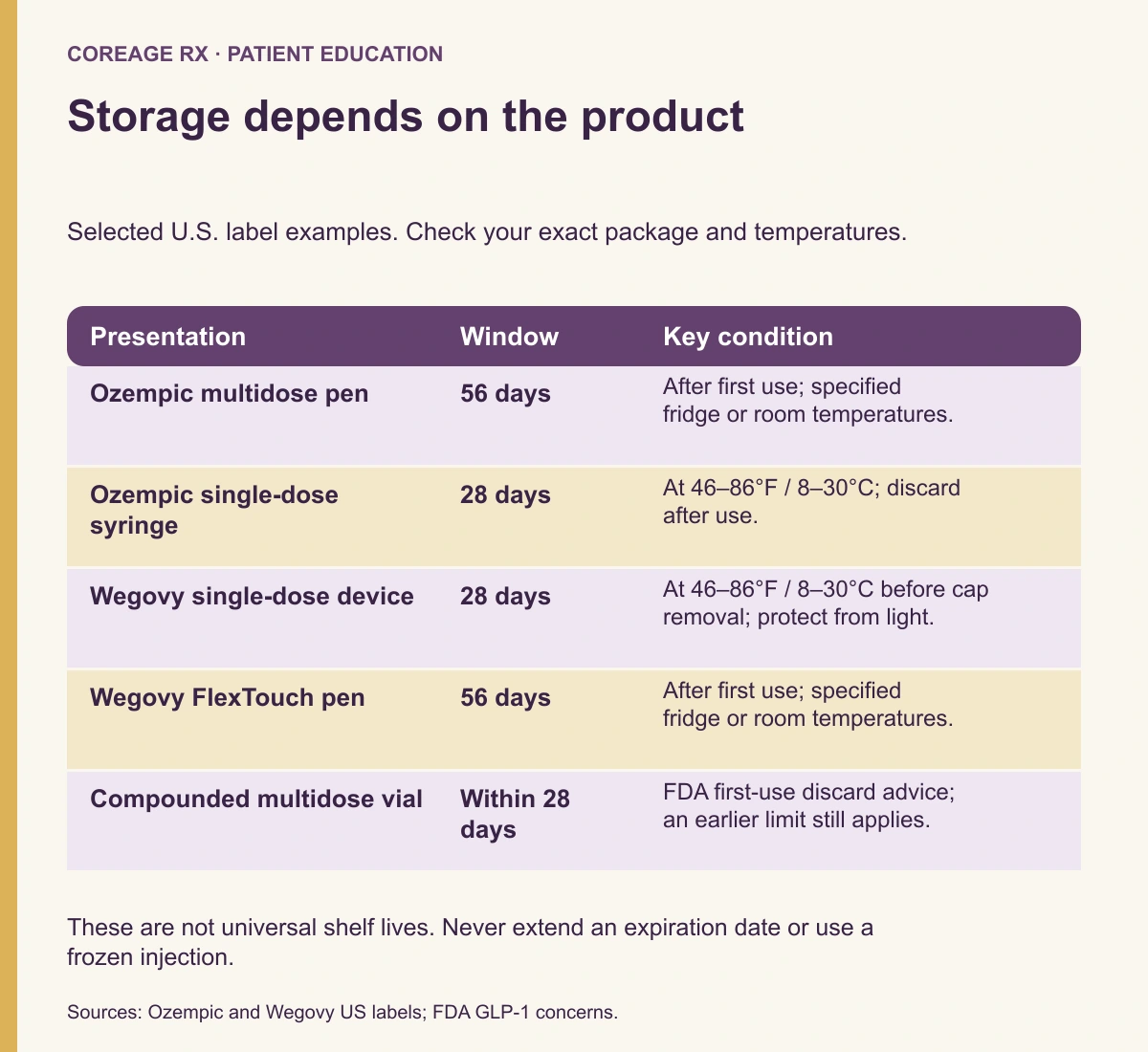
Current U.S. branded-product examples
The table summarizes selected instructions in the current Ozempic injection label and Wegovy label. It does not replace the instructions for your package, and it does not extend a printed expiration date.
| Product and presentation | Refrigerated storage before use | Relevant allowance outside that initial condition |
|---|---|---|
| Ozempic multidose pen | 36–46°F / 2–8°C before first use | After first use: up to 56 days refrigerated or at 59–86°F / 15–30°C |
| Ozempic single-dose prefilled syringe | 36–46°F / 2–8°C | May be kept at 46–86°F / 8–30°C for up to 28 days; discard after use |
| Wegovy single-dose pen or syringe | 36–46°F / 2–8°C | Before cap removal: up to 28 days at 46–86°F / 8–30°C, with the required light protection |
| Wegovy FlexTouch multidose pen | 36–46°F / 2–8°C before first use | After first use: up to 56 days refrigerated or at 59–86°F / 15–30°C |
| Wegovy tablets | Refrigeration is not the labeled routine | Store at 68–77°F / 20–25°C; permitted excursions 59–86°F / 15–30°C, dry and in the original bottle |
The injection labels say not to freeze the medicine or use it if it has been frozen. Keep the appropriate carton or cap in place as instructed to protect the product from light. For multidose pens, remove and safely discard the needle after each injection and store the pen without a needle attached.
Do not apply the tablet row to every oral semaglutide package without checking its own label. The oral semaglutide versus injections guide explains other differences between routes.
Why an unused pen and an in-use pen are different
An unopened Ozempic multidose pen is labeled for refrigeration before first use. Its 56-day rule describes storage after first use under specified conditions. It should not be casually reinterpreted as permission for any unopened shipment to spend 56 days anywhere below an assumed room temperature.
Once you first use a multidose pen, record the date and the applicable discard date. Keeping it refrigerated afterward does not erase the first-use clock. A medicine can also reach its printed expiration date before an otherwise allowed in-use period ends.
Similarly, the 28-day allowance for specified single-dose devices is tied to the product’s stated temperatures and handling conditions. It does not permit repeated use of a single-dose device or establish that a damaged or overheated product is acceptable.
If you are unsure which presentation you have, our Ozempic pen guide can help you prepare the right device questions for the pharmacist.
Our guide to semaglutide vial labels and pharmacy questions separates total content, concentration, one dose, preparation instructions, current FDA multidose-vial advice and storage concerns.
Compounded semaglutide has a separate answer
A compounded vial does not inherit Ozempic’s 56-day pen allowance or Wegovy’s single-dose storage allowance. The ingredients, formulation, container, preparation process, and evidence supporting its beyond-use date may differ.
Ask the dispensing pharmacy for the required storage temperature, the beyond-use date before first use, and instructions after the first puncture. FDA’s current GLP-1 concerns page recommends discarding compounded multidose vials within 28 days after first use, even when a compounder’s labeling allows longer. An earlier applicable beyond-use date or shorter instruction is still a limit. See FDA’s guidance on unapproved GLP-1 drugs.
This means the answer is not “use the vial until it is empty.” Record first use, follow sterile handling instructions, and use a new sterile needle and syringe for each injection. If the label and current advice appear inconsistent, ask the pharmacy and prescriber to resolve the instructions rather than choosing the longest possible date.
The compounded GLP-1 guide explains the broader ingredient, quality, and pharmacy questions. Compounded products are not FDA-approved generics of the branded medicines.

What to do if a shipment arrives warm
Do not judge a temperature-sensitive shipment only by whether the liquid looks clear. Appearance cannot reconstruct the temperature history or establish potency and sterility.
FDA advises against using injectable GLP-1 products that arrive warm or inadequately refrigerated. Contact the dispensing pharmacy promptly. Provide the delivery time, packaging condition, any temperature indicator, how the package was stored after delivery, and the exact product details. Keep the packaging while the issue is being assessed.
A branded label may allow a defined period at specified temperatures, but that does not tell you how hot a delayed shipment became. The pharmacy needs to assess the actual situation and arrange an appropriate resolution. Do not assume that placing the product back in the refrigerator restores its verified quality or resets its allowed time.
If a dose is due while the problem is unresolved, ask the prescriber or pharmacist how to handle the interruption. Do not use a questionable product or double the next dose to compensate.
What if it froze or touched an ice pack?
The branded injection labels explicitly say not to use the medicine if it has been frozen. Thawing it does not reverse that instruction. Keep products away from the refrigerator’s cooling element and avoid arrangements that may put them directly against freezing surfaces.
For a compounded preparation, report possible freezing to the pharmacy and obtain instructions before use. Do not assume that a storage recommendation for a different vial, brand, or concentration applies.
An insulated bag can reduce temperature changes, but the bag itself does not prove that the required temperature was maintained. A cold pack can also create a freezing risk if packed incorrectly. Ask the pharmacist for a packing method suitable for the exact medicine and travel duration.
Plan travel around the product’s instructions
Before leaving, check whether your supply is unopened or already in use, the remaining expiration or beyond-use period, and the temperatures likely during the journey. Take the labeled package and written instructions so you can identify the medicine and obtain help if needed.
Think about the whole trip: the drive to the airport, time in a parked car, transfers, arrival delays, and storage at your destination. A car or an unattended bag can become much hotter or colder than the room you left. “Room temperature” in a label means a defined range, not every environment outside a refrigerator.
If you plan to use a hotel refrigerator, check that it maintains an appropriate temperature and does not freeze items near a cooling plate. A thermometer or temperature logger can provide useful information, but it cannot by itself establish that a medicine is acceptable after an excursion. The pharmacist or manufacturer still needs the product details and exposure history.
For flights, check the current airline and security rules for medication and cooling supplies directly before travel. Storage planning and airport screening requirements are separate questions.
What to do during a power outage
First identify the product and its current stage of use. Record when the outage began and any measured temperature information. Minimize unnecessary changes in storage while you seek product-specific advice, and avoid transferring the medicine to a place that may freeze it.
The relevant question is not simply how many hours the power was off. It is what temperatures the medicine reached, for how long, and which labeled allowances apply to that presentation. If you do not know the exposure, say so; guessing can create false reassurance.
Contact the dispensing pharmacist or manufacturer with the package details. If the medicine cannot be confirmed suitable, ask about replacement and how to handle the treatment gap. Our semaglutide missed-dose and restart guide explains why a prolonged interruption can require more than resuming an old schedule.

Can I tell whether semaglutide has gone bad?
Visible particles, an unexpected appearance, damaged packaging, or an unclear label are reasons to stop and ask the pharmacist. However, a normal-looking solution does not prove that a storage problem has caused no damage. Do not perform a “test dose” to see whether a questionable product still works.
Likewise, a stronger or weaker appetite effect cannot verify storage quality. Appetite and side effects vary for many reasons, and they are not an assay of the amount or integrity of medicine in the package.
If your question is about limited treatment response rather than a known handling problem, our semaglutide plateau guide can help organize a separate clinical review.
What if I accidentally used expired semaglutide?
Contact the dispensing pharmacist or prescribing clinician promptly with the exact product, printed expiration or beyond-use date, first-use date if applicable, storage history, dose and time of use, and any symptoms. FDA advises against using expired medicines because safety and effectiveness are no longer guaranteed; that general advice cannot establish what happened after your particular dose. Do not take another dose to compensate, assume the expired dose was ineffective, or continue using the supply without instructions. Severe symptoms require urgent or emergency assessment. Obtain a product-specific plan for the next scheduled dose and replacement supply. Don’t Be Tempted to Use Expired Medicines.
A simple storage record prevents confusion
Keep a short record with the product name and presentation, printed expiration or beyond-use date, first-use date if applicable, and any time outside the required storage conditions. Add the pharmacy’s contact number and retain its written instructions.
At each refill, check again. A change in brand, device, pharmacy, or formulation may change the instructions even when the active ingredient remains semaglutide. Do not carry an old discard rule forward automatically.
If you are exploring CoreAge Rx’s semaglutide care information, ask during the prescribing process which preparation will be dispensed and who handles storage or shipment questions. Clear instructions should arrive with the actual medicine, before you need to decide whether a package is safe to use.
Educational information for adults; individual treatment decisions require a qualified clinician. Sources checked September 27, 2026. Original AI-generated article illustrations depict fictional people and objects, not patient outcomes. Other editorial images are illustrative. Graphics summarize the cited sources.