
A compounded GLP-1 medication is a preparation made through compounding rather than supplied as an FDA-approved finished drug. Compounded semaglutide and tirzepatide may be considered for a specific patient’s medical need, but they are not FDA-approved generic versions of Ozempic, Wegovy, Mounjaro, or Zepbound. The pharmacy, formulation, prescription, concentration, and handling instructions all matter.
Before comparing prices, establish exactly what is being offered. A website may use a familiar ingredient name while selling a different formulation from the branded medicine whose clinical trials it describes. This guide explains the distinctions, the questions to ask, and the current FDA concerns that should be part of the discussion.
What compounding means
Compounding involves preparing a medicine to meet an identified patient’s needs, for example when an appropriate approved product cannot meet those needs. It can involve combining or altering ingredients or preparing a different dosage form. The medical reason and applicable requirements matter; compounding is not simply another name for manufacturing an approved generic.
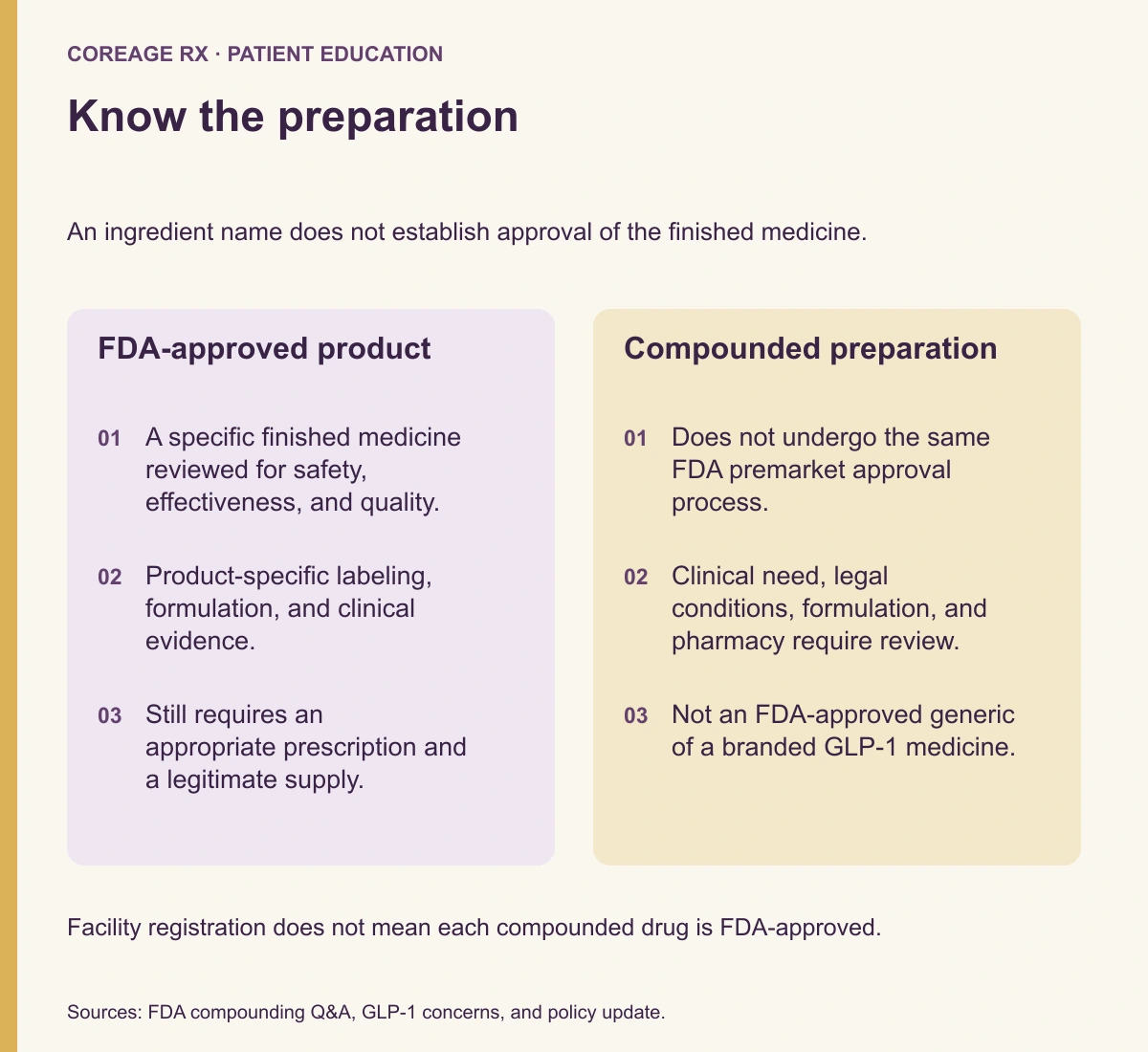
FDA-approved drugs undergo review for safety, effectiveness, and quality. Compounded drugs do not undergo that same premarket approval process. A generic drug also has an FDA approval pathway and requirements demonstrating its relationship to the reference medicine. A compounded vial does not gain generic status because its label uses the same ingredient name. The FDA’s compounding questions and answers explains this distinction.
The word “customized” should therefore lead to a specific question: what clinical need is this preparation intended to address for me? A marketing description alone does not answer it.
Approved brand, ingredient, and formulation are different facts
Semaglutide is an ingredient found in several approved products. Tirzepatide is the ingredient in Mounjaro and Zepbound. Each finished product has its own approved indications, strengths, route, device, labeling, and supporting evidence.
| Description | What it establishes | What still needs verification |
|---|---|---|
| An FDA-approved branded product | A specific reviewed finished medicine | Whether it is appropriate for your diagnosis and supplied legitimately |
| An FDA-approved generic | Approval through the applicable generic pathway | The exact product, strength, and prescription |
| A compounded preparation | A medicine prepared through compounding | Clinical need, legal conditions, ingredients, pharmacy, concentration, and quality |
| A “research use” peptide | A label claiming a research purpose | It does not establish an approved or appropriate medicine for a patient |
Our semaglutide and Ozempic comparison and Zepbound versus Mounjaro guide explain the ingredient-versus-brand distinction in more detail.
What changed after national shortages resolved?
Compounding rules include restrictions on making products that are essentially copies of commercially available or approved drugs. Shortage status can affect how those restrictions apply. Older advertisements discussing a national shortage should not be treated as current authorization for every preparation.
The FDA’s latest policy entry reviewed for this article, dated April 1, 2026, describes the stabilized national supply and the applicable restrictions. It distinguishes traditional compounding under section 503A from outsourcing facilities under section 503B. Patient-specific exceptions and other conditions can matter, but they are not a blanket permission to sell routine copies. See the FDA’s GLP-1 compounding policy update.
A local pharmacy being out of stock is not the same as an FDA national shortage designation. Likewise, a lower price or a preference for a different package does not by itself explain the medical need for a compounded product. Ask the prescriber and pharmacy to explain the basis for the proposed preparation in your case.
Does adding B12 make the medicine different enough?
An added vitamin does not automatically establish better effectiveness, fewer side effects, or an exemption from restrictions on essential copies. The FDA’s policy discussion specifically explains that combining ingredients can still result in a preparation considered an essentially copied product under the relevant analysis.
Ask what the additional ingredient is intended to accomplish, whether you have a documented need for it, and what evidence supports the combination actually being dispensed. Evidence about semaglutide alone cannot establish the safety or effectiveness of every semaglutide-and-vitamin mixture.
If a seller says a blend prevents nausea or guarantees superior weight loss, ask for evidence on that exact formulation. General information about vitamins or a branded GLP-1 trial is not the same evidence. The FDA’s concerns about unapproved GLP-1 drugs include uncertainty about these combinations.

Why semaglutide salt forms deserve attention
FDA has warned about products using semaglutide sodium or semaglutide acetate. These are different active ingredients from the semaglutide used in approved drugs. FDA states that it is not aware of a lawful basis for their use in compounding under the applicable conditions described on its concerns page.
A patient should not have to infer the ingredient from an advertisement. Request the actual dispensing label and ask the pharmacy to identify the active ingredient. Terms such as “pharmaceutical grade” or “same molecule” do not resolve a mismatch between the advertised product and the ingredient supplied.
This is also a reason to avoid injectable products sold without a prescription or labeled for research while being promoted for personal treatment. A certificate uploaded by a seller does not substitute for the relevant clinical and dispensing safeguards.
Verify the pharmacy as well as the telehealth service
A consultation company and a dispensing pharmacy may be separate organizations. Obtain the pharmacy’s legal name, physical address, telephone number, and license information. Verify the license through the appropriate state board rather than relying only on a badge on a sales page.
FDA recommends using online pharmacies that require a valid prescription, provide access to a licensed pharmacist, and have a verifiable U.S. address and phone number. Unexpected packaging, unclear labels, or a pharmacy name that cannot be confirmed should be resolved before use. See FDA advice on buying medicines online.
An FDA-registered outsourcing facility is not the same thing as an FDA-approved drug. Registration and inspection frameworks concern the facility and applicable standards; they do not approve each compounded formulation. Our online weight-loss prescription guide walks through the roles of the clinician, platform, and pharmacy.
Is Zepbound stronger than compounded tirzepatide?
“Stronger” is not an established universal comparison. An approved Zepbound product and an individually compounded preparation do not share the same FDA review of safety, effectiveness and manufacturing quality. Milligrams, milliliters and concentration are different measures, and a more concentrated liquid does not automatically provide more medicine in the prescribed dose. Identify the actual ingredient, formulation, pharmacy and directions; do not infer equivalence or change the amount from a price or potency claim.
Why concentration and syringe instructions matter
Our guide to tirzepatide reconstitution and vial-label questions explains why total milligrams do not define a mixing recipe and separates product identity, concentration, pharmacy instructions and sterile preparation.
The prescribed dose is usually expressed in milligrams. A vial’s concentration is expressed as an amount of drug per volume, such as milligrams per milliliter. Syringe markings indicate volume according to the syringe type. These are related quantities, but they are not interchangeable words.
The same number of syringe markings can represent a different dose when the concentration changes. A refill that looks similar may therefore require new instructions. Do not copy a measurement from a friend, an online chart, or an earlier vial without having the pharmacist confirm the exact prescription and equipment.
FDA has received reports of dosing errors with compounded injectable semaglutide, including errors requiring medical attention. Before the first dose, ask the pharmacy to demonstrate how the written dose corresponds to the supplied syringe. If the prescription, label, and instructions disagree, stop and resolve the discrepancy. Our semaglutide dosage chart guide explains why a universal units conversion is unsafe.
If you think you used too much, contact a clinician or Poison Control promptly rather than waiting for the next scheduled visit. Severe symptoms warrant emergency assessment.
Storage and shipping need their own review
Compounded preparations do not automatically inherit the storage allowances of a branded pen. Ask for written storage conditions, the beyond-use date, and the discard instructions after the vial is first used. Record the opening date where you can find it.
FDA’s current concerns page recommends discarding compounded GLP-1 multidose vials within 28 days after first use, even if the compounder’s label permits longer. A shorter applicable beyond-use date or other limiting instruction still matters. Do not extend use because liquid remains in the vial.
FDA also advises against using injectable GLP-1 products that arrive warm or inadequately refrigerated. Contact the dispensing pharmacy to resolve the shipment. Putting an uncertain shipment in the refrigerator does not establish that its quality has been restored. The semaglutide storage and travel guide separates these questions from approved-device storage rules.

Side effects still require clinical follow-up
Compounding does not eliminate the ingredient’s potential adverse effects. Nausea, vomiting, diarrhea, and other symptoms can occur, while concentration errors or quality problems introduce additional concerns. Reports to FDA cannot establish an exact side-effect rate because reporting is incomplete and a report does not by itself prove causation.
Persistent vomiting, inability to maintain fluids, severe abdominal pain, fainting, or allergic symptoms require prompt assessment. A clinician should review relevant medical history, pregnancy plans, other medicines, and the precise formulation before prescribing. If you are considering tirzepatide, our compounded tirzepatide side-effects guide covers related questions.
Do not let a seller’s assurance that a preparation is “gentler” replace a clear plan for responding to symptoms. Ask who answers urgent medication questions and which pharmacy can investigate a suspected quality or dosing problem.
A practical checklist before paying
Request these details in writing:
- The exact medicine, ingredients, concentration, dosage form, and dispensing pharmacy.
- The clinical reason an approved product cannot meet your needs appropriately.
- The full recurring cost, including visits, supplies, shipping, and follow-up.
- The prescription and product-specific measuring instructions.
- Storage, beyond-use, and first-use discard dates.
- What happens if a shipment arrives warm, a label is unclear, or symptoms develop.
Compare those answers with the available approved options and your insurance situation. A lower advertised price is only one part of the decision; it does not establish equivalent evidence or quality.
For a discussion of treatment through CoreAge Rx, review the semaglutide care information or tirzepatide care information. Confirm the exact formulation and pharmacy during the clinical process. An informed choice starts with knowing what will actually be prescribed and dispensed.
For a different substance often discussed online, our guide to KPV dosing claims and human evidence shows why laboratory findings and regulatory briefing documents cannot establish a human protocol. KPV is not a GLP-1 medicine, and this comparison does not establish that a KPV product is available or appropriate.
Check the preparation and dispensing source
- Choosing a tirzepatide compounding pharmacy — Verify the pharmacy, product, concentration, handling instructions, and clinical rationale.
- Oral tirzepatide approval and evidence — Separate approved injections, preclinical delivery research, and marketed oral preparations.
Educational information for adults; individual treatment decisions require a qualified clinician. Sources checked September 27, 2026. Original AI-generated article illustrations depict fictional people and objects, not patient outcomes. Other editorial images are illustrative. Graphics summarize the cited sources.