
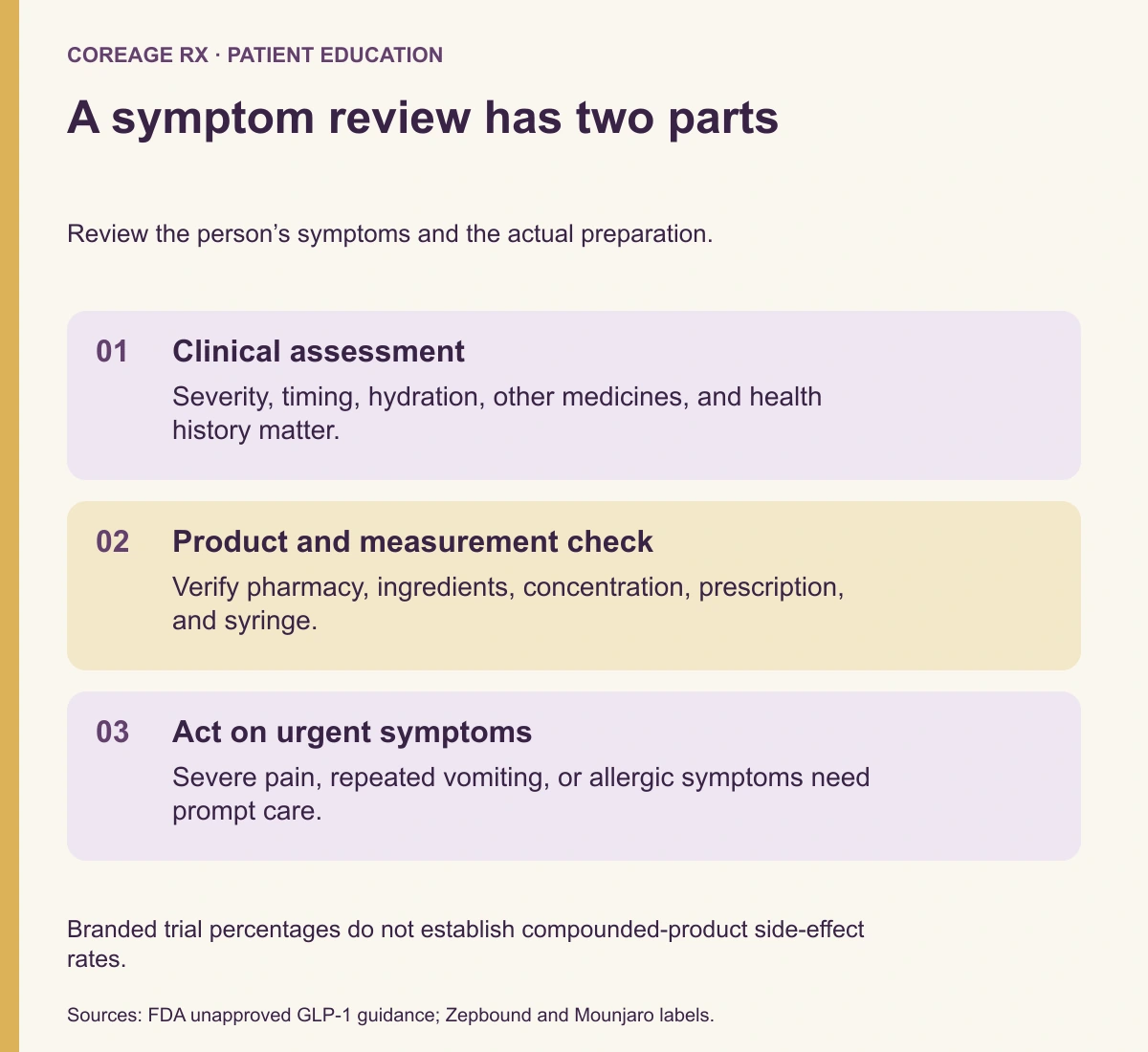
Compounded tirzepatide can raise two different safety questions: how your body responds to tirzepatide, and whether the particular preparation has been made, labeled, stored, and measured correctly. Nausea or constipation may relate to the medicine’s effects, but an unexpected reaction also deserves a review of the product and dose.
Compounded tirzepatide is not FDA-approved Mounjaro or Zepbound. Those brands have product-specific clinical trials and prescribing information. Their side-effect percentages cannot establish the rate for a compounded preparation. The FDA’s current guidance on unapproved GLP-1 drugs explains these distinctions and the additional concerns with compounded products.
Start by identifying what you actually received
Save the pharmacy label, packaging, written instructions, and information about the dispensing pharmacy. The ingredient name alone does not identify the preparation’s concentration, added ingredients, storage requirements, or intended dose.
If a refill looks different, resolve the difference before using it. A new concentration may require different measurement instructions even when the prescribed amount of tirzepatide has not changed. A clinician or pharmacist should reconcile the prescription, vial, and syringe together.
Our tirzepatide questions guide covers broader treatment planning. This article focuses on symptoms and the extra questions that arise with compounding.
Which symptoms are associated with tirzepatide?
Approved tirzepatide labels describe gastrointestinal reactions including nausea, diarrhea, vomiting, constipation, abdominal discomfort, and indigestion. Other reactions depend on the product and study population. The Zepbound label, for example, also lists injection-site reactions, fatigue, burping, reflux, and hair loss among common reactions in its weight-management trials.
These findings help clinicians recognize possible ingredient-related effects. They do not prove that every symptom while using a compounded product is caused by tirzepatide, or that the compounded preparation has the same safety profile.
| Question | What the available evidence can tell you |
|---|---|
| Can tirzepatide cause digestive symptoms? | Yes. Approved-product trials and labeling document them. |
| What percentage of compounded-product users get nausea? | A branded trial percentage cannot answer this for an unspecified compounded preparation. |
| Does a symptom prove that the dose is correct? | No. Feeling nauseated or feeling nothing does not confirm identity, strength, or correct measurement. |
| Does an added vitamin prevent side effects? | An added ingredient does not establish that a specific mixture prevents tirzepatide reactions. |
| Does a report to FDA prove the drug caused the event? | No. Reports can identify concerns but may have incomplete information and other contributing factors. |
For the actual branded trial results, see Zepbound side effects and Mounjaro side effects. Their separate populations and indications matter.
Mild symptoms still deserve a workable plan
For mild nausea or uncomfortable fullness, smaller meals, a slower eating pace, and stopping before becoming overly full may help. Large, rich meals can be difficult to tolerate. Maintain fluid intake and ask for help if eating becomes so limited that normal activities or nutrition suffer.
The joint advisory on nutrition during GLP-1 treatment emphasizes individualized food and activity support. The aim is a sustainable pattern that meets nutritional needs, not simply eating as little as possible.
Track when symptoms start relative to the injection, meals, a refill, or a dose change. A short record is more useful than trying several new remedies at once. Our tirzepatide nausea and reflux guide and protein and muscle guide offer related questions for follow-up.
Persistent symptoms, a worsening pattern, or difficulty drinking warrant contact with the care team. Do not make an upcoming increase automatic because a calendar says it is time. The prescriber needs to review tolerability and the treatment plan.
Symptoms that need urgent attention
Trouble breathing, swelling of the tongue or throat, collapse, or signs of a severe allergic reaction require emergency help. Stop using the medicine and seek medical assistance.
Severe, persistent abdominal pain, sometimes extending to the back and occurring with or without vomiting, can indicate pancreatitis. Seek urgent assessment and do not take another dose until the clinician advises you. Upper abdominal pain with fever, yellowing of the skin or eyes, or pale stools can signal a gallbladder problem.
Repeated vomiting, inability to keep fluids down, very little urine, fainting, or marked weakness can reflect dehydration or another serious problem. Approved tirzepatide labeling warns about kidney injury related to volume depletion. Severe constipation accompanied by vomiting, a swollen abdomen, or inability to pass gas also needs urgent evaluation.
Low glucose is a particular concern when tirzepatide is combined with insulin or medicines such as sulfonylureas. Confusion, seizures, or unconsciousness require emergency care. Have the diabetes team provide an individualized glucose-monitoring and low-glucose treatment plan. These examples come from approved tirzepatide safety information and are not a complete list of possible emergencies.

Why “units” can cause confusion
Milligrams describe the amount of medication. Milliliters describe the volume of liquid. Marks called units on a syringe are a measurement scale; they do not independently identify how much tirzepatide is in that liquid.
The same syringe mark can represent different medication amounts when concentrations differ. This is why a dosing screenshot from another person, a previous refill, or a different pharmacy is an unsafe substitute for instructions matched to the current vial.
Ask the pharmacist to write and demonstrate the prescribed medication amount and corresponding measurement for the exact concentration and syringe supplied. Do not calculate a conversion from this article. If the instructions conflict or omit essential information, pause and get a clear answer before administering the product.
FDA has received reports involving measurement errors with compounded semaglutide and reports involving compounded semaglutide or tirzepatide prescribed beyond approved-label doses or escalation schedules. Some involved serious symptoms and medical treatment. That warning supports careful verification; it does not mean every compounded reaction is an overdose. Source: FDA dosing concerns.
What if you think you took the wrong amount?
Contact the prescribing team or a poison-control service promptly, even if symptoms have not yet become severe. In the United States, Poison Control is available at 1-800-222-1222. Use emergency services for severe symptoms.
Keep the vial, label, syringe information, estimated amount, and time of administration available. Do not repeat the injection to compensate for uncertainty, and do not try to counteract it with another medicine without professional direction.
The same principle applies after missed doses or an interruption: ask for a restart plan. Our tirzepatide missed-dose and restart guide explains why the time since the last dose and prior tolerance matter.
Storage and contamination are separate safety issues
FDA advises against using injectable GLP-1 products that arrive warm or without adequate refrigeration. Contact the dispensing pharmacy about the shipment and keep the product out of use while the issue is resolved.
The agency’s current guidance also recommends discarding multidose compounded GLP-1 vials within 28 days after first use, even if liquid remains or a compounder’s instructions allow longer. Record the first-use date and use a new sterile needle and syringe for every dose. These recommendations concern contamination risk; they are not the same as the handling instructions for a branded pen. Source: FDA multidose-vial and shipping guidance.
Redness at an injection site can have different causes. Spreading redness, increasing pain, warmth, drainage, fever, or feeling unwell should be evaluated. A photograph may help the clinician understand the change, but it does not replace examination when infection or a serious reaction is possible.
Review health history and other medicines
The tirzepatide boxed warning concerns thyroid C-cell tumors in rodents; whether this risk applies to humans is unknown. Approved products are contraindicated with a personal or family history of medullary thyroid carcinoma or multiple endocrine neoplasia syndrome type 2. A different thyroid diagnosis should be discussed specifically rather than treated as interchangeable with those conditions.
Also disclose pancreatitis or gallbladder history, severe stomach-emptying problems, kidney problems, diabetic retinopathy, and every prescription, supplement, and nonprescription drug. Do not combine a compounded preparation with Mounjaro, Zepbound, or another GLP-1 medicine unless the prescribing team has explicitly reviewed the regimen.
Tell surgical and anesthesia teams about treatment because delayed stomach emptying may affect aspiration risk. Obtain their procedure-specific instructions. Pregnancy or plans for pregnancy require a prompt medication review.
Approved tirzepatide labeling advises people using oral hormonal contraception to switch to a nonoral method or add a barrier method for four weeks after starting and four weeks after each dose increase. Discuss how that precaution applies to your treatment. See tirzepatide and birth control.

Questions to take to the pharmacy or prescriber
- Which pharmacy compounded this preparation, and how can I contact its pharmacist?
- What medical need is this preparation intended to address that an approved product cannot meet?
- What are the exact ingredients, concentration, prescribed amount, and matching syringe measurement?
- What should I do if a shipment, label, or refill differs from the previous one?
- Who answers symptom questions after hours, and what should prompt urgent care?
- When should the current vial be discarded, and when is follow-up scheduled?
FDA recommends compounded drugs only when a patient’s medical needs cannot be met by an approved drug. If you are considering CoreAge Rx’s tirzepatide service, ask these same questions of our team. A product or service description should not substitute for identifying the preparation you would actually receive.
Frequently asked questions
Is less nausea proof that a compounded version is safer?
No. Symptoms vary with the person, dose, timing, and other factors. A personal comparison cannot establish quality or comparative safety.
Can I use vitamins or supplements to prevent reactions?
There is no universal supplement that makes tirzepatide risk-free. Review the actual symptom and any nutritional gap before adding products. Our supplements during GLP-1 treatment guide explains that approach.
Should an adverse reaction be reported?
Tell the clinician and dispensing pharmacy. Suspected medication reactions and quality problems can also be reported through FDA MedWatch. Reporting helps identify safety concerns, even when the cause is not yet certain.
Educational information for adults; individual treatment decisions require a qualified clinician. Sources checked September 26, 2026. Original AI-generated article illustrations depict fictional people and objects, not patient outcomes. Other editorial images are illustrative. Graphics summarize the cited sources.