
Finasteride can cause sexual side effects, and its labeling also includes reports of depression, suicidal thoughts or behavior, and sexual symptoms that continued after stopping treatment. That does not mean everyone will experience these problems. It does mean that a useful treatment discussion should include what to watch for and how to get help.
The product matters. Oral finasteride 1 mg is used for male pattern hair loss, while 5 mg products are used for benign prostatic hyperplasia, or an enlarged prostate. Compounded topical sprays and solutions are a separate category. Their risks should not be dismissed simply because they are applied to the scalp.
This guide uses the current U.S. finasteride 1 mg prescribing information and the FDA’s warning about compounded topical finasteride. It focuses on questions adults can discuss with their prescriber, not on selecting a dose or diagnosing the cause of a symptom.
What does finasteride do?
Finasteride inhibits an enzyme involved in converting testosterone to dihydrotestosterone, usually called DHT. That action explains its use in male pattern hair loss and, at a different approved dose, enlarged-prostate treatment.
Changing DHT signaling is a pharmacologic effect. Describing a product as a hair treatment does not mean its effects are limited to hair follicles, and describing a symptom as hormonal does not establish its cause.
The first step when reviewing a concern is to identify the actual product: tablet strength, topical concentration if applicable, other ingredients, start date, and any recent changes. A combined topical product containing minoxidil and finasteride needs a review of both ingredients and the complete preparation.
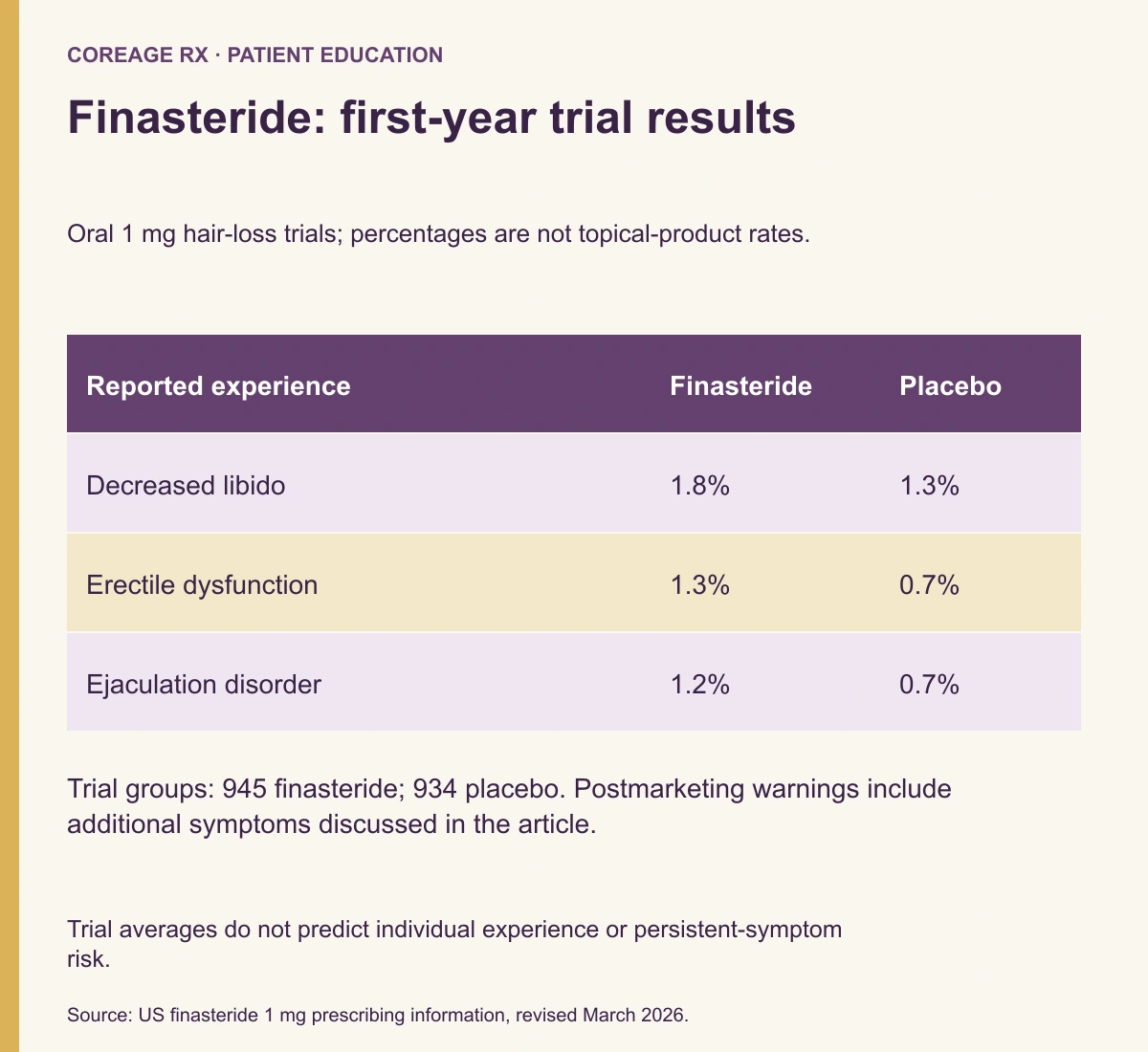
How common were sexual side effects in the 1 mg trials?
The labeling reports the following drug-related adverse experiences during the first year of male pattern hair-loss trials. These percentages describe the studied oral 1 mg product and population; they are not reliable estimates for every user or for compounded topical products.
| Reported experience | Finasteride 1 mg | Placebo |
|---|---|---|
| Decreased libido | 1.8% | 1.3% |
| Erectile dysfunction | 1.3% | 0.7% |
| Ejaculation disorder | 1.2% | 0.7% |
In the integrated analysis, 3.8% of men receiving finasteride and 2.1% receiving placebo reported one or more of these experiences. The trial groups included 945 and 934 men, respectively. Source: label, clinical-trials section.
Those numbers deserve context. A group average does not predict whether a particular person will have symptoms. Trial definitions, follow-up, and the population affect what is measured. The placebo group also reported symptoms, which reminds us that sexual function can change for several reasons; it does not make a new symptom during treatment unimportant.
What if libido, erections, or ejaculation change?
Tell the prescriber what changed and when. “Sexual side effects” can refer to different experiences: less interest in sex, difficulty getting or maintaining an erection, a change in ejaculation, or difficulty with orgasm. Clear descriptions help the clinician assess the problem.
Useful details include whether symptoms began before treatment, whether they are consistent or intermittent, any change in dose or formulation, and other medicines or major health changes. Bring a full medication list rather than assuming that one product must be the only explanation.
Do not feel obliged to tolerate a problem because the treatment is elective or because a trial percentage looks small. Equally, avoid adding another medicine on your own to cover up the symptom. If you are exploring CoreAge Rx’s 4Play product information, discuss the suspected medication effect and complete medical history first. It is not an antidote to finasteride, and adding treatment is not a substitute for reviewing the cause.
Can symptoms continue after finasteride is stopped?
The postmarketing section of the oral label includes sexual dysfunction that continued after discontinuation, including erectile, libido, ejaculation, and orgasm disorders. It also includes reports of male infertility or poor semen quality, with improvement reported after discontinuation in some cases. Source: finasteride label.
Postmarketing reports are different from a randomized trial. They help identify potential problems, but the number of reports does not by itself show how frequently an event occurs or establish the cause of every reported case. The label explicitly notes those limitations for voluntarily reported reactions.
Persistent symptoms still warrant a clinical evaluation. A useful plan considers timing, other possible contributors, the impact on daily life, and appropriate follow-up. Neither “it always goes away immediately” nor “it will definitely be permanent” is a responsible prediction for an individual.

Mood changes need attention
Depression and suicidal ideation or behavior appear in the oral product’s postmarketing labeling. If you notice a significant change in mood after starting treatment, contact the prescriber promptly and explain the timing and severity. Discuss the medication plan directly rather than waiting for a routine refill.
If you are thinking about suicide, feel unable to stay safe, or may act on thoughts of self-harm, seek immediate help. In the U.S., call or text 988; call 911 for an immediate emergency. Do not wait for an online message response or a scheduled hair-loss appointment.
It can be helpful to tell someone you trust that you are having difficulty. A medication discussion and mental-health support can happen together; you do not need to prove which factor caused the symptoms before receiving care.
Is topical finasteride free of systemic side effects?
No. FDA states that absorption through the skin into the bloodstream is expected. Its safety communication describes reports involving compounded topical finasteride, including sexual symptoms, anxiety, depression, and other complaints. It also states that there is currently no FDA-approved topical finasteride product in the United States. Source: FDA communication.
The agency identified 32 reports submitted between 2019 and 2024. That is a safety signal, not an incidence rate: without knowing how many people used the products, how consistently events were reported, and other clinical details, the reports cannot tell you the percentage of users affected.
Topical products can also cause local irritation, dryness, scaling, stinging, or burning. Concentrations, vehicles, instructions, and additional ingredients may differ. Do not assume that an oral trial percentage applies to a spray, or that changing the route eliminates the need for informed consent and follow-up.
Why pregnancy exposure and transfer matter
Finasteride is contraindicated during pregnancy because of the potential risk to the development of a male fetus. The oral labeling advises that people who are pregnant or may become pregnant should not handle crushed or broken tablets. An intact tablet’s coating prevents contact with the active ingredient during normal handling.
Topical preparations create a different exposure concern because applied product may transfer to another person. FDA specifically highlights this issue for compounded topical finasteride. Ask the prescriber and dispensing pharmacy for written instructions about application, drying, handwashing, surfaces, and contact with other people. Do not invent a safe waiting period from an unrelated product’s directions.
If unintended exposure occurs during pregnancy, contact a healthcare professional promptly for advice about the specific exposure. Keep the product details available so the clinician can identify what was involved.
Other symptoms and monitoring questions
The label includes reports of breast tenderness or enlargement, testicular pain, blood in semen, and hypersensitivity reactions. A new breast lump, nipple discharge, or persistent breast change should be discussed with a clinician. Signs of a serious allergic reaction, such as swelling of the tongue or throat or difficulty breathing, need urgent medical care.
Finasteride also lowers prostate-specific antigen, or PSA. Tell the clinician interpreting a PSA test that you take it, including the product and dose. A result cannot be interpreted properly if the medication history is missing. Do not try to adjust your own laboratory result using an internet formula.
The prescribing information also discusses a high-grade prostate-cancer signal from studies using 5 mg in a different population. That finding needs its own context; it should not be presented as a percentage risk established by the 1 mg hair-loss trials.

Prepare a useful follow-up conversation
Write down the product, start date, symptom timeline, other medication changes, and the outcomes that matter to you. Ask which symptoms require urgent care, which require a prompt treatment review, and how long the team expects to follow the concern.
If the question is whether symptoms indicate low testosterone, a symptom alone cannot make that diagnosis. Our guides to low-testosterone symptoms and testing and overlapping effects of stress and poor sleep explain why a separate evaluation may be needed. Finasteride use does not automatically mean testosterone replacement is appropriate.
For the practical budget discussion, compare finasteride cost by strength, quantity and payment route. It includes a dated public example and explains additional care fees, oral versus topical formulations and why a lower quote does not authorize a strength change.
Frequently asked questions
Are 1 mg and 5 mg side-effect rates interchangeable?
No. The products are used for different indications and were studied in different populations. Use the data that match the treatment being discussed, with attention to how the study measured adverse events.
Does taking less or using it less often remove the risks?
Do not assume that an improvised schedule eliminates adverse effects or preserves benefit. Discuss changes with the prescriber. This is particularly important when a compounded topical product’s amount and concentration are not the same as a tablet dose.
Can I report a suspected reaction even if I am unsure of the cause?
Yes. FDA encourages reporting suspected adverse events and product-quality problems through MedWatch. Reporting does not replace medical care. Include the exact product, dates, symptoms, and dispensing information when available.
What is the most useful question before starting?
Ask how the expected benefit compares with the risks that matter to you, what symptoms to watch for, and how the team will respond if a problem appears. A clear follow-up plan is part of the prescription.
Educational information for adults; individual treatment decisions require a qualified clinician. Sources checked September 26, 2026. Original AI-generated article illustrations depict fictional people and objects, not patient outcomes. Other editorial images are illustrative. Graphics summarize the cited sources.
Considering another hair-loss treatment?
- Minoxidil side effects: topical and oral treatment — Compare product-specific warnings and the separate questions raised by off-label oral use.