
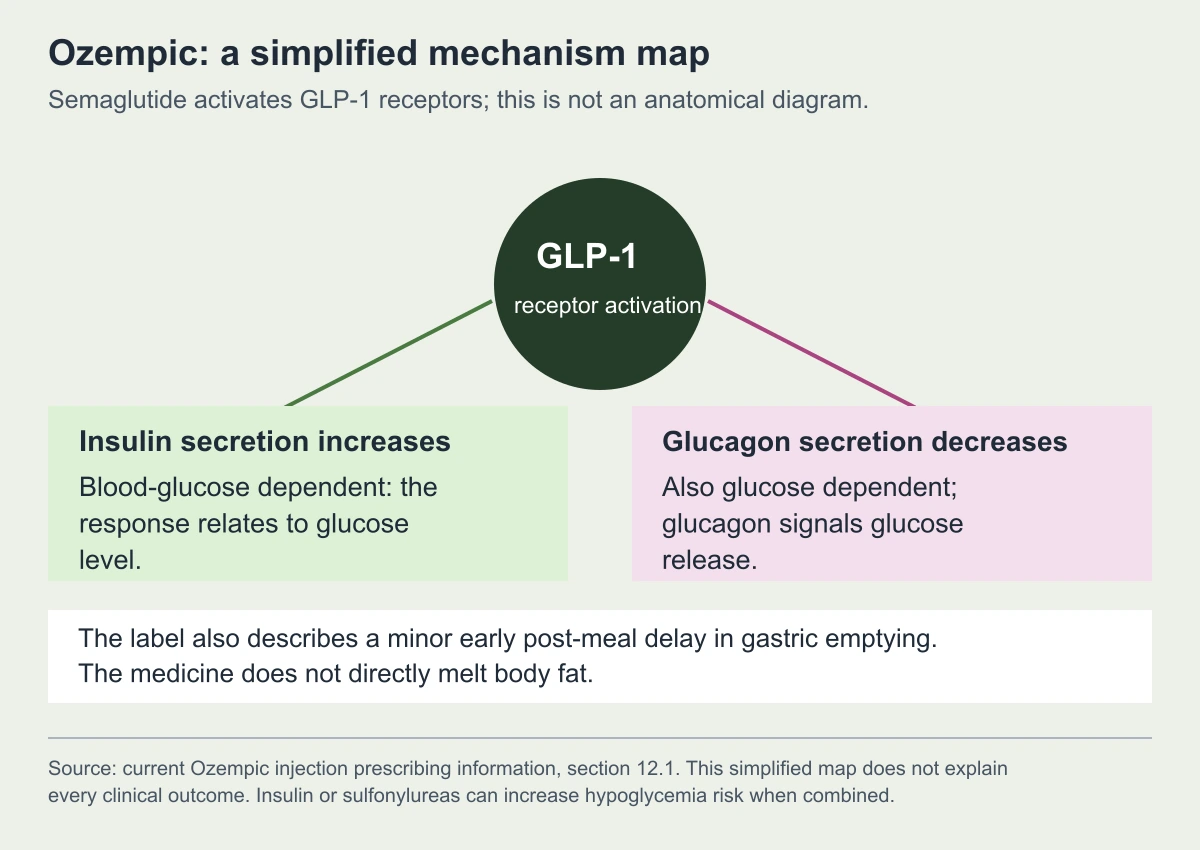
Ozempic contains semaglutide, a medicine that activates receptors for the naturally occurring hormone GLP-1. The Ozempic injection label explains that it lowers blood glucose by increasing insulin secretion and reducing glucagon secretion in a glucose-dependent way. It also describes a minor delay in stomach emptying early after a meal. Ozempic prescribing information.
Those effects are different from supplying insulin or directly “melting” body fat. Appetite, body weight, blood glucose and the medicine’s approved indications are related questions, but they are not interchangeable. Start with the exact product and the reason your clinician prescribed it.
What is GLP-1, and what is a receptor agonist?
GLP-1 stands for glucagon-like peptide-1. It is a physiological hormone with several actions relevant to blood glucose. A receptor is a receiving structure that responds to a signal. An agonist is a substance that binds to a receptor and activates it.
Semaglutide is a GLP-1 analogue that selectively activates GLP-1 receptors. “Analogue” means it is related to the naturally occurring signal, with modifications that affect its behavior as a medicine. The label describes albumin binding and protection from degradation as reasons for its prolonged action. Ozempic clinical pharmacology.
A receiving-loop illustration can help picture signaling, but it is a metaphor rather than a real receptor structure. For the broader introduction to this medication class, read what GLP-1 means. The class name does not establish that every GLP-1 product has the same dose, device or approved purpose.
How does Ozempic affect insulin and glucagon?
Insulin and glucagon serve different roles in regulating glucose. The Ozempic label describes increased insulin secretion and reduced glucagon secretion when blood glucose is high. These glucose-dependent effects help lower blood glucose. Ozempic mechanism information.
“Glucose dependent” is important, but it does not mean hypoglycemia is impossible. The label warns that using Ozempic with insulin or an insulin secretagogue, such as a sulfonylurea, can increase the risk of low blood glucose. The prescriber may need to review the other diabetes treatment and monitoring plan.
Do not stop or change insulin because semaglutide has an insulin-related effect. It is a different medicine, and the combination question requires the prescribing team’s instructions. Ask how low glucose would be recognized and what response plan applies to you.
| Mechanism question | Label-based explanation | Practical limitation |
|---|---|---|
| Does it supply insulin? | It contains semaglutide and can stimulate insulin secretion. | It is not a replacement instruction for a prescribed insulin regimen. |
| Does it affect glucagon? | It reduces glucagon secretion in a glucose-dependent manner. | This does not independently explain every clinical benefit. |
| Does glucose dependence eliminate low-glucose risk? | The response relates to glucose level. | Concomitant insulin or sulfonylureas can increase hypoglycemia risk. |
| Does it slow stomach emptying? | The injection label describes a minor early post-meal delay. | Do not interpret this as a fixed delay for every meal or person. |
What does stomach emptying have to do with treatment?
Stomach emptying describes movement of stomach contents onward through the digestive tract. The injection label describes a minor delay early after a meal as part of its blood-glucose-lowering mechanism. It also cautions that delayed emptying can affect absorption of oral medicines. Ozempic prescribing information.
This should not be exaggerated into a claim that food always remains in the stomach for a specified number of extra hours. Effects depend on the medicine, circumstances and assessment method. A mechanism summary is not a diagnosis of the cause of someone’s digestive symptoms.
Tell the clinician about other medicines and significant gastrointestinal problems. Also tell a procedure team that you use a GLP-1 medicine before anesthesia or deep sedation. The label discusses rare postmarketing aspiration reports and notes that the appropriate approach requires the treating team’s assessment. Do not invent your own fasting or medication-withholding schedule.
The semaglutide nausea and vomiting guide addresses tolerability questions. Nausea is an adverse-effect question, not a measurement of how well the medication is lowering glucose.
Why can appetite and weight change?
Semaglutide’s weight-related effects involve more than a simple image of a slower stomach. Wegovy’s semaglutide label describes GLP-1 as a regulator of appetite and calorie intake and describes reduced calorie intake, likely mediated by appetite effects. That is information about the active ingredient in a separate labeled product; it does not make the products’ doses or indications interchangeable. Wegovy pharmacology.
A 2021 double-blind trial in 72 adults with obesity assessed weekly semaglutide escalated to 2.4 mg over 20 weeks. The published abstract describes reduced hunger, increased fullness and lower intake during a study meal compared with placebo. It also reports no evidence of delayed gastric emptying at week 20 using its indirect paracetamol-absorption method. Original trial abstract.
The study helps explain why “it works only by keeping food in the stomach” is too simplistic. It does not predict an individual’s appetite response, prescribe how much to eat or establish the same result for an Ozempic starting dose or a compounded preparation.
If appetite decreases, nutrition still matters. The protein and muscle guide and balanced-meal guide provide questions to discuss when eating feels different during care.

What is Ozempic injection approved to treat?
The current U.S. injection label gives defined adult indications. It includes improving glycemic control alongside diet and exercise in adults with type 2 diabetes. It also includes cardiovascular risk reduction in adults with type 2 diabetes and established cardiovascular disease, and specified kidney-related risk reduction in adults with type 2 diabetes and chronic kidney disease. Ozempic indications.
Those population details should not be dropped from a headline about “heart protection” or “kidney protection.” The label also states that the mechanism of kidney-related risk reduction has not been established. A glucose-mechanism diagram cannot claim to explain that benefit fully.
Weight change can occur during treatment, but the injection’s labeled indications are not a blanket approval to prescribe it solely for weight loss in everyone. Wegovy has its own labeling and treatment criteria. The semaglutide versus Ozempic guide explains why an active-ingredient name and a brand name answer different questions.
Why is the injection taken weekly?
Semaglutide has a prolonged action, and the Ozempic injection label specifies once-weekly administration. The label describes an approximately one-week half-life. Half-life is a pharmacokinetic measure of how the drug amount changes over time; it does not mean that the medicine disappears completely at the end of seven days. Ozempic label.
Weekly administration also does not mean that a missed dose, dose increase or restart can be improvised. Follow the prescription and product-specific instructions. The Ozempic dosage guide explains labeled dose questions, while the pen guide distinguishes strength, total pen contents and device instructions.
The mechanism is not a reason to increase a dose faster in pursuit of more appetite suppression. Benefit and tolerability need assessment, and the prescribed indication affects the treatment plan.
How soon should you expect it to work?
Avoid using the first change in appetite or a single glucose reading as the complete assessment. Your clinician should explain which outcomes matter for the prescribed indication and when they will be reviewed. That may include glucose records, laboratory measures, symptoms and tolerability rather than only body weight.
The starting phase and later maintenance treatment are different parts of the plan. Not feeling a dramatic appetite change immediately does not establish treatment failure. Equally, inability to eat or drink adequately should not be celebrated as evidence that the drug is working.
For practical starting questions, see the semaglutide first-month guide. For a sustained concern about response, the plateau guide can help organize follow-up. Neither replaces instructions from the prescriber for the exact product.

Do oral Ozempic and other semaglutide products work the same way?
The active ingredient is part of the explanation; the formulation determines how it is delivered and how it must be used. Current NovoCare materials describe Ozempic pill and pen offers. An oral prescription should not be used according to the weekly injection directions. NovoCare product and savings information.
Read the exact label and confirm which product the pharmacy dispensed. Do not infer equivalent dose, administration conditions or savings eligibility from a shared brand or ingredient name. The oral semaglutide versus injections guide discusses those distinctions.
Compounded semaglutide is a separate product-quality question. FDA explains that compounded drugs do not undergo the same premarket review as approved drugs and identifies dosing, handling and quality concerns. Mechanism similarity does not establish equivalent safety, effectiveness or approval. FDA guidance.
If cost affects the treatment conversation, the Ozempic GoodRx comparison guide explains how to match a prescription, pharmacy quote and payment route.
Ozempic’s mechanism does not make it an anticoagulant. Our review of Ozempic and blood-thinner questions separates warfarin research findings from clinical monitoring and explains why INR rules cannot be transferred to every anticoagulant.
How does the mechanism fit into choosing treatment?
Mechanism can help explain a medication’s role, but it cannot determine eligibility alone. Review the intended indication, health history, other medicines, tolerability, cost and follow-up. The GLP-1 selection guide and Ozempic cost guide address other parts of that decision.
CoreAge Rx’s semaglutide service page describes offered compounded care. Its preparation should not be assumed to share branded Ozempic’s FDA approval or product-specific trial evidence. Ask what product is being considered and what the clinician will monitor.
The central idea is GLP-1 receptor activation with several related effects—not direct fat removal, insulin replacement or a guaranteed appetite response. Understanding those distinctions makes it easier to ask useful questions and follow the instructions for the medicine actually prescribed.
Educational information for adults; individual treatment decisions require a qualified clinician. Sources reviewed September 30, 2026. Original AI-generated article images depict fictional people and objects, not patient outcomes. Other editorial images are illustrative. Graphics summarize the cited sources.