
Ozempic is not an anticoagulant or a substitute for a prescribed blood thinner. If you take warfarin or another medicine that affects clotting, starting Ozempic calls for a review of the exact prescriptions, changes in eating, symptoms, and the monitoring plan. A reassuring drug-interaction result does not remove that need.
Warfarin deserves particular attention because its effect is monitored with the international normalized ratio, or INR, and can change with medicines, illness, and dietary vitamin K. Evidence from a controlled semaglutide study and a newer real-world GLP-1 study helps explain why a direct absorption question differs from maintaining stable anticoagulation in everyday care.
For broader treatment questions, start with our semaglutide questions guide. This article does not provide individual clearance to combine medicines or a warfarin dose adjustment.
Is Ozempic a blood thinner?
No. Ozempic contains semaglutide, a GLP-1 receptor agonist. Its prescribing information describes effects on glucose-dependent insulin release, glucagon, and gastric emptying, with specific approved indications. Those are not instructions for preventing or treating blood clots with an anticoagulant. Ozempic prescribing information.
Warfarin is a vitamin K antagonist anticoagulant with a different role and monitoring requirements. A cardiovascular indication for a diabetes medicine should not be interpreted as permission to discontinue anticoagulation prescribed for another reason. Warfarin sodium prescribing information.
Also identify what you mean by “blood thinner.” People use the term for several medicines that do not share one mechanism or one monitoring method. The name, dose, indication, and other prescriptions are needed for a meaningful review.
If you cannot remember the medicine name, bring the bottle or dispensing list. An INR discussion specifically about warfarin should not be copied onto every medicine described casually as a blood thinner.
What the controlled semaglutide–warfarin study found
An original clinical pharmacology study evaluated oral warfarin before and during steady-state weekly subcutaneous semaglutide in healthy adults. It assessed exposure to warfarin and the INR response under controlled study conditions. Original semaglutide interaction study.
The investigators did not find a clinically relevant change in warfarin exposure or its measured anticoagulant response. This is useful evidence about a direct pharmacokinetic or pharmacodynamic interaction under the tested conditions.
The scope matters. Participants were healthy adults, the warfarin assessment used a single dose, and semaglutide was studied at a particular steady-state regimen. This was not a long-term trial of every anticoagulant in patients experiencing changing appetite, vomiting, fluctuating dietary intake, or multiple illnesses.
The current Ozempic label similarly says that studied oral medicines were not affected to a clinically relevant degree in clinical pharmacology trials, while advising caution because Ozempic delays gastric emptying. The findings support a specific conclusion about what was studied; they do not guarantee stable INR for every patient. Ozempic prescribing information.
What the newer real-world study adds
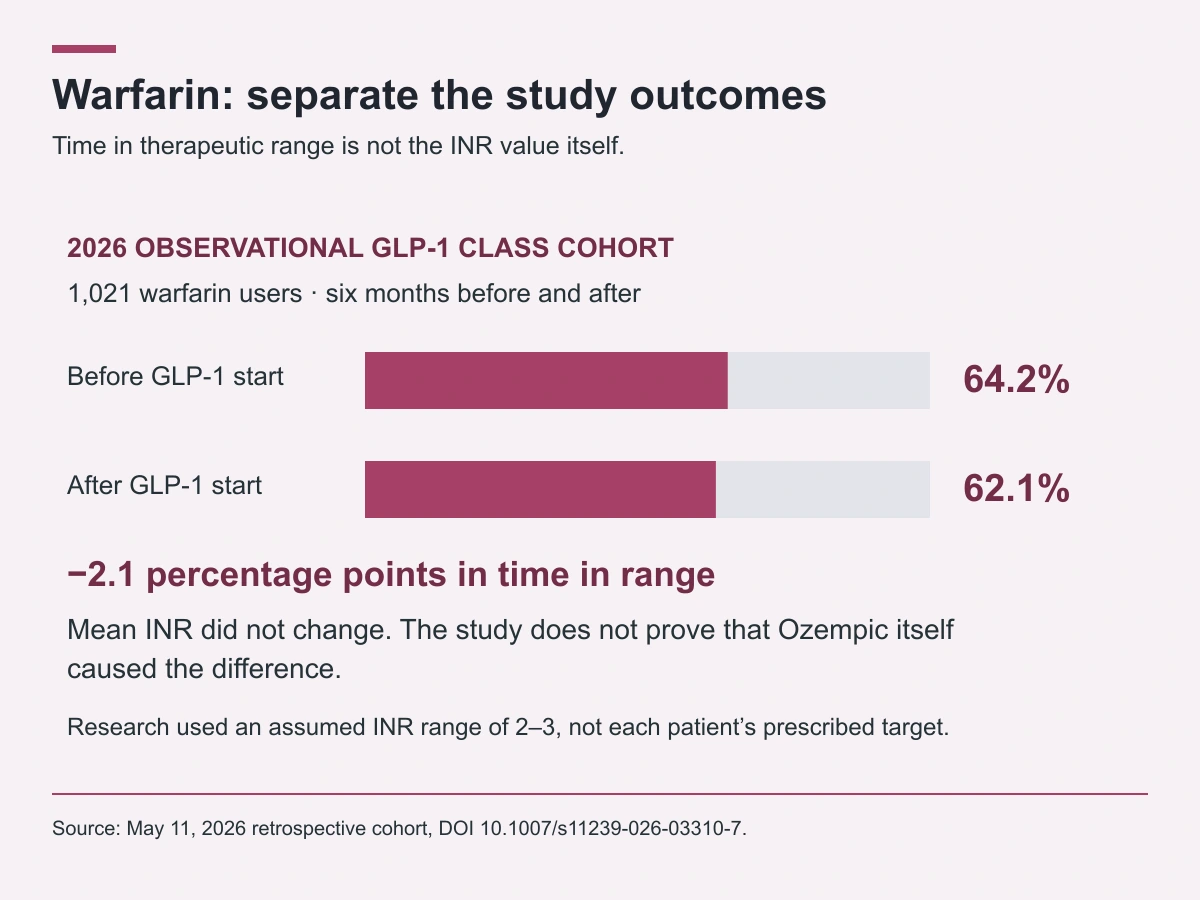
A study published in May 2026 examined 1,021 eligible warfarin-treated patients in a retrospective electronic-record cohort. It compared the six months before and after initiation of a GLP-1 receptor agonist. The source data extended through November 2024. Original real-world GLP-1 and warfarin study.
Average time in the therapeutic INR range fell from 64.2% to 62.1%, a decrease of 2.1 percentage points. Average INR did not change. The study therefore suggests a modest change in the proportion of time within range without showing a simple shift of everyone’s INR upward or downward.
The analysis concerned GLP-1 receptor agonists as a group, not Ozempic alone. It was observational and could not establish that the medicine caused an individual patient’s change. The researchers also lacked information on dietary vitamin K, medication adherence, warfarin dose changes, and GLP-1 dosing.
Because individual INR targets were unavailable, the analysis assumed a target range of 2.0 to 3.0 for its calculations. That research assumption is not a recommended target for every reader. Your anticoagulation team determines your own target. Original real-world study, Warfarin patient information.
Why the two studies are not contradictory answers
| Evidence | Main question | Finding and boundary |
|---|---|---|
| Controlled healthy-adult semaglutide study | Does the tested semaglutide regimen meaningfully alter warfarin exposure or measured INR response? | No clinically relevant change under those study conditions; not a long-term everyday-care guarantee |
| Retrospective GLP-1 cohort | Does INR control change after class treatment starts in patients already using warfarin? | Small average decrease in time within range; average INR unchanged; association rather than proof of causation |
| Current warfarin label | How should anticoagulation be monitored when medicines and relevant circumstances change? | Regular INR monitoring and additional assessment around medication changes; individual dosing and targets |
Absorption is only one part of anticoagulation control. Changes in food intake, illness, adherence, and the rest of the medication list can matter even when a controlled experiment does not show a meaningful direct interaction.
The real-world study also had selection limitations: patients needed enough follow-up and INR results to enter the analysis. It could underrepresent people who stopped treatment or had early serious complications. Its small average change should not be used to predict what will happen to you. Original real-world GLP-1 and warfarin study.

Appetite and vitamin K belong in the review
Warfarin’s label explains that dietary vitamin K can affect its action. It also identifies poor nutritional status and diarrhea among factors that can increase INR response, while increased vitamin K intake can decrease it. Warfarin prescribing information.
If treatment changes how much or what you eat, tell the anticoagulation team. Examples include eating much less overall, changing the amount of leafy vegetables, replacing meals with a shake, or beginning a vitamin-containing supplement. The important issue is the actual change in your routine.
Do not respond by eliminating nutritious foods or taking vitamin K to “balance” the medicines yourself. Ask for an eating plan that supports nutrition and a monitoring plan appropriate to your prescription. Our balanced meals guide can help organize meal questions, but it does not establish a warfarin-specific diet.
Bring supplements to the review too. The GLP-1 supplement guide explains why a product’s ingredients matter. A vitamin, herb, or powder should not be considered irrelevant simply because it is sold without a prescription.
Vomiting, diarrhea, and missed medicines need a clear plan
Ozempic can cause gastrointestinal symptoms, and its label warns about dehydration-related kidney injury. Persistent vomiting or diarrhea deserves assessment, particularly if it interferes with fluids, food, or regular prescriptions. Ozempic prescribing information.
If you vomit after taking an oral medicine, do not automatically repeat the dose. Tell the pharmacist or clinical team what you took and when, and ask for instructions. It may be unclear how much was absorbed; guessing can create another medication problem.
Likewise, ask what to do if illness interrupts either prescription. Warfarin and Ozempic have their own missed-dose directions, and their schedules are different. A missed weekly injection does not create a general rule for managing a daily anticoagulant.
Use the semaglutide nausea and vomiting guide for symptom questions and the semaglutide missed-dose guide for product distinctions. The anticoagulation team should provide the warfarin instructions.
INR is not the monitoring method for every blood thinner
Warfarin treatment uses INR to guide anticoagulation according to the patient’s target. Other anticoagulants require their own assessment; a stable INR cannot be treated as evidence that every such medicine is correctly dosed.
For example, the current Eliquis label states that changes in routine clotting tests such as PT, INR, and aPTT are not useful for monitoring apixaban’s anticoagulant effect. That distinction does not mean apixaban needs no clinical follow-up. It means the warfarin monitoring framework should not be transferred to it. Eliquis prescribing information.
If you use a different anticoagulant or an antiplatelet medicine, ask the prescriber or pharmacist to review that exact product with Ozempic and the rest of your list. The studies described above cannot provide a blanket safety guarantee for all blood-thinning medicines.
Do not switch anticoagulants, change doses, or stop one based on an article or a normal INR result. The reason for treatment and the product’s own instructions determine the plan.
Bleeding symptoms should not wait for the next routine check
Warfarin can cause serious or fatal bleeding, including when INR is within the intended range. Its patient information advises prompt contact for symptoms including unusual or enlarging bruises, bleeding that takes a long time to stop, blood in urine, red or black stools, coughing blood, or vomiting blood or material resembling coffee grounds. Warfarin prescribing and patient information.
Seek emergency help for severe or uncontrolled bleeding, collapse, or severe symptoms. Do not assume a new bleeding problem is an ordinary injection effect or wait for a routine appointment to investigate it.
For an injection-site concern, describe the amount and duration of bleeding, whether bruising is spreading, and any other bleeding. The clinician can assess the symptom and review injection instructions. The appearance of the injection site cannot tell you your INR.
Tell healthcare professionals that you use an anticoagulant when you seek care, including for abdominal pain or another illness. That information can change the assessment and the medicines they consider.

Questions to agree on before starting or changing treatment
Ask the anticoagulation team when the next INR should be checked and which changes should trigger an earlier call. The warfarin label calls for additional INR assessment when other medicines are started, stopped, or taken irregularly. It does not create one Ozempic-specific testing interval for every patient. Warfarin prescribing information.
Clarify who will receive INR results, who adjusts warfarin, and how the Ozempic prescriber will be informed. Bring a list of planned diet changes and all medicines, including antibiotics, pain relievers, and supplements.
The goal is a coordinated plan. You should know what to do if appetite changes substantially, vomiting occurs, bleeding develops, or either prescription is interrupted.
Common questions about Ozempic and blood thinners
Does Ozempic thin the blood?
It is not an anticoagulant and does not replace a blood thinner. Its labeled treatment roles and mechanism differ from warfarin’s clotting-related action. Ozempic prescribing information, Warfarin prescribing information.
Does starting Ozempic mean my warfarin dose must change?
Not automatically. The evidence supports attention to monitoring and relevant changes, not a universal preemptive dose adjustment. Follow the anticoagulation team’s instructions and INR results.
Is the 2.1-point study result my expected INR change?
No. It was an average change in time within a research INR range, not a 2.1-unit change in INR or a personal prediction. Average INR remained unchanged in that observational class-level analysis. Original real-world study.
Should I take the medicines several hours apart?
The reviewed sources do not establish a universal spacing workaround. Ask about your exact prescriptions and follow their directions. Monitoring, intake, and symptoms still matter.
Where can I learn about semaglutide treatment services?
CoreAge Rx’s semaglutide information and the semaglutide questions guide can help you prepare. Bring the complete anticoagulant prescription and your monitoring history to the clinical assessment.
Educational information for adults; individual treatment decisions require a qualified clinician. Sources reviewed October 2, 2026. Original AI-generated article images depict fictional people and objects, not patient outcomes. Other editorial images are illustrative. Graphics summarize the cited sources.