Sweet tea is not automatically a lower-sugar or lower-calorie choice than soda. The recipe, product, amount poured, and number of refills determine the comparison. A useful decision starts with the actual label and the portion you plan to drink, rather than the word “tea” on the bottle.
Some sweet teas contain less sugar than some sodas at the same volume; others do not. Unsweetened tea is a separate choice, and a home recipe can differ substantially from a bottled product. This guide uses two named U.S. products to show how equal-volume estimates and full-container amounts answer different questions.
For the broader daily pattern, see our water and drinks guide. No single beverage choice guarantees weight loss.
Compare the product and the portion together
“One drink” could mean an 8-ounce glass, an 18.5-ounce bottle, a 20-ounce soda, or a large restaurant cup with refills. Comparing those containers without their sizes can make the lower-sugar recipe look like the higher-sugar choice, or the reverse.
Start with four details: the exact product, its labeled serving size, sugar and calories per serving, and how much you actually consume. If the bottle contains more than one serving, the label’s per-serving amount is not the whole-bottle amount.
Check both total and added sugars. FDA explains that added sugars are included within total sugars. They are not extra grams to add a second time. Sugar, honey, and syrups used to sweeten drinks count as added sugars. FDA added-sugars label guidance.
The comparison below concerns standard sweetened products. A zero-sugar tea, unsweetened tea, diet soda, or a different flavor needs its own label.
Two actual manufacturer labels
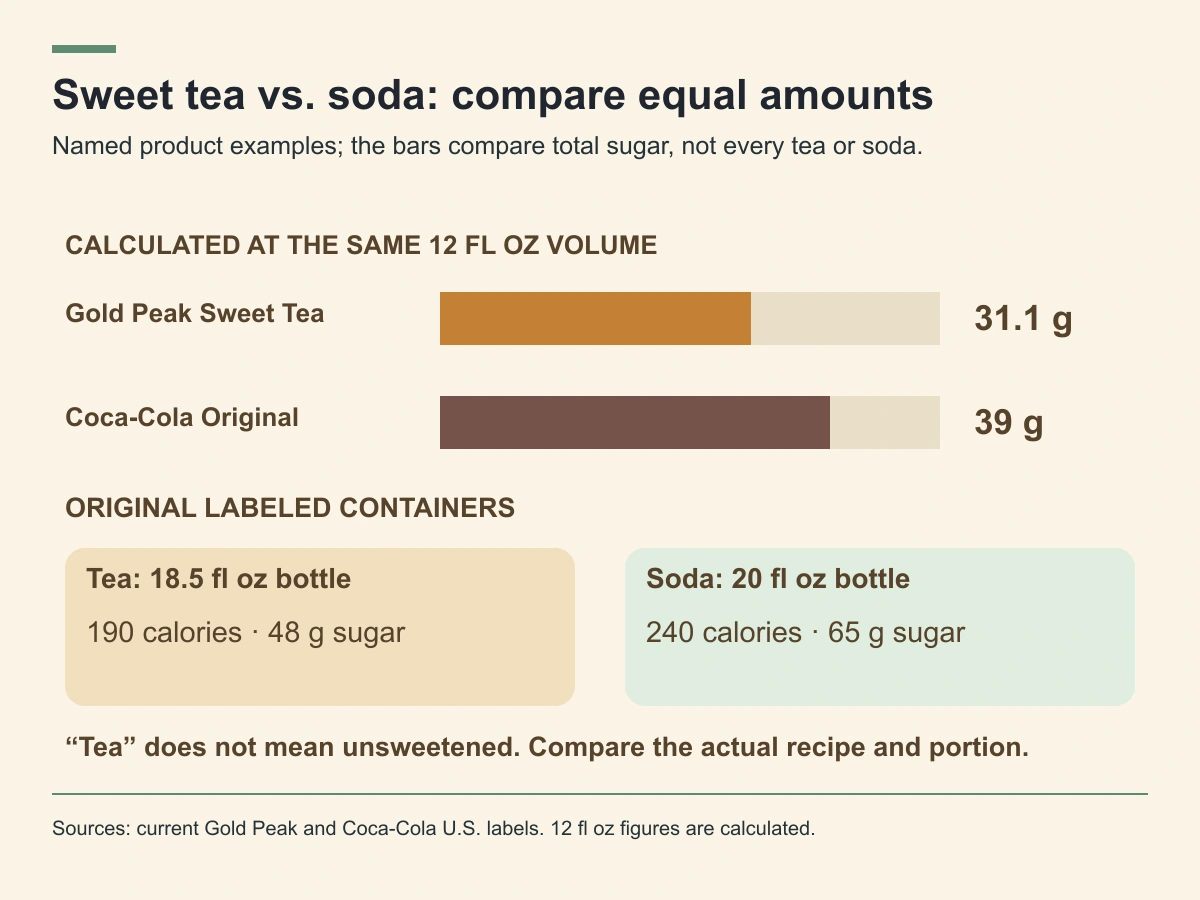
The current manufacturer pages list the following nutrition values for Gold Peak Sweet Tea and Coca-Cola Original in the specified bottle sizes. These are examples, not averages for every sweet tea or soda. Gold Peak product nutrition, Coca-Cola Original product nutrition.
| Named U.S. product | Label serving and container | Calories per container | Total sugars | Added sugars |
|---|---|---|---|---|
| Gold Peak Sweet Tea | One 18.5 fl oz bottle | 190 | 48 g | 48 g |
| Coca-Cola Original | One 20 fl oz bottle | 240 | 65 g | 65 g |
The Gold Peak bottle in this example supplies less sugar and fewer calories than the larger Coca-Cola bottle. That statement applies to the identified products and containers. It does not establish that all tea is the better choice, that either amount is your personal serving, or that the two bottle sizes are equal.
For reference, FDA’s Nutrition Facts Daily Value for added sugars is 50 grams on a 2,000-calorie reference diet. The listed bottles therefore show 96% and 130% of that label reference, respectively. The Daily Value is a comparison tool, not an individualized calorie prescription. FDA added-sugars label guidance.
What changes when the volume is equal?
To compare the drinks at the same volume, divide the label amount by the labeled fluid ounces and multiply by the chosen amount. Here is a calculated 12-fluid-ounce comparison based on the two bottle panels above.
| Calculated amount | Gold Peak Sweet Tea, using its 18.5 fl oz panel | Coca-Cola Original, using its 20 fl oz panel |
|---|---|---|
| 12 fl oz calories | About 123 | About 144 |
| 12 fl oz total sugars | About 31.1 g | 39.0 g |
| 12 fl oz added sugars | About 31.1 g | 39.0 g |
These are arithmetic estimates from rounded printed label values. They are not a new Nutrition Facts panel or a substitute for the label on another package. For example, the manufacturer separately lists 140 calories for a 12-ounce can of Coke; use that package’s stated value if that is what you are drinking. Gold Peak product nutrition, Coca-Cola Original product nutrition.
Equal volume helps compare the products’ sugar concentration. Full-container amounts help answer what you consume if you finish the bottle. Both views are useful, provided you keep them separate.
A larger portion can change the conclusion
Even when one recipe has less sugar per ounce, drinking more of it can change the total. A refill or a larger cup matters more than whether the drink was described as tea.
For example, using the identified Gold Peak label, two 18.5-ounce bottles would supply 380 calories and 96 grams of sugar. That is a different intake from one bottle, and it exceeds the 240 calories and 65 grams in the identified 20-ounce Coke bottle. This is simple portion arithmetic, not a recommended amount of either drink.
The same principle applies to restaurant drinks. Ask the cup size, whether nutrition information is available, and whether refills are included in the amount you are considering. A small soda and a large sweet tea should not be called an equal-portion comparison.
If you usually pour from a family-size bottle, use the amount in the glass. The size of the bottle in the refrigerator does not tell you how much was consumed at one sitting.
Home-brewed sweet tea is its own recipe
Our guide to Thai tea ingredients and drink choices separates the tea base from sweeteners and milk, and discusses actual serving size, caffeine and useful café questions.
Homemade tea can range from unsweetened to heavily sweetened. The amount of sugar in a pitcher and the volume of the finished drink determine the sugar concentration. A recipe name such as “Southern sweet tea” does not provide a standardized number.
For a practical record, note the sugar or other sweetener used, the finished pitcher volume, and the amount you pour. Do not use a bottled tea’s label for a home recipe unless the ingredients and quantities actually match.
Honey, agave syrup, and other sweeteners still contribute added sugars when used to sweeten the drink. A different sweetener name does not make the added-sugars question disappear. FDA added-sugars label guidance.
If you want to reduce sweetness, adjust the recipe gradually to a level you enjoy or mix sweet and unsweetened tea in a known proportion. The result depends on the recipe and amount. There is no need to label the change a detox or promise that it will produce a particular weight outcome.
Is unsweetened tea different from sweet tea?
Yes. The named Gold Peak Unsweetened Tea page lists zero calories and zero sugars for its 18.5-ounce bottle. Its ingredients differ from the sweetened product. That is a product-specific label fact, not a claim that all drinks called tea are sugar-free. Gold Peak product nutrition.
Also distinguish unsweetened from zero-sugar sweetened tea. The manufacturer lists a separate Zero Sugar Sweet Tea with non-sugar sweeteners. Reading the ingredient list lets you distinguish no added sweetness from a sweet taste supplied by another ingredient.
Added flavorings, syrups, milk, or other ingredients can change a drink prepared at a cafe or at home. If you are tracking intake, include what is added after brewing.
The label can help you reduce sugar or calories in the drink you choose. It does not establish that the product will cause weight loss or that the rest of the day’s intake no longer matters.
What about caffeine?
Both black tea and cola products may contain caffeine, and the amount depends on the specific beverage and serving. Tea’s natural caffeine is still caffeine; a soda can also be sold in a caffeine-free version.
The Gold Peak page lists 44 mg per 16.9 fluid ounces for its Sweet Tea, while Coca-Cola lists 34 mg for a 12-ounce can of Coke. These are serving-specific manufacturer entries with different volumes, so they should not be presented as a measured equal-size comparison or attached to the 18.5-ounce tea nutrition panel without explanation. Check your actual package. Gold Peak product information, Coca-Cola caffeine information.
FDA cites 400 mg per day as an amount not generally associated with negative effects for most adults, while emphasizing substantial individual variation. That is not a target, a guarantee, or a personalized limit. Medicines, medical conditions, pregnancy, and individual sensitivity can change the discussion. FDA caffeine guidance.
If you notice palpitations, anxiety, or sleep difficulty, consider total caffeine from all sources and discuss symptoms with your clinician. Switching from soda to caffeinated tea does not necessarily remove caffeine from the day.
How this fits into weight management
The useful question is what changes in your actual pattern. Replacing a routinely consumed sweetened drink with an option containing less sugar and fewer calories can reduce the amount supplied by that beverage. The size of the change depends on the portion and frequency.
It does not follow that a person will lose a fixed number of pounds, that tea burns fat, or that one drink prevents progress. The whole eating pattern, health circumstances, and treatment goals still matter.
Our balanced meals guide can help you consider drinks alongside food. For a breakfast example, see protein breakfast ideas and calorie questions. The aim is a pattern you can maintain, not a rule that one food or drink must carry the entire health plan.
If you use a GLP-1 medicine, ask about your nutrition and fluid needs if appetite changes or symptoms interfere with eating. Routine beverage choices and treating a documented low blood sugar are different situations. Follow the diabetes team’s rescue plan when hypoglycemia occurs; do not substitute a zero-sugar drink for the prescribed source of rapid glucose. NIDDK low blood glucose guidance.

A simple shopping and ordering checklist
Use these questions when comparing the drinks you actually buy:
- What is the exact product or recipe?
- How many fluid ounces will I drink, including refills?
- Is the nutrition panel per serving or per container?
- How many calories and grams of added sugar are in that amount?
- Does it contain caffeine, and does that fit my needs?
- Would a smaller portion, less-sweet recipe, unsweetened option, or water suit the situation?
You do not need to make the same choice every time. A clear portion and label comparison is more informative than assigning a permanent “healthy” label to tea or a permanent “bad” label to soda.
Common questions about sweet tea versus soda
Is sweet tea healthier than Coke?
There is no universal answer based on the beverage names. The identified tea has less sugar and fewer calories than the identified soda at equal calculated volume, but portions, caffeine, other ingredients, and your needs still matter. Other products or recipes can give a different result.
Does sweet tea count as added sugar?
Sugar added to sweeten tea counts as added sugar. The named Gold Peak Sweet Tea panel lists all 48 grams in its 18.5-ounce bottle as added sugars. Do not add that figure again to total sugars. Gold Peak product nutrition, FDA label guidance.
Is homemade sweet tea always lower in sugar?
No. It depends on how much sweetener you use, the finished volume, and the portion poured. A home recipe needs its own calculation.
Will switching to unsweetened tea make me lose weight?
It can change the calories and sugar supplied by that drink, but it does not guarantee a weight outcome. Look at the actual change and the overall plan.
Where can I learn about prescription weight-management options?
If you have questions about medication, review the semaglutide guide or tirzepatide guide, alongside CoreAge Rx’s semaglutide and tirzepatide service information. A clinical assessment considers your health history and goals; the choice between two drinks does not determine medication eligibility.
Educational information for adults; individual treatment decisions require a qualified clinician. Sources reviewed October 2, 2026. Original AI-generated article images depict fictional people and objects, not patient outcomes. Other editorial images are illustrative. Graphics summarize the cited sources.