Blue Cross Blue Shield may cover a weight-management medicine under some plans, but there is no single BCBS answer for every member. Your local Blue company, employer benefit, prescribed product, reason for treatment, and current plan rules all matter.
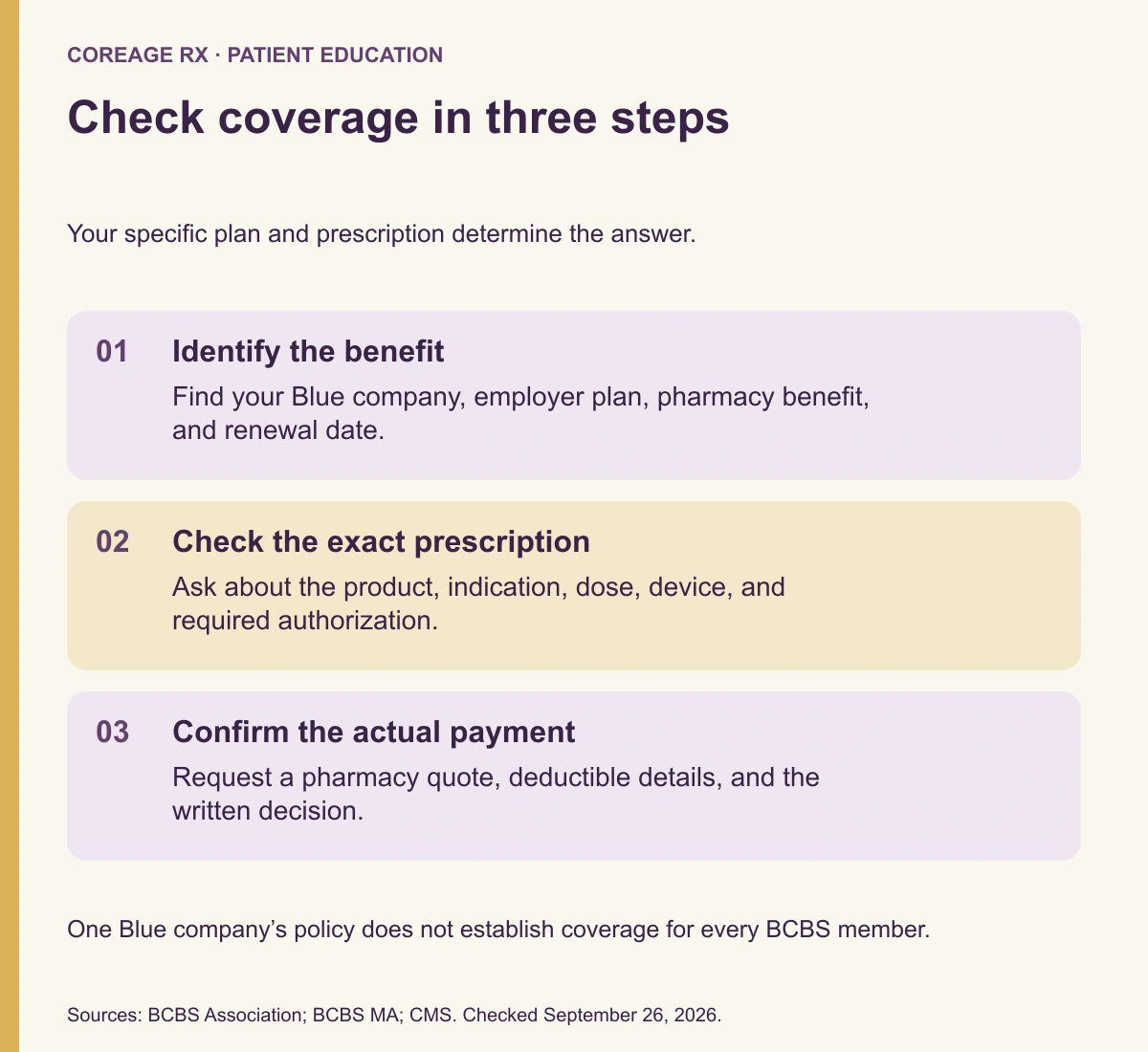
The fastest way to get a useful answer is to check the exact prescription against your own pharmacy benefit. This guide explains what to ask, why a formulary listing may not be the whole answer, and how to interpret a denial or a price quote. U.S. coverage information was checked September 26, 2026.
Why two BCBS members can get different answers
The Blue Cross Blue Shield Association describes a system of independent, locally operated companies. The Blue name on an insurance card does not mean every member has an identical prescription benefit.
Even within one company, an employer may choose different coverage from another employer. A plan can also change at renewal. Advice from a coworker, an old social-media thread, or another state’s Blue website may therefore describe a benefit that is different from yours.
Before searching a drug name, identify the full plan name, the pharmacy benefit contact on your card, and the current benefit year. If you have coverage through work, the benefits team can help identify the relevant plan documents. Personal medical details should go through the appropriate clinical or benefits channel.
Start with the exact medicine and diagnosis
“Weight-loss injections” is a broad phrase. Semaglutide and tirzepatide are ingredient names used in products with different approved indications, formulations, and coverage rules. The insurer needs more detail than a general interest in losing weight.
| Prescription detail | Why it matters |
|---|---|
| Exact product | Wegovy, Ozempic, Zepbound, and Mounjaro are distinct branded products. |
| Reason for treatment | Weight management, type 2 diabetes, and other approved uses may follow different criteria. |
| Route and presentation | A tablet, single-dose pen, multidose pen, or vial may have different benefit or program rules. |
| Dose and quantity | The claim must match the actual prescription and permitted supply. |
| Benefit date | The formulary, prior authorization, or employer coverage can change at renewal. |
Our GLP-1 guide explains the medicine families. The Ozempic eligibility article explains why obesity-treatment criteria should not be applied automatically to Ozempic. A clinician should document the actual condition being treated; coverage searches should not lead to an inaccurate diagnosis.
A current BCBS Massachusetts example
Blue Cross Blue Shield of Massachusetts states that its GLP-1 coverage changes take effect at plan renewal beginning January 1, 2026. Its member page describes ending coverage outside type 2 diabetes for affected benefits, while noting that some employers can choose to maintain weight-management coverage.
This illustrates why both the renewal date and employer benefit matter. It is not a rule for every Blue company or every member nationwide. The same page directs members to their personal account for plan-specific information.
If you are affected by a change, ask whether your current authorization ends at renewal and what notice or transition information applies. A prescription that was covered earlier in the year does not necessarily establish the benefit after renewal. Discuss continuity of care with the prescriber before the next refill becomes urgent.
Formulary, benefit exclusion, and prior authorization are different
A formulary is the plan’s covered-drug list. Prior authorization means the insurer requires specified information before approving a prescription under the benefit. A benefit exclusion means the benefit does not include a particular category or use under its terms.
These situations need different follow-up questions. A request missing clinical documentation may be handled differently from a weight-management benefit that the employer did not purchase. A general drug lookup can be useful, but it may not reveal every exclusion in your own contract.
Ask the plan to identify the specific rule behind its answer. If a page says a drug is covered but the pharmacy rejects the claim, the relevant question is why this prescription, for this member and purpose, was rejected. That is more actionable than repeating a broad search about the brand.
Questions to ask your BCBS plan
Have the prescription details ready, then ask:
- Does my current benefit cover this product for the condition my clinician is treating?
- Is there a weight-management exclusion in my specific plan?
- Is prior authorization required, and where are the current criteria?
- Are prior treatment records, clinical measurements, or other documents needed?
- Does the plan require a preferred alternative or a particular pharmacy?
- What dose, device, and quantity are covered?
- What would I pay after the deductible and any applicable coinsurance?
- When does an approval expire, and what is required for renewal?
Write down the date, representative or reference number, and where the explanation can be found in writing. The prescribing office can then respond to the actual requirement. Do not assume that every plan uses the same BMI threshold, treatment history, or reauthorization process.

Why approval does not settle the monthly price
Coverage means a benefit applies; it does not necessarily mean a low copay. Your deductible, coinsurance, pharmacy network, quantity, and any savings-program limits can still affect the amount due.
Ask the dispensing pharmacy for a quote for the actual prescription after any required approval is in place. If it differs from the insurer’s estimate, ask which part of the claim explains the difference. Save the quote with the date and quantity so that you can make a meaningful comparison later.
The Wegovy cost guide, Zepbound cost guide, and Ozempic cost article explain current manufacturer offers and common price differences. Their advertised figures are not substitutes for a quote under your BCBS benefit.
What to do when a request is denied
Read the written decision before deciding what comes next. Ask whether the issue is missing documentation, a clinical coverage criterion, a nonpreferred product, a quantity limit, or a benefit exclusion. Request the relevant policy and any available review instructions and deadlines.
The prescriber may be able to correct an incomplete submission or provide appropriate supporting information. A different covered option might also be clinically reasonable. Those possibilities depend on the actual reason for the decision; an appeal does not guarantee a benefit that the plan excludes.
For example, the BCBS Massachusetts update characterizes its affected weight-management exclusion as a benefit exclusion that cannot be appealed under that policy. Do not generalize that statement to every denial from another plan. Use your own written decision and benefit documents.
If your employer excludes weight-management medication
Ask the benefits team whether the exclusion is part of the current plan design and whether any alternative benefit is available. You can also ask how employees provide feedback for a future benefits review. That conversation is different from asking a clinician to supply missing medical information for an individual authorization.
Meanwhile, discuss a sustainable clinical plan. Depending on your circumstances, appropriate options may include nutritional support, another medication, or another form of obesity care. A coverage problem is a reason to review the plan together, not to improvise a medication schedule or use someone else’s prescription.
Our tirzepatide versus semaglutide cost comparison helps organize affordability questions across products. The right comparison includes ongoing care and refill costs, not only the introductory price.
Medicare members need a separate coverage check
A Blue-branded Medicare plan is not the same as an employer commercial plan. Commercial savings-card rules should not be carried over automatically, and older statements that Medicare never provides access to weight-management GLP-1 medicines need current context.
CMS currently describes a Medicare GLP-1 Bridge running from July 1, 2026, through December 31, 2027. It is a demonstration outside the normal Part D payment flow, with a $50 copay for eligible beneficiaries. Enrollment, clinical criteria, prescription purpose, product, and prior authorization all matter.
The CMS provider guidance lists Wegovy injections and tablets, Foundayo, and Zepbound KwikPen among eligible products. Zepbound single-dose pens and vials are not included in that Bridge list, and Ozempic is not a Bridge product. Medicines prescribed for certain Part D-coverable indications follow the applicable Part D route instead.
Ask the prescriber and plan to determine which pathway applies. Bridge payments do not count toward the Part D true out-of-pocket calculation, and the program should not be described as universal Medicare obesity-drug coverage. CMS guidance is the appropriate source for current demonstration requirements.

Savings programs and compounded products need their own review
Manufacturer savings cards and cash-pay programs have eligibility rules, product restrictions, savings caps, and end dates. Government-program beneficiaries are excluded from some commercial offers. An insurance denial does not automatically qualify someone for every cash offer or coupon.
A compounded preparation is another distinct comparison. It is not FDA-approved Wegovy, Ozempic, Zepbound, or Mounjaro. FDA’s GLP-1 guidance describes concerns involving unapproved preparations, including dosing errors and quality issues, and advises using compounding for individual medical needs that cannot be met by an approved medicine.
If you explore CoreAge Rx’s semaglutide service or tirzepatide service, ask about the exact preparation, pharmacy, clinical rationale, complete fees, and follow-up. Those product pages are not evidence that your BCBS plan will reimburse the service or medicine.
Frequently asked questions
Does BCBS cover Zepbound without diabetes?
The answer depends on your plan and the actual approved indication being treated. Do not assume a diabetes requirement applies to every obesity-treatment benefit. Ask for the current criteria for Zepbound under your specific coverage.
Will BCBS pay for Ozempic just because my BMI is high?
A BMI number alone does not establish Ozempic coverage. Ozempic’s approved uses and the insurer’s criteria are distinct from the eligibility rules for some weight-management medicines. The clinician should assess the actual diagnosis and appropriate product.
Can an existing approval survive a plan change?
Do not assume it does. Ask when the authorization expires and whether a renewal or benefit change affects it. The answer can depend on the transition rules and the new benefit.
Does being on the drug list guarantee my prescription will be paid?
No. Indication, authorization, exclusions, pharmacy network, quantity, and other benefit conditions can still matter. Request confirmation for the actual prescription and obtain a pharmacy quote.
What is the most useful next step?
Identify your exact plan and prescription, get the applicable rule in writing, and share it with the prescribing team. That gives everyone a concrete starting point for coverage, treatment, and affordability decisions.
Educational information for adults; individual treatment decisions require a qualified clinician. Sources checked September 26, 2026. Original AI-generated article illustrations depict fictional people and objects, not patient outcomes. Other editorial images are illustrative. Graphics summarize the cited sources.