
The Wegovy pill can cause digestive side effects, including nausea, vomiting, diarrhea, constipation, and abdominal discomfort. Swallowing semaglutide does not remove the medicine’s systemic risks. It also creates practical questions about empty-stomach dosing, other oral medicines, and what to do if symptoms interfere with the daily routine.
The evidence needs careful labeling. Many widely repeated Wegovy percentages come from weekly-injection trials. This article focuses on what the current U.S. label actually says about the daily tablet, how to interpret its trial, and when symptoms need a clinical response.
Which Wegovy product are you taking?
The current Wegovy label covers both injection and tablet formulations. The tablets are for specified adult weight-management and cardiovascular-risk indications. They have a separate dose schedule and administration instructions from the weekly injection.
Read the bottle and prescription rather than relying on “semaglutide pill” as the complete name. Rybelsus and Ozempic tablets are other semaglutide products with different strengths and labels. A compounded dissolving product is another category and should not be assumed to have the approved Wegovy tablet’s evidence.
Our semaglutide brand comparison explains the names. The oral-versus-injection guide explains why milligram amounts cannot be compared directly across routes.
What did the Wegovy tablet safety study include?
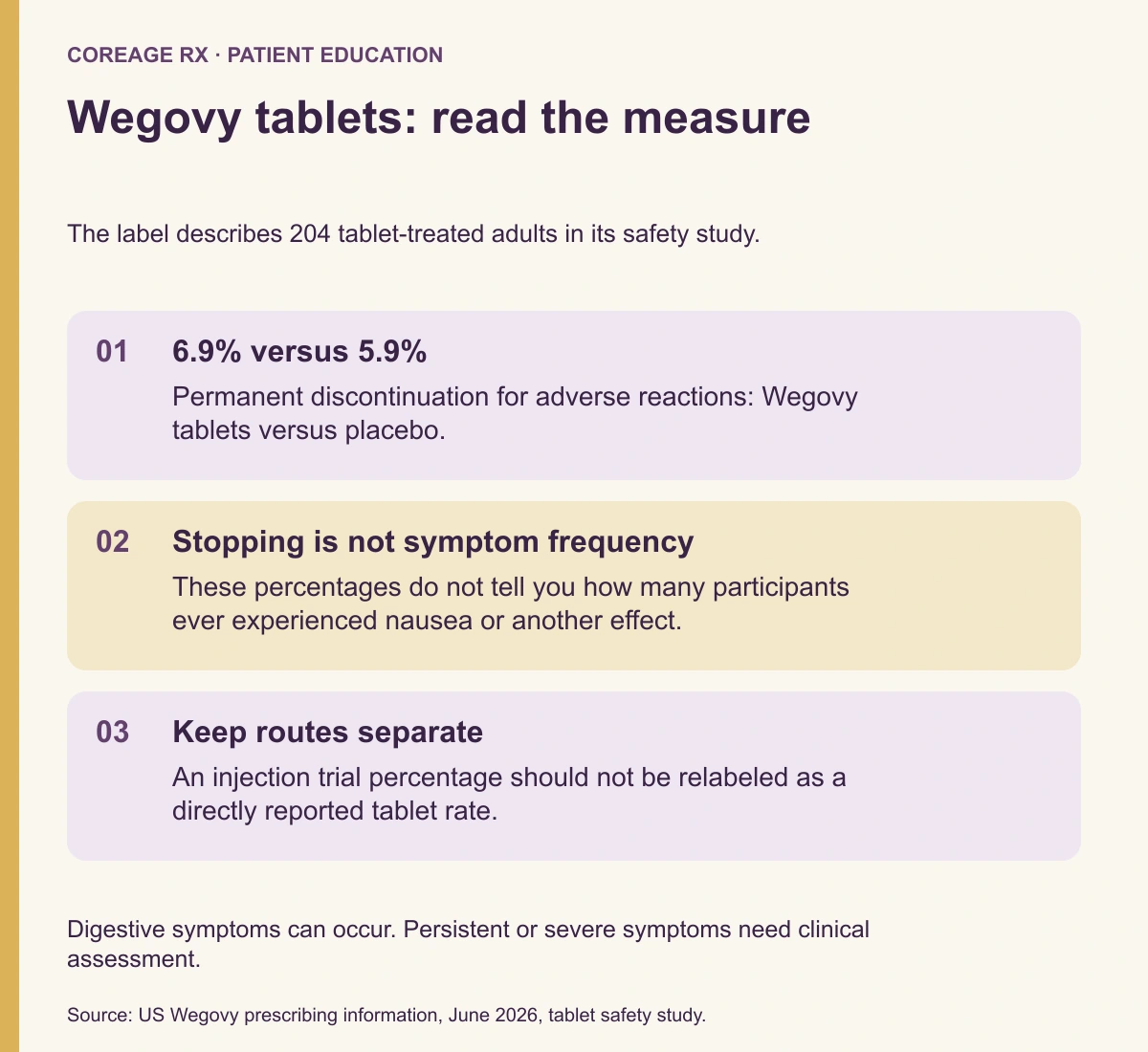
The label describes a randomized, double-blind, placebo-controlled study in adults with obesity, or overweight with a weight-related condition. 204 participants received Wegovy 25 mg tablets, with treatment for up to 64 weeks and a seven-week off-drug follow-up. People with type 2 diabetes were excluded from that study.
The label reports that the types and frequency of common adverse reactions were similar to those listed in its table for 2.4 mg injections. That supports discussing the same broad digestive concerns, but it is not a reason to relabel every injection-table percentage as a directly reported tablet rate.
A useful source should identify the route, dose, population, and duration behind a number. A percentage without that context can look precise while answering the wrong question.
How many people stopped treatment because of adverse reactions?
In the tablet study, the label reports permanent discontinuation due to adverse reactions in 6.9% of Wegovy-treated participants and 5.9% of placebo-treated participants. Gastrointestinal reactions led to discontinuation in 3.4% and 2.0%, respectively.
| Measure | Wegovy tablets | Placebo |
|---|---|---|
| Stopped treatment because of adverse reactions | 6.9% | 5.9% |
| Stopped because of gastrointestinal adverse reactions | 3.4% | 2.0% |
These are discontinuation measures, not the percentage who ever felt nausea or had any side effect. Someone can experience symptoms without permanently stopping treatment. The numbers also do not prove that the tablet and injection are equally tolerable for a particular person.
What digestive symptoms can occur?
Nausea, vomiting, diarrhea, constipation, abdominal pain, indigestion, and related digestive symptoms appear in Wegovy labeling. Semaglutide affects appetite and stomach emptying, so an old meal size may feel uncomfortable even when it used to be easy to finish.
Record the symptom, when it started, any recent dose increase, whether you can eat and drink, and whether there is pain, fever, or another concerning feature. Mention other medicines, supplements, or an intercurrent illness. Timing after a tablet does not by itself prove the cause.
The semaglutide nausea guide and general side-effects guide provide related detail. Mild symptoms and persistent inability to maintain food or fluids need different responses.
Does a daily pill mean side effects should disappear overnight?
No. Daily administration does not mean the medicine leaves the body completely before the next morning. Skipping one tablet is not a reliable test of whether semaglutide caused a symptom, and repeatedly stopping and restarting without advice can make the treatment harder to assess.
Contact the prescriber when symptoms persist, worsen, or interfere with daily function. The clinician may need to review escalation, other medicines, hydration, nutrition, or an unrelated condition. An internet timeline cannot establish when a particular person’s symptoms should be ignored or considered safe.
Do not assume nausea is required for benefit. The treatment should be assessed using the agreed health goals and tolerability, not the intensity of discomfort.

The dose increases gradually for a reason
The tablet schedule starts at 1.5 mg daily for 30 days, then uses 4 mg for 30 days and 9 mg for 30 days before the 25 mg maintenance dose. The label says escalation can be delayed when a dose is not tolerated.
If symptoms are significant before a planned increase, contact the prescriber instead of automatically moving to the next strength. Do not take multiple tablets, split tablets, or use another semaglutide product to create a different dose. The tablets are intended to be swallowed whole.
Our Wegovy dosage chart explains the schedule and the difference from weekly injection maintenance. A printed schedule is a framework for prescribed care, not a requirement to continue escalating despite a problem.
Can you take the tablet with food to prevent nausea?
Follow the product’s administration instructions. The approved tablet is taken in the morning on an empty stomach with water, up to four ounces. Wait at least 30 minutes before food, other drinks, or other oral medicines. Do not change these conditions as an improvised side-effect treatment.
If the routine is difficult, tell the pharmacist or prescriber. For example, another medicine may also have fasting instructions, or nausea may make the morning routine impractical. The solution should account for both medicines and the person’s needs.
Once the waiting period has passed, manageable meals can help preserve nutrition. Our balanced-meal guide offers food ideas without treating one diet as mandatory for every semaglutide user.
What if you vomit or miss a tablet?
The label says to skip a missed tablet and take the next dose the following day. Do not double up. If vomiting occurs after a dose, ask the pharmacist what to do rather than automatically taking another tablet; the amount already absorbed cannot be determined from the symptom alone.
Repeated vomiting deserves clinical review, particularly if fluids or other essential medicines cannot be retained. Tell the team which medicines were affected and whether urination, alertness, or ability to stand comfortably has changed.
The missed-dose and restart guide explains why tablet and injection rules differ. A prolonged interruption should be discussed with the prescriber rather than treated as a series of unrelated missed doses.
Which symptoms should not wait?
| Symptom pattern | Appropriate response |
|---|---|
| Trouble breathing, swelling of the tongue or throat, collapse | Seek emergency help for a possible serious allergic reaction |
| Severe persistent abdominal pain, sometimes extending to the back, with or without vomiting | Stop the medicine and obtain urgent assessment for possible pancreatitis |
| Repeated vomiting, inability to keep fluids down, very little urine, or substantial dizziness | Obtain prompt medical assessment for dehydration or another complication |
| Upper abdominal pain with fever or jaundice | Seek prompt assessment for a possible gallbladder or bile-duct problem |
These examples reflect product warnings, not a complete list of emergencies or a way to diagnose yourself. Severe constipation with vomiting or a swollen abdomen also needs assessment. Do not keep adding fiber or symptom remedies while a potentially serious problem remains unexplained.
Other medicines and vision history matter
Insulin or sulfonylureas can increase the risk of low blood sugar when used with Wegovy. Ask the diabetes team for a monitoring and treatment plan. Severe confusion, seizure, or unconsciousness requires emergency help; ordinary dizziness should not automatically be dismissed as a harmless adjustment.
Semaglutide can affect absorption of other oral medicines. The label describes a levothyroxine interaction study and recommends considering additional monitoring for medicines that require close clinical or laboratory follow-up. Provide the complete medication list and avoid changing thyroid or other treatment on your own.
Report new or worsening vision symptoms promptly, especially with known diabetic eye disease. Sudden vision loss requires urgent evaluation. A symptom may have several possible causes, and an online side-effect list cannot decide which is present.

Pregnancy, breastfeeding, thyroid history, and procedures
The label advises stopping Wegovy at least two months before a planned pregnancy. If pregnancy occurs while using it for weight reduction, discontinue it and contact the prescribing team. The tablet label also says breastfeeding is not recommended during treatment. Discuss those plans before starting.
Wegovy is contraindicated with a personal or family history of medullary thyroid carcinoma or MEN2. The boxed warning reflects thyroid C-cell tumors in rodents; whether the same risk occurs in humans is unknown. Tell the clinician the actual thyroid diagnosis rather than assuming every thyroid condition has the same implication.
Tell the anesthesia or procedural team about treatment before general anesthesia or deep sedation. Delayed stomach emptying can affect aspiration risk. Follow that team’s plan rather than applying a blanket rule to stop or continue the medicine yourself.
How should the pill be compared with an injection?
Compare the complete care plan: appropriate indication, administration routine, previous symptoms, other medicines, cost, and follow-up. A tablet avoids injections but adds daily fasting instructions. It should not be chosen on the assumption that oral treatment cannot cause serious adverse effects.
Our Wegovy cost guide separates tablet and injection offers. If reviewing CoreAge Rx semaglutide information, confirm the actual preparation; an offered compounded product is not automatically approved Wegovy in another package. FDA’s guidance explains the distinction.
Bring a short symptom record and the medicine packaging to follow-up. A workable treatment plan should support nutrition, daily life, and the intended health benefit, with clear instructions for problems between appointments.
Educational information for adults; individual treatment decisions require a qualified clinician. Sources checked September 26, 2026. Original AI-generated article illustrations depict fictional people and objects, not patient outcomes. Other editorial images are illustrative. Graphics summarize the cited sources.