
Berberine has not been established as a reliable substitute for an approved weight-management medicine. Some earlier studies suggested modest effects on weight, but their results were inconsistent. A newer randomized trial published in 2026 found no meaningful advantage over placebo for weight or the main fat measurements studied in adults with obesity and fatty liver disease who did not have diabetes.
That finding deserves attention when a supplement is advertised as “nature’s Ozempic.” It does not answer every question about berberine, but it helps separate a plausible biological story from a demonstrated clinical benefit. This guide reviews the evidence, important limitations, and questions to ask before adding a supplement.
What is berberine?
Berberine is a substance found in several plants, including barberry and goldenseal. It has a history of use in traditional medical systems and is now sold in various supplement formulations. Researchers have studied possible effects on glucose, lipids, and other metabolic measures.
An ingredient’s history or an effect in a laboratory does not establish a reliable weight-loss result in people. The formulation, amount, population, comparison group, and outcome all matter. A supplement containing several ingredients cannot simply borrow the findings of a study of berberine alone.
The National Center for Complementary and Integrative Health summarizes both the interest in berberine and the uncertainty surrounding weight claims. Its overview is a useful starting point, but newer trials should also be considered.
What did the earlier evidence suggest?
NCCIH describes a 2022 review that found reductions in weight and body mass index across included studies. It also emphasizes high risk of bias in many studies, inconsistent individual results, and substantial variation in doses, formulations, and participants’ health conditions.
Many participants had diabetes, fatty liver disease, or other metabolic conditions. Those characteristics can affect the question being studied and whether a finding applies to another person. Most studies were conducted in Asian countries, which adds another consideration when generalizing results.
The useful conclusion is uncertainty, rather than a promised number of pounds. A pooled average from unlike small studies should not be treated as a guaranteed effect of whichever bottle happens to be sold online.
What does the 2026 randomized trial add?
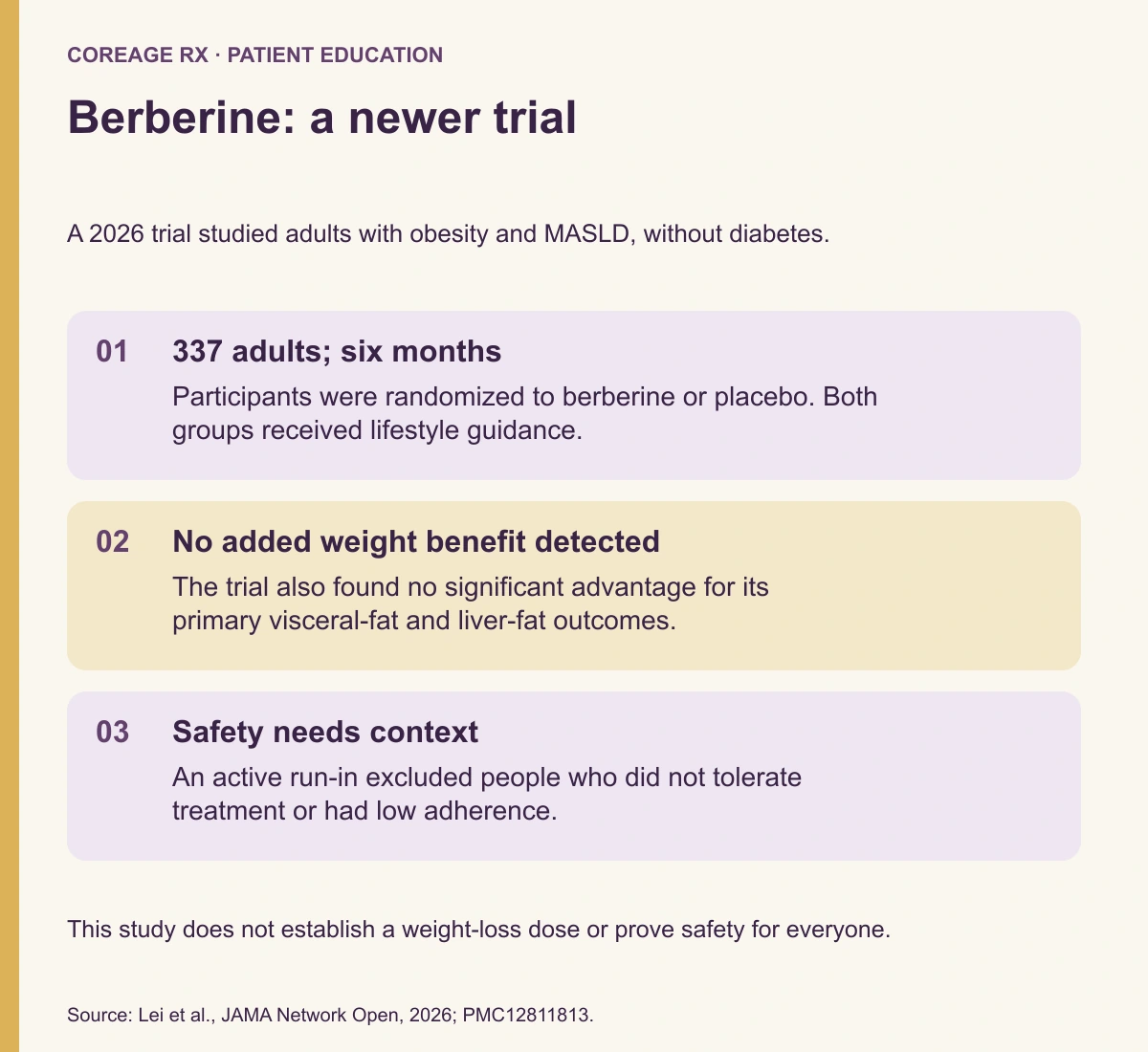
The 2026 trial by Lei and colleagues randomized 337 adults at 11 hospitals in China. Participants had obesity and metabolic dysfunction-associated steatotic liver disease, often abbreviated MASLD, and did not have diabetes. They received berberine or a matching placebo for six months, alongside lifestyle support.
The main outcomes were visceral abdominal fat area and liver fat content measured using CT. Berberine did not significantly improve either primary outcome compared with placebo. The study also did not show a significant advantage for body weight, body mass index, or waist circumference.
This was a stronger design for assessing a treatment effect than an uncontrolled before-and-after story: random assignment and a placebo group helped distinguish the supplement’s effect from changes that could happen without it.
What happened to body weight in that study?
The paper’s reported mean weight changes were approximately 1.8 kg lower with berberine and 1.9 kg lower with placebo over six months. The between-group difference was not statistically significant. Both groups received lifestyle support.
| Reading the result | What it means |
|---|---|
| People in the berberine group lost some weight | A within-group change occurred during the study |
| The placebo group had a similar change | The berberine group’s loss cannot simply be attributed to the supplement |
| There was no significant difference between groups | This trial did not demonstrate an added weight-loss benefit from berberine |
These findings do not prove that no person could ever respond differently. They do argue against using this study to promise reliable weight loss from berberine or to claim that its effects resemble those of semaglutide.
Were there any potentially favorable findings?
The trial reported some reductions in lipid and inflammation markers, including LDL cholesterol, apolipoprotein B, and high-sensitivity C-reactive protein. Those findings were secondary or exploratory, and the authors explicitly cautioned that the analyses were not formally adjusted for the many comparisons performed.
In ordinary language, testing many outcomes makes some apparently positive findings more likely to occur by chance. The paper treats these results as reasons for further study, not proof that berberine prevents heart attacks or should replace prescribed cholesterol treatment.
A laboratory-marker change and a clinical outcome are different claims. Ask which one an advertisement is describing and whether the study was designed to establish it.

What are the limits of this trial?
The participants had a defined health profile, the study used a particular berberine hydrochloride preparation, and follow-up lasted six months. The results should not be assumed to cover every formulation, every population, or every possible duration.
There is also an important safety detail: participants completed a berberine run-in before randomization, and people who could not tolerate it or did not meet adherence requirements were excluded. That means the randomized group’s experience cannot establish that starting berberine is equally tolerable for everyone.
The trial found no significant difference in adverse-event frequency between groups, but that does not mean adverse events never occurred or that rare risks were ruled out. Study eligibility, selection, sample size, and follow-up all limit what a safety conclusion can support.
Is berberine the same as a GLP-1 medicine?
No. Berberine is not semaglutide or tirzepatide, and the nickname “natural Ozempic” does not establish the same mechanism, quality controls, approved indications, or outcomes. A supplement’s marketing language cannot substitute for product-specific clinical evidence.
Our introduction to GLP-1 explains the hormone and prescription medicines. The natural GLP-1 article explains why a short-term hormone measurement or a biological hypothesis should not be equated with a proven weight-management result.
Do not stop diabetes or other prescribed treatment because a supplement is presented as a natural alternative. If medication is unsuitable or unaffordable, discuss that problem directly with the treating team so the alternative plan addresses the actual condition.
What side effects and interactions matter?
NCCIH lists gastrointestinal effects reported in studies, including nausea, abdominal pain, bloating, constipation, and diarrhea. Those effects can matter if another medicine is already making food or fluids difficult to tolerate.
Berberine can interact with medicines; NCCIH specifically discusses an interaction with cyclosporine, which is used after organ transplantation. Give a clinician or pharmacist the complete medication and supplement list before adding it. A transplant medicine or other closely monitored treatment should not be combined with an unreviewed supplement on the assumption that plants are harmless.
New severe symptoms need appropriate medical assessment. Do not respond to persistent digestive problems by adding further “gut support” products without reviewing the cause and the entire regimen.
Pregnancy, breastfeeding, and infants require particular caution
NCCIH notes that berberine exposure has been linked to harmful bilirubin buildup in infants. It describes berberine as likely unsafe for infants and potentially unsafe during pregnancy or breastfeeding because of possible effects on the fetus or infant.
Avoid starting it for weight loss during pregnancy or breastfeeding, and discuss any existing use with the relevant clinician. Weight-management goals during these periods require a different assessment from a general adult supplement review.
An ingredient being sold without a prescription does not establish suitability at every life stage. A combination product can make the review more complicated, which is another reason to bring the full label.
Is there an established berberine dose for weight loss?
There is no single self-selected regimen established by this evidence as an effective weight-loss treatment. Study doses are descriptions of research protocols, not instructions for a reader to copy. Increasing the amount after a disappointing result does not create evidence of benefit.
Different salts, delivery systems, and combinations may have different exposures. A claim of better absorption does not automatically establish better clinical outcomes or equal safety. Ask for research on the actual finished product rather than assuming the largest milligram number is the best choice.
Our supplement guide for GLP-1 users explains how to separate a nutritional need from an additional weight-loss claim. There is no basis here for a universal berberine add-on to a prescribed GLP-1 regimen.

How should you assess a product claim?
Start with four questions: What exact product was tested? Who participated? Was there a comparison group? What outcome improved? Then ask whether the claimed benefit was the main planned outcome or an exploratory finding.
Check whether the label identifies all ingredients and amounts, whether independent quality testing is described, and whether the company separates quality assurance from proof of effectiveness. The NIH supplement overview explains why dietary supplements are regulated differently from medicines and why a label claim is not the same as FDA approval for treatment.
These standards apply to CoreAge Rx products too. GLP-1 Support should be evaluated for its actual ingredients and role, without assuming that its name establishes medication-like weight loss. If considering semaglutide care, ask about the exact preparation and follow-up; a compounded preparation is a separate category from an approved branded medicine.
A more useful next step for weight concerns
Describe the problem you want to solve: persistent hunger, a change in weight, difficulty eating regularly, an abnormal glucose result, or a treatment side effect. A clinician can help connect that problem with an appropriate assessment instead of beginning with a particular supplement.
Our calorie-intake guide treats estimates as one part of a sustainable plan, and balanced meal ideas provide practical food options. Adequate nutrition, activity suited to your health, sleep, and treatment of relevant conditions remain useful whether or not a medicine is considered.
The current evidence does not support promising a particular berberine weight-loss result or timeline. A better decision begins with realistic evidence, a medication-interaction review, and a plan that addresses your health needs over time.
Educational information for adults; individual treatment decisions require a qualified clinician. Sources checked September 26, 2026. Original AI-generated article illustrations depict fictional people and objects, not patient outcomes. Other editorial images are illustrative. Graphics summarize the cited sources.