
Your body already makes GLP-1 as part of its response to food. Supporting a nutritious eating pattern is a reasonable goal; trying to make food or a supplement act like a prescription GLP-1 medicine is a different claim that needs clinical evidence. The two are often blurred in online discussions of “natural GLP-1.”
This guide explains the distinction and turns it into practical questions about meals, fiber, protein, probiotics, and supplements. The aim is a sustainable routine that supports health and adequate nutrition, not a promise that one ingredient will switch off hunger.
What does “natural GLP-1” mean?
GLP-1 is short for glucagon-like peptide-1. It is one of the signals involved in the response to eating, including glucose regulation and appetite-related processes. Prescription GLP-1 receptor agonists use related biology, but their formulation and pharmacology are designed for particular treatment effects.
The phrase “natural GLP-1” is used in several ways: to describe the body’s own hormone, foods that influence meal-related signaling, or supplements marketed around gut health and appetite. Those meanings should not be treated as interchangeable.
Our introduction to GLP-1 explains the hormone and the medicines. Product labels, such as the Ozempic and Wegovy prescribing information, describe the mechanism and clinical uses of specific semaglutide products. They do not establish that a food or supplement with a GLP-1 marketing claim has equivalent effects.
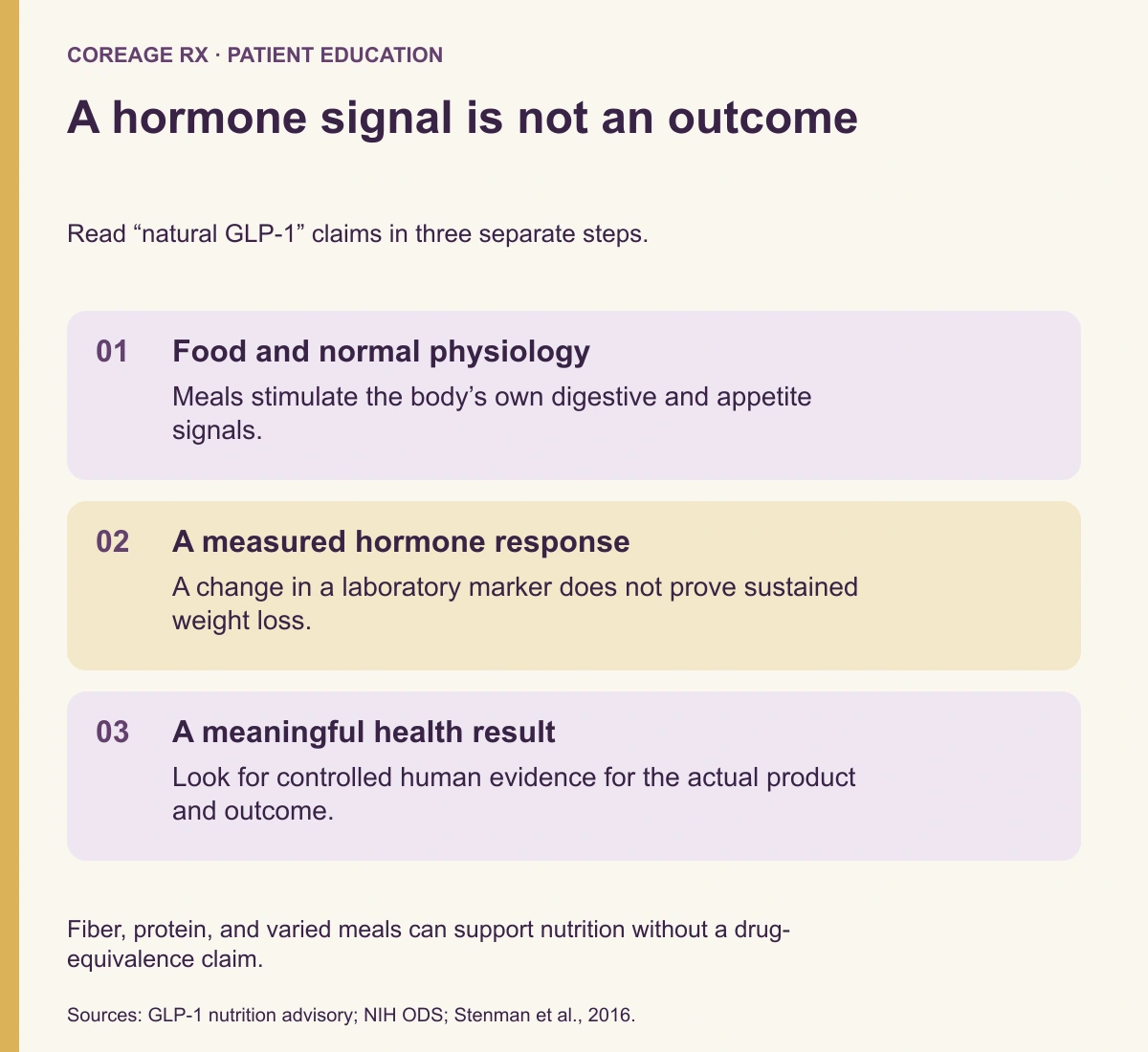
Why a hormone change is not the same as a health outcome
A study can measure a short-term change in a hormone after a meal. Another study can measure appetite ratings. A longer trial can measure body weight, glucose control, nutritional status, adverse effects, or other clinical outcomes. These studies answer different questions.
Suppose a supplement advertisement describes a large percentage increase in GLP-1. Before treating that as meaningful, ask what was measured, in whom, compared with what, and for how long. A percentage change in a laboratory signal cannot be compared directly with a percentage of body weight lost in a medication trial.
The NIH Office of Dietary Supplements reviews the uneven evidence behind weight-loss supplements. Its discussion is a useful reminder that a plausible biological explanation does not by itself establish a reliable weight-management benefit.
Build meals around nutrition and satisfaction
Rather than trying to identify the single food that produces the biggest hormone response, start with meals that provide useful nutrients and are satisfying enough to fit daily life. A practical meal can include a protein food, a source of fiber-rich carbohydrate or produce, and other foods that fit your preferences and health needs.
Examples include eggs with whole-grain toast and fruit, beans with rice and vegetables, or yogurt with oats and berries. These are meal ideas, not prescriptions for a particular calorie intake or a claim that each combination produces a medication-like response.
Our balanced-meal guide and protein breakfast ideas offer ways to adapt those building blocks. A useful question is whether a meal helps you eat adequately and comfortably through the day, rather than whether it belongs on a list of “GLP-1 superfoods.”
Where fiber fits
Fiber-rich foods can contribute to an overall eating pattern that supports digestive health and fullness. Different fibers have different properties, and the effect of a specific supplement cannot be inferred from the word fiber alone.
Beans, lentils, oats, vegetables, fruit, nuts, and seeds can add fiber along with other nutrients. If your usual intake is low, sudden large changes may be difficult to tolerate. Adjust the pattern in a way that fits your digestion and any clinical advice about fluids or food restrictions.
The joint nutrition advisory for GLP-1 therapy emphasizes individualized nutrition and attention to gastrointestinal symptoms. Although it addresses medication users, its focus on adequate intake and practical food choices is more useful than treating fiber as a substitute drug.
Read food fiber versus supplements and fiber and fullness for a closer look at the decision. A fiber capsule cannot provide every benefit of the foods it might otherwise displace.
Where protein fits
Protein deserves attention during weight management because nutritional adequacy and physical function matter alongside changes on the scale. Protein foods can also be part of satisfying meals. That does not establish that eating more protein indefinitely will create progressively greater appetite control.
Needs vary with body size, activity, health conditions, and the rest of the diet. People with kidney disease or other conditions that affect nutrition should obtain individualized guidance rather than adopting a high-protein target from a supplement advertisement.
If you use a medication that reduces appetite, review whether smaller meals still provide enough nutrition. Our semaglutide protein and muscle guide and tirzepatide protein and muscle guide connect that discussion with strength and function. The nutrition advisory also makes clear that protein alone does not replace physical activity and resistance training.

Do probiotics or GLP-1 boosters cause medication-like weight loss?
That cannot be assumed from a product category or an ingredient name. Probiotic effects can depend on the strain, preparation, amount, and population studied. A result for one combination is not automatically a result for every bottle containing related bacteria.
For example, a randomized trial of B420 with or without a particular fiber produced different findings in the intention-to-treat and selected-completer analyses. Its overall primary body-fat comparison was not significant in the intention-to-treat population. That is more nuanced than a broad promise that probiotics reliably cause substantial weight loss.
Our Bioma GLP-1 Booster review shows how to examine a specific product without confusing ingredient research with a finished-product trial. Our GLP-1 support supplement guide explains the same distinction more generally.
What about herbs, berberine, or other “natural Ozempic” products?
The nickname does not establish equivalent ingredients, effects, safety, or clinical evidence. An herbal or dietary supplement can have its own adverse effects and interactions, and a combination product may make it harder to identify which ingredient is responsible for a problem.
Review the complete label with a clinician or pharmacist when appropriate, especially if you take medicines that affect glucose, have a significant medical condition, or are pregnant or breastfeeding. Do not replace prescribed diabetes treatment with a supplement based on a social-media comparison.
The NIH weight-loss supplement review is a useful place to assess what is known about individual ingredients. Our natural herbs for weight-loss article provides related questions to bring to a clinical discussion.
Compare the decisions clearly
| Option | What to evaluate |
|---|---|
| A food or meal pattern | Nutritional adequacy, satisfaction, preferences, affordability, and how well the routine can be maintained. |
| A fiber or protein supplement | Whether there is a specific intake gap, the actual formulation, tolerance, and whether it displaces useful food. |
| A supplement marketed as a GLP-1 booster | Finished-product evidence, ingredient amounts, safety, meaningful outcomes, and recurring cost. |
| A prescription medicine | Clinical eligibility, product-specific evidence and risks, instructions, monitoring, and access. |
These categories can overlap in a care plan, but their roles remain different. Choosing a nutritious meal does not require a prescription, while choosing or changing a medication requires an appropriate clinical assessment.
Hunger does not mean you failed to optimize a hormone
Hunger and appetite reflect many influences. Meal timing, inadequate intake, sleep, stress, activity, medicines, and health conditions can all be relevant. A strong appetite is not a reliable home test for a deficiency of GLP-1.
If hunger feels unusually persistent, describe the pattern rather than immediately buying a booster. Are you skipping meals, eating less than you intended, sleeping poorly, or noticing a change after another medication? Our food-noise and hunger guide and sleep and weight-management article can help organize those observations.
Persistent symptoms or concerns about glucose deserve clinical evaluation. A food diary can support that conversation, but it cannot establish a diagnosis on its own.

How CoreAge Rx products should be considered
Full House fiber capsules and GLP-1 Support should be evaluated for their actual ingredients and intended role. Neither should be assumed to reproduce a prescription GLP-1 medicine’s outcomes. Ask what specific need a supplement would address and what evidence supports that use.
For someone considering prescription weight-management care, the first question is medical fit. The CoreAge Rx semaglutide information page can help frame product questions, including whether a preparation is compounded and what follow-up is available. FDA’s GLP-1 guidance explains why compounded and approved products require different descriptions.
Frequently asked questions
Can I increase my natural GLP-1 through food?
Food participates in normal hormone signaling. The more useful clinical question is whether a dietary pattern improves nutrition, satisfaction, glucose management, or other outcomes that matter to you. A hormone change alone does not establish a medication-equivalent benefit.
Is the goal to stop feeling hungry?
No. Some hunger is part of ordinary eating regulation. A routine that makes it difficult to eat enough or leaves you persistently unwell needs review, whether it involves food restrictions, a supplement, or a medicine.
Should I take a booster with a prescription GLP-1?
Do not assume that combining them adds benefit. Identify the actual problem and review the full formula with the care team. Our supplement guide for GLP-1 users separates nutritional gaps from additional weight-loss claims.
What is a sensible first step?
Choose one practical improvement that fits your current routine, such as adding a satisfying breakfast or a fiber-rich food you tolerate. If weight or metabolic concerns need more support, arrange a clinical assessment. A sustainable care plan is more informative than chasing a single hormone number.
An ingredient-specific evidence example
- Halim seeds as food — Distinguish culinary uses, food-composition research, and animal extract experiments from human weight-loss claims.
Evaluate a product sold as a GLP-1 patch
- GLP-1 patches: ingredients and evidence — Distinguish retail botanical patches, approved oral or injectable medicines, and experimental engineered microneedle research.
Educational information for adults; individual treatment decisions require a qualified clinician. Sources checked September 26, 2026. Original AI-generated article illustrations depict fictional people and objects, not patient outcomes. Other editorial images are illustrative. Graphics summarize the cited sources.
Related questions about treatment and planning
- Calorie Intake for Weight Loss: Estimates, Limits, and a Sustainable Plan — Use calorie estimates as one part of an individualized, nourishing eating plan.
- Three-Day Water Fast: Weight Changes, Risks, and Alternatives — Understand the limits of short-term scale changes and small fasting studies.
Look more closely at supplement evidence
- Berberine for weight loss — Examine a newer randomized trial, its limits, and medication-interaction questions.
- ColonBroom review — Separate fiber ingredients from product-level claims and learn what a single-group study can establish.