
Tretinoin may help acne, some post-acne dark marks, and the appearance of mild scarring, but it is not a universal treatment for every mark or indentation left by a breakout. A flat patch of darker color and a deep change in skin texture are different problems. Identifying which one you have is more useful than choosing the strongest cream.
Acne scars do not have to be treated unless you want to address them. If you do, the aim is a realistic improvement that fits your skin, preferences, budget, and tolerance. This guide explains where tretinoin may fit and when a dermatologist may recommend a different approach.
First separate color changes from texture changes
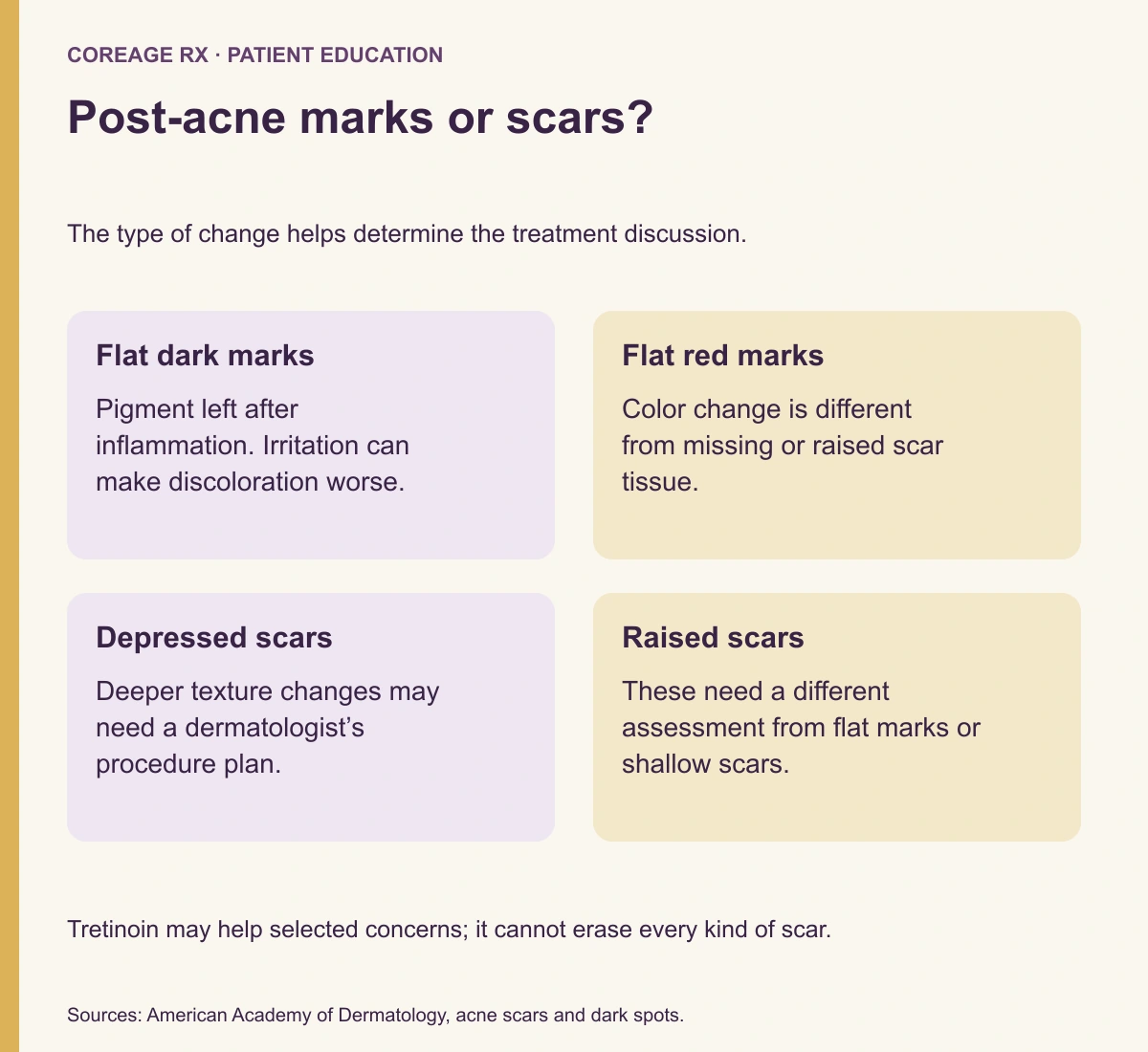
People often use “acne scars” to describe everything that remains after a pimple. That can include persistent color, a depression, or a raised area. More than one type can occur in the same place.
| What remains after acne | What the treatment discussion usually needs to address |
|---|---|
| A flat brown or gray mark | Post-inflammatory pigmentation and prevention of further inflammation. |
| A flat pink or red mark | Residual redness or another cause that needs assessment; it is not automatically excess pigment. |
| A sunken area or uneven indentation | A change in texture, often described as an atrophic or depressed scar. |
| A firm raised area | A raised scar, including a possible hypertrophic scar or keloid. |
| Ongoing inflamed breakouts | Active acne and prevention of additional marks or scars. |
This table is a way to describe your concern, not a tool for diagnosing every lesion at home. A spot that is changing, bleeding, painful, or unlike your usual acne marks deserves an examination. Our comparison of melasma, sunspots, and post-acne marks explains other reasons a dark area may appear.
How can tretinoin help?
Tretinoin is a prescription topical retinoid. The American Academy of Dermatology describes its role in preventing clogged pores and treating acne, as well as effects on skin turnover, tone, and collagen. Its usefulness depends on the condition being treated and the preparation prescribed.
For someone who still develops acne, treating the active breakouts can help reduce the repeated inflammation that leads to new marks. That preventive role can matter even when an older scar needs a different treatment.
Tretinoin is not the same as every product labeled retinol or retinoid. Concentrations across different molecules and formulations are not directly interchangeable. Our tretinoin versus retinol guide explains why a larger percentage on one label does not necessarily make it a more effective choice.
What about flat dark marks after a breakout?
Post-inflammatory hyperpigmentation occurs when inflammation is followed by increased pigment in the affected skin. The AAD lists retinoids among ingredients that can help fade dark spots, while emphasizing treatment of the underlying cause and sun protection. Source: AAD dark-spot guidance.
That does not mean every dark mark responds at the same speed. Depth of pigment, continued breakouts, irritation, sun exposure, and the actual diagnosis can change the course. A patch of melasma should not be assumed to be a leftover acne mark simply because acne also occurs nearby.
A useful treatment goal might be fewer new inflamed breakouts and gradual fading of existing flat marks. That is more specific than asking a cream to erase all “scars.” See dark spots after acne for ways to keep those two goals connected.
Can it improve pitted or depressed scars?
The AAD notes that a topical retinoid or salicylic acid can make mild acne scarring less noticeable. It also explains that depressed scars may require procedures or a combination of treatments chosen for the scar type. Source: AAD acne-scar treatment guidance.
A deep, narrow indentation is not the same problem as a shallow textural irregularity. A clinician may discuss options such as scar surgery, fillers, lasers, chemical peels, or microneedling, depending on the skin and the type of scar. These are examples of treatments used in clinical practice, not a recommendation to buy a device or perform a procedure at home.
If a deep indentation remains after acne improves, that does not necessarily mean you failed to apply tretinoin correctly. The treatment may be addressing a different part of the problem. Increasing irritation in an attempt to force a result can create another concern without correcting the scar’s structure.
Raised scars need their own assessment
Raised scars and keloids are not treated in the same way as depressed scars. The AAD describes options such as injections, lasers, or other combinations for selected raised scars. A standard facial retinoid routine should not be presented as a dependable way to flatten every raised lesion.
Tell the dermatologist if you have previously developed keloids, if a scar is growing beyond the original injury, or if it itches or hurts. That history can influence which treatments are considered and which procedures require extra caution.
Avoid applying strong acids, using an at-home needling device, or repeatedly picking the area to try to level it. The first useful step is to identify the scar and understand the expected benefit and risks of the proposed treatment.

How long should improvement take?
There is no single tretinoin deadline that applies to acne, pigment, and scar texture. Those outcomes change on different timelines, and an improvement in one does not guarantee the same change in another.
AAD guidance notes that some superficial dark spots may fade over roughly six to twelve months after the cause is addressed, while deeper pigment can last longer. That describes the course of pigmentation generally; it is not a promise that tretinoin will clear your marks within that period. Source: AAD dark-spot guidance.
Ask the prescriber when to review tolerance and when to assess the intended outcome. Our tretinoin results timeline explains why peeling in the first weeks is not a reliable measure of long-term benefit.
Irritation can work against pigment goals
Dryness, stinging, redness, or peeling can make a routine difficult to continue. In skin prone to post-inflammatory hyperpigmentation, irritation can also contribute to new dark marks. The AAD specifically highlights that concern in people with darker skin tones. Source: AAD retinoid guidance.
More irritation is not proof that treatment is working better. If several products sting, or your skin becomes increasingly inflamed, review the whole routine with the prescribing clinician. Strong exfoliants, duplicate retinoids, harsh cleansers, and repeated scrubbing can complicate the picture.
Follow the instructions for your own prescription rather than copying an online schedule. The guides to starting tretinoin, peeling and irritation, and moisturizer layering can help you prepare more specific questions.
Sun protection belongs in the plan
Sun protection helps prevent additional pigment changes and supports a tolerable skin-care routine. For people addressing dark spots, the AAD recommends considering a tinted sunscreen with iron oxide, broad-spectrum protection, and SPF 30 or higher. Iron oxide helps address visible-light exposure, which can matter for pigmentation. Source: AAD dark-spot guidance.
Choose a product you can use consistently and follow its label for application and reapplication. Shade, clothing, and a hat are useful parts of protection too. A treatment cream is not a substitute for a sunscreen with appropriate labeled protection.
Our tretinoin and sunscreen guide covers practical issues such as pilling and stinging without turning the routine into a long list of additional active ingredients.
Pregnancy, sensitive skin, and other reasons to review suitability
The AAD advises against using retinoids during pregnancy. Discuss pregnancy, pregnancy plans, and breastfeeding with the clinician before starting or continuing a prescription. A topical product still needs a suitability review.
Significant redness, eczema-like irritation, a history of skin allergies, or another inflammatory skin condition may also change the treatment choice. If your acne is severe, repeatedly causes scars, or comes with other concerning symptoms, a dermatologist can assess whether a topical routine alone is adequate.
Before a peel, laser treatment, or other procedure, tell the clinician about all recent acne medicines and skin products. Do not assume that a product should be stopped or continued for a standard number of days; the instructions depend on the procedure and the treatment.

Where CoreAge Rx skin products fit
If you are considering Smooth Move, review the complete formula and the prescribing instructions with the care team. Evidence about tretinoin does not automatically establish identical results for every compounded combination, concentration, or vehicle.
Someone whose main concern is pigmentation may also look at Spot On, while ongoing breakouts may lead to questions about Pore Favor. These are different product discussions. Their availability does not establish that all three should be combined, or that a product is suitable for a particular scar.
Start with the diagnosis and the treatment goal. Our hyperpigmentation guide and acne and pore-treatment guide connect those goals to the broader care plan.
Frequently asked questions
Does peeling mean an acne scar is being removed?
No. Surface peeling is not a measurement of scar correction. Persistent or severe irritation is a reason to review the routine, not a target to pursue.
Can tretinoin prevent new scars?
Controlling acne can help reduce the inflammation that creates new scars. That is one reason to treat ongoing breakouts while discussing old marks. It does not guarantee that every future breakout will heal without a scar.
Should I choose the highest strength for faster results?
Not automatically. Suitability, formulation, tolerance, and the intended outcome matter. A prescription that you cannot tolerate may undermine consistent care. Let the clinician guide the strength and schedule.
What should I bring to a scar consultation?
Bring your current product list, previous treatment history, and a clear description of whether color, texture, active acne, or all three bother you. Ask what improvement is realistic, what downtime and follow-up are involved, and which result each proposed treatment is intended to produce.
Educational information for adults; individual treatment decisions require a qualified clinician. Sources checked September 26, 2026. Original AI-generated article illustrations depict fictional people and objects, not patient outcomes. Other editorial images are illustrative. Graphics summarize the cited sources.