
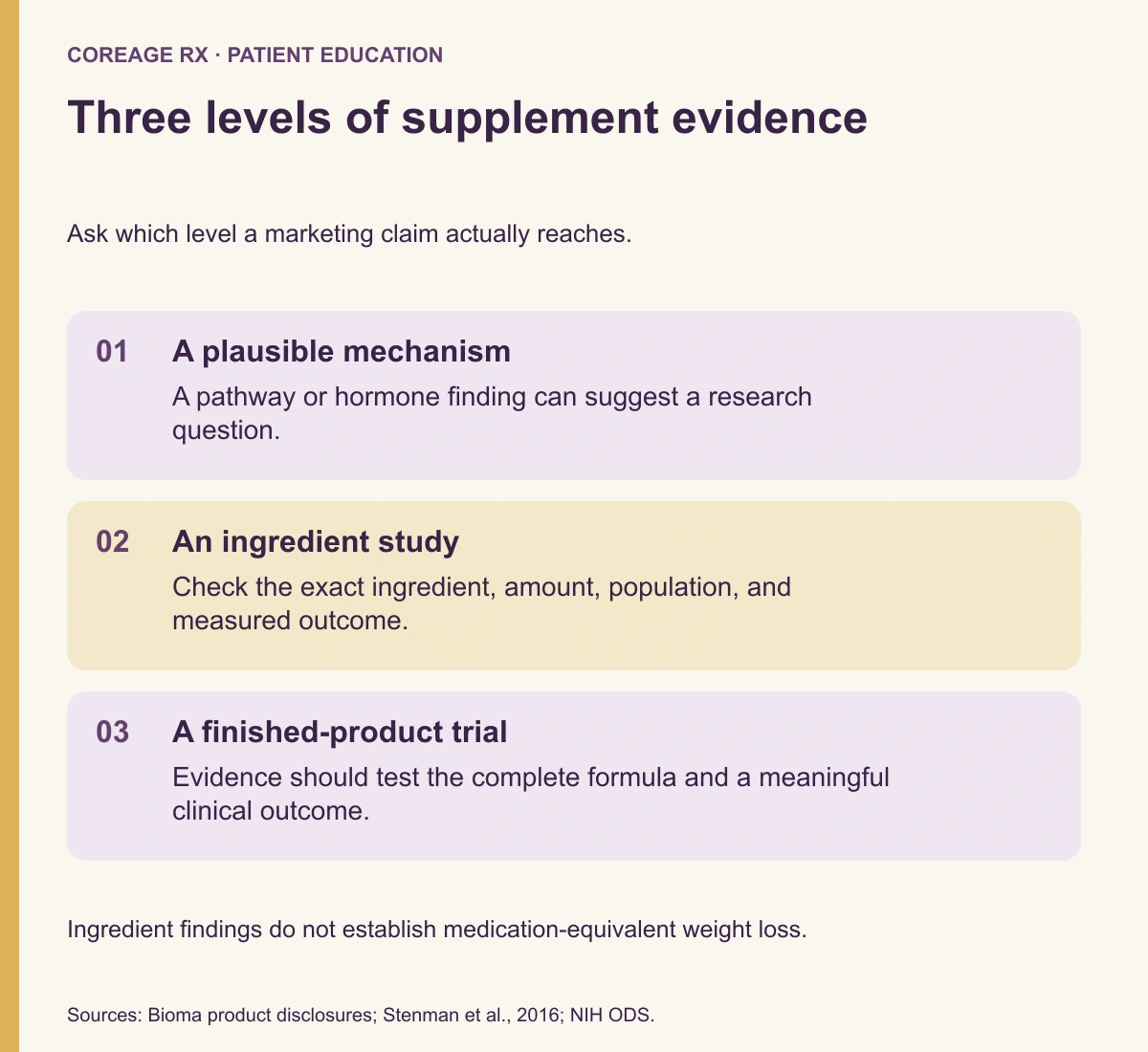
Bioma GLP-1 Booster is a dietary supplement marketed around appetite, gut bacteria, and the body’s natural GLP-1 signaling. Evidence about an ingredient or a hormone measurement is not the same as evidence that the finished supplement produces the outcomes of a prescription GLP-1 medicine. That is the central distinction to keep in mind when reviewing its claims.
This review examines the manufacturer’s public product information, relevant ingredient research, and supplement-evidence guidance. It is not a personal-use review, laboratory analysis, or clinical trial. CoreAge Rx offers weight-management care and supplements, so readers should understand that commercial interest. The same evidence standards discussed here apply to our own products.
Which Bioma product are we discussing?
Bioma sells several products. Its GLP-1 Booster should not be confused with the company’s separate probiotic product, nighttime formula, or other items displayed alongside it. Reviews that mix their ingredient lists can leave readers with the wrong understanding of what is in the bottle they are considering.
The GLP-1 Booster page describes a combination of prebiotic, probiotic, and other ingredients. It presents the product as a way to support natural GLP-1 activity and appetite control. It also includes a statement that the supplement is not a replacement for prescribed medication.
Before purchasing, match the exact product name and current Supplement Facts panel to the offer in your cart. Formulas and offers can change. A review of a different Bioma product, even a positive one, is not evidence about this particular formulation.
What ingredients does the manufacturer highlight?
The product page highlights Sukre, triacetin, HOWARU Shape B420, cayenne, and Akkermansia. The table below explains what to investigate about those ingredients; it does not certify the contents or effects of a bottle.
| Ingredient highlighted on the page | A useful evidence question |
|---|---|
| Sukre, described as a prebiotic ingredient | What exact substance and amount were studied, and was the result a human health outcome or a laboratory hormone response? |
| Triacetin | Does the cited research test the marketed oral formulation and dose in people seeking weight management? |
| HOWARU Shape B420 | Does the evidence concern this strain, at a comparable amount, with the same accompanying ingredients? |
| Cayenne | What was the dose and outcome in human studies, and how does that compare with the product? |
| Akkermansia | Was the studied preparation live or pasteurized, what strain or preparation was used, and is that comparable to the label? |
The names alone cannot resolve those questions. Probiotic research can be strain-specific, and a proprietary blend may make it difficult to match each ingredient to a study dose. Ask for the current label and the actual trial, rather than relying on a general statement that ingredients are clinically studied.
What does the B420 trial actually show?
One relevant randomized trial of B420 assigned 225 adults to a placebo, a specified fiber, B420, or B420 plus the fiber for six months. The study evaluated body fat and related measures. It did not test the finished Bioma GLP-1 Booster product.
The results also require more care than a headline about a probiotic causing weight loss. In the intention-to-treat analysis, which included 209 participants, there were no significant between-group differences in the primary body-fat outcome. Some favorable results appeared in analyses restricted to participants who completed the intervention with adequate adherence and other requirements.
That distinction matters. An analysis of selected completers answers a different question from an analysis that more fully preserves the randomized comparison. Body-fat change is also not interchangeable with total body-weight change. The trial can inform an ingredient discussion, but it does not establish that every product containing B420 will produce the same result.
The study used a defined B420 dose and a specific fiber preparation. A different ingredient combination, amount, or dosing pattern should not inherit the findings automatically. Funding and investigators’ industry affiliations are additional details worth reading when assessing any commercial ingredient study.
Does boosting natural GLP-1 mean it works like Ozempic?
No such equivalence follows from the phrase alone. GLP-1 is part of normal meal-related signaling. Prescription receptor agonists are medicines with product-specific pharmacology, clinical trials, dosing, contraindications, and monitoring requirements.
A study showing a change in a hormone level might help explain a mechanism. To establish a useful treatment effect, readers also need to know whether the finished product improves meaningful outcomes in an appropriate human trial, by how much, for how long, and with what harms or withdrawals.
For example, a percentage increase in a laboratory marker cannot be compared directly with a percentage of body weight lost in a medication trial. The denominators, measurements, and clinical meaning are different. Read what GLP-1 is and natural GLP-1 foods and supplements for a fuller explanation.

What evidence would make a product claim stronger?
A useful study would identify the exact finished formulation, enroll a relevant population, compare it with an appropriate control, and report outcomes over a meaningful period. It should also describe adverse events, withdrawals, adherence, and whether the analysis includes the people originally assigned to each group.
Questions to ask the company include:
- Was the current finished product tested, or are the citations about separate ingredients?
- What was the main outcome established before the study began?
- Were weight and health outcomes measured, or only appetite ratings and hormone markers?
- How many people dropped out, and how were their results handled?
- Is the complete study available, including funding and conflicts of interest?
Customer testimonials can describe an experience, but they cannot answer those questions. The NIH Office of Dietary Supplements explains the variable and often limited evidence behind weight-loss supplements. We did not identify a published randomized trial of the current finished Bioma GLP-1 Booster formulation in the materials reviewed for this article; that is a limit of this review, not proof that no additional research exists.
What does it cost?
On September 26, 2026, the product page displayed these subscription offer prices:
| Supply selected | Displayed price per bottle |
|---|---|
| One month | $50.39 |
| Three months | $35.75 |
| Six months | $27.09 |
These were advertised offer prices, not a guarantee of the amount you will be charged later. The page also displayed one-time-purchase options at different prices and stated that subscription plans renew until canceled. A price shown per bottle should not be mistaken for the total charge for a multi-bottle order. Source: official product page.
Before paying, check the order total, number of bottles, renewal date and amount, cancellation process, and refund conditions. The page mentions a 14-day money-back policy subject to terms. Keep the actual checkout and order terms; an introductory offer or a review may not describe every condition that applies to a later shipment.
Are there safety questions to consider?
“Natural” does not establish that a product is suitable for everyone or that it cannot cause an adverse effect. The complete formula, dose, medical history, and other medicines matter. Digestive symptoms after starting a supplement should not automatically be treated as proof that it is working.
Ask a clinician or pharmacist to review the current label if you take prescription medicines, have a significant medical condition, are pregnant or breastfeeding, or are considering the supplement for a child. People using medicines that affect blood sugar should discuss the whole regimen rather than independently adding products marketed for metabolic effects.
If you are already taking a GLP-1 medicine, decide what problem you are trying to solve before adding a supplement. A nutrition gap, constipation, medication intolerance, and a desire for additional weight loss are different questions. Our guides to supplements during GLP-1 treatment and probiotics during GLP-1 use help separate them.

How should it compare with CoreAge Rx products?
The comparison should use the same rules for every seller. CoreAge Rx GLP-1 Support is a supplement, not an FDA-approved replacement for diabetes or obesity medication. Its own ingredient list, evidence, and limitations need review; our ingredient guide provides a starting point.
Prescription care is a separate decision involving medical eligibility and follow-up. If you are comparing semaglutide information or tirzepatide information, clarify the exact preparation and whether it is compounded. FDA-approved products and compounded preparations are not automatically equivalent. The FDA’s current GLP-1 guidance explains that distinction.
Frequently asked questions
Is Bioma GLP-1 Booster a GLP-1 prescription medicine?
No. It is marketed as a dietary supplement. A statement about supporting the body’s GLP-1 signaling does not make it the same treatment as an approved receptor agonist.
Can I stop prescribed treatment and use this instead?
Do not stop or replace a prescription without discussing the plan with the prescribing clinician. This is particularly important when treatment is controlling diabetes or addressing another medical condition.
Do positive reviews prove that it causes weight loss?
No. Reviews do not control for changes in eating, activity, other treatment, expectations, or which customers choose to post. They may help identify practical questions, but they are not a substitute for a well-designed clinical study.
What is the most useful conclusion from this review?
Evaluate the current finished product, rather than the appeal of its mechanism. Ask for a clear label, relevant human evidence, realistic safety information, and complete recurring-cost terms. Apply that standard to Bioma, CoreAge Rx, and any other product you consider.
Educational information for adults; individual treatment decisions require a qualified clinician. Sources checked September 26, 2026. Original AI-generated article illustrations depict fictional people and objects, not patient outcomes. Other editorial images are illustrative. Graphics summarize the cited sources.