
CoreAge Rx GLP-1 Support is a dietary supplement containing microbial ingredients and prebiotic fibers. This guide reviews the disclosed product information and image; it is not a clinical trial or a hands-on effectiveness review. The name does not make the supplement equivalent to a GLP-1 receptor agonist medicine.
What the public material lists
| Item | Disclosed information |
|---|---|
| Bacterial species | Akkermansia muciniphila, Bifidobacterium infantis, Clostridium butyricum |
| Chicory inulin | 211 mg |
| Potato resistant starch | 100 mg |
| Front-label blend statement | 36 mg proprietary blend per serving |
| Routine | One capsule daily with 8 oz water, with or without food |
| Capsule description | Delayed-release vegetarian capsule |
| Storage | Refrigerate after opening |
The front image shows 30 capsules. Check the current bottle for the complete Supplement Facts panel, directions, and any updated information before use.
What milligrams do not tell you
The 36 mg blend statement describes weight. It is not 36 billion CFUs and does not reveal how many viable microorganisms are supplied. The reviewed public material also does not provide strain IDs for the three named species.
The NIH probiotic guidance explains why strain identity and appropriate quantity are important when comparing a product with human studies. Ask for those details and whether the microbial preparations are live, inactivated, or otherwise characterized.

Put the prebiotic amounts in context
The listed inulin amount is 0.211 g, and the resistant starch amount is 0.1 g. These small quantities should not be counted as a complete daily fiber plan. They also should not be equated to a trial using a much larger amount of an isolated fiber.
Read inulin evidence and resistant starch research for specific examples of why amount and preparation matter. Do not increase capsule servings to approximate a different study; that changes all components of the formula.
What can be said about outcomes?
There is research on particular preparations of the listed bacterial species. That does not establish the same result from this combination with undisclosed strains and viable counts. The Akkermansia article reviews both promising and nonsignificant human findings.
The product should not be described as a substitute for prescribed diabetes or weight-management treatment, or as a guaranteed solution for GLP-1 medicine side effects. Product positioning and clinical evidence are separate parts of the decision.
Review suitability and handling
NCCIH’s safety overview notes that serious illness and immune compromise can change the risks of microbial supplements. Discuss use with your care team in those situations, with significant digestive disease, or when taking medicines.
Plan for refrigeration after opening and follow the current directions. If symptoms are persistent or severe, seek advice rather than treating them as a necessary adjustment. The main supplement guide and label checklist can help you identify which questions are answered and which need more product information.
What this review covers
This is a review of the publicly available product information and its relationship to ingredient research. It is not a personal trial of the finished formula, and it does not establish that every result reported for an individual component applies to this product.
The goal is to make the disclosed details understandable: species names, fiber amounts, blend weight, dosage form, daily directions, and storage. The review also identifies information that was not disclosed in the public materials examined.
Use the current bottle for final instructions and request clarification if it differs from the product page. A specific label question is more useful than assuming all supplements with a GLP-1 theme contain the same ingredients or have the same evidence.

Read the microbial entries as species-level information
The page lists Akkermansia muciniphila, Bifidobacterium infantis, and Clostridium butyricum. These names identify the listed species. The reviewed material does not provide strain designations or a CFU count.
That limits comparisons with studies that used a particular strain and amount. It also leaves the live-versus-inactivated preparation insufficiently specified for some research comparisons, including Akkermansia studies using defined live or pasteurized materials.
Ask for the full identity and preparation information when it matters to the decision. Do not assume a well-known strain is present because it is the first one that appears in a search result. The probiotic-label guide explains why the additional detail is important.
Keep the 36 mg statement in the correct unit
The front product image states a 36 mg proprietary blend. Milligrams measure mass. They do not identify a viable-organism count, and 36 mg should never be rewritten as 36 billion CFUs.
The blend statement also does not disclose an individual amount for each species. Dividing it equally among three names would invent a formula that is not provided. A species count, a capsule count, and a blend weight each answer different questions.
When requesting quantity information, ask how each microbial preparation is appropriately measured and whether relevant claims are supported through expiration under the directed storage conditions. A larger-looking number is not a substitute for a clearly defined measurement.
Put the two listed substrates into gram context
The page lists 211 mg chicory inulin and 100 mg potato resistant starch. These convert to 0.211 g and 0.1 g, respectively. The combined listed weights total 0.311 g, which should not be described as a full daily fiber intake or as a multi-gram fiber intervention.
The conversions are useful for reading studies, but they do not establish a recommendation to increase capsules. The inulin trials discussed in this series used a much larger specified amount, and resistant-starch research also depends on the exact preparation and protocol.
The inulin article and resistant-starch article show how to preserve those differences. An ingredient can be present without supplying the same exposure used in a separate clinical trial.
Evaluate the combination as a finished formula
Combining microbial ingredients and substrates may be a formulation choice, but it does not automatically prove synergy or a larger health benefit. The finished combination needs to be evaluated for its own amounts, preparation, intended use, and evidence.
Research on one component can provide background. It cannot be added to research on another component as if the combined capsule had demonstrated every outcome from both. This is especially important when individual strain or quantity information remains unavailable.
Ask whether suitable human research exists for the exact formula and the outcome being proposed. If the reviewed material does not establish that, keep the limitation explicit. A clear product review does not need to turn an evidence gap into either a guarantee or a claim that no effect is possible.
Make the handling instructions part of the decision
The reviewed page describes a delayed-release vegetarian capsule, one daily with 8 oz water, with or without food. It instructs refrigeration after opening. Those details help you decide whether the routine fits your home, work, and travel circumstances.
A delayed-release description does not remove the need to follow storage instructions or establish a particular clinical outcome. If the product has been exposed to unusual temperatures, ask the manufacturer about the exact conditions and lot rather than relying on capsule appearance.
The storage guide and timing guide offer practical examples. Keep the current bottle information available for any manufacturer or clinician discussion.
Define realistic expectations before use
| Question | What the reviewed information allows |
|---|---|
| Which species are listed? | Three species are named |
| Which strains are present? | Not disclosed in the reviewed public material |
| How many viable organisms are supplied? | A CFU count is not disclosed |
| What fiber-related amounts are listed? | 211 mg inulin and 100 mg resistant starch |
| How is it used and stored? | Daily capsule directions and refrigeration after opening are provided |
| Is it a GLP-1 prescription substitute? | No; it is a dietary supplement with different evidence and use |
The NIH guidance and NCCIH overview provide context for why these questions should remain separate.
Review health circumstances and the purpose with a clinician
If you use a GLP-1 medicine, show the product to the prescriber or pharmacist rather than assuming the name establishes compatibility or symptom treatment. Persistent or severe digestive symptoms should receive appropriate assessment.
People who are seriously ill, immunocompromised, have a central venous catheter, or have significant digestive disease should discuss bacterial products with their care team before use. A general wellness description does not eliminate those considerations.
If a trial is considered appropriate, agree on the goal, label-directed routine, observations, and review point. Keep meals, other supplements, and treatment changes visible so later observations can be interpreted honestly.
Frequently asked questions
Does the product contain a disclosed 36 billion CFUs?
No such count appears in the reviewed material. The front image states 36 mg of a proprietary blend. Weight and CFUs are different measurements and should not be substituted.
Does it replace a prescribed GLP-1 medication?
No. It is a dietary supplement, and the name does not establish the same mechanism or clinical outcomes as a prescription. Keep treatment changes with the prescriber.
Can I take extra capsules for more inulin or resistant starch?
Do not exceed the current directions for that purpose. Extra capsules increase the entire formula, and isolated-fiber studies do not authorize a different regimen for this combination.
What information should I request if I want a stronger study comparison?
Ask for strain identities, preparation details, appropriate quantity information, usable-life support, and research on the finished formula for the intended outcome. Those details are more useful than a broad assurance of gut-health support.
Explore GLP-1 Support™
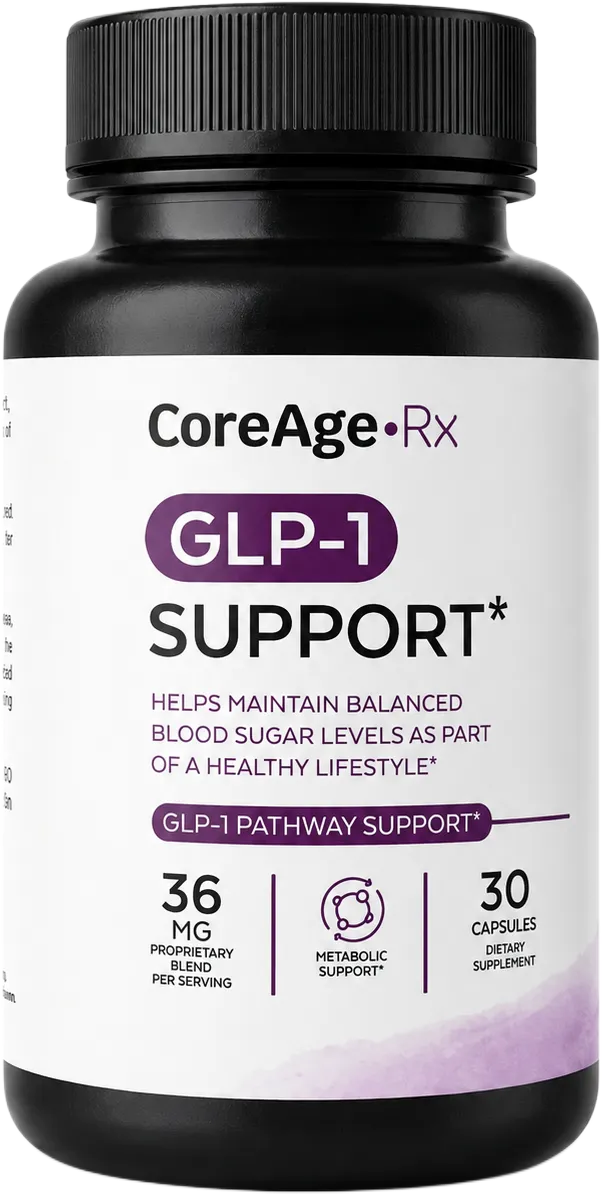
CoreAge Rx GLP-1 Support combines the three listed bacterial species with chicory inulin and potato resistant starch. It is a dietary supplement; it does not replace a GLP-1 prescription. See the current GLP-1 Support™ page and check the bottle you receive before use.
Related reading
- GLP-1 Support Supplements: Ingredients, Evidence, and Expectations
- How to Read a Probiotic Label: Strains, CFUs, and Storage
- Akkermansia Muciniphila Supplements: What Human Research Shows
- How fiber supplements differ from probiotic products
Educational information, not individualized medical advice. Product information and linked research checked September 15, 2026. Ingredient research does not establish identical effects for a finished supplement.