
Akkermansia muciniphila is a gut bacterium being studied for metabolic health. Human results are interesting but do not establish that every supplement listing the species causes weight loss or improves blood sugar. The preparation, strain, amount, population, and study design matter.
What the 2019 pilot showed
A randomized exploratory study enrolled 40 adults with overweight or obesity and insulin resistance; 32 completed it. Participants received a defined live or pasteurized preparation, or placebo, for three months.
The pasteurized preparation improved some metabolic measures compared with placebo. The reported body-weight difference did not meet conventional statistical significance. This is a useful early signal for research, not a basis for promising a particular amount of weight loss from a commercial product.
What a later trial adds
A 2025 randomized trial studied 58 people with overweight or obesity and type 2 diabetes for 12 weeks using the strain AKK-WST01. Overall between-group differences in body weight and HbA1c were not significant. A subgroup with low baseline Akkermansia showed more favorable findings.
Subgroup results can suggest who might benefit, but they do not turn an overall mixed result into a universal success. They also do not establish that a consumer microbiome test can reliably select a supplement regimen for you.

Four details to match before extrapolating
| Study detail | Why it matters |
|---|---|
| Strain or preparation | Different products may not use the same material |
| Live or pasteurized form | These are biologically different interventions |
| Amount and duration | A name does not establish an equivalent exposure |
| Participants and outcomes | Results in one clinical group may not apply to another |
The NIH probiotic guidance provides the broader principle that strain and product details matter. Mechanistic explanations about the microbiome are not substitutes for matching human evidence.
What this means for CoreAge Rx GLP-1 Support
The product page lists Akkermansia muciniphila with two other bacterial species, inulin, and resistant starch. The reviewed public material does not disclose a strain ID, CFU count, or enough preparation detail to equate it with either trial above.
That does not prove the product cannot have an effect. It means the cited trials cannot honestly be presented as clinical proof for this finished combination. The product is also a dietary supplement, not a GLP-1 receptor agonist medicine.
A sensible next step
Ask for the current label and strain/preparation details, identify the outcome you care about, and discuss use with your clinician when relevant. Do not change diabetes or weight-management treatment based on a supplement headline.
Read probiotics and weight-loss evidence and how to read a probiotic label to keep the research in proportion to what a specific bottle discloses.

Distinguish a biological association from an intervention
Microbiome research can examine whether a microorganism is associated with a health characteristic. Supplement research asks a different question: what happens when people receive a defined preparation under specified conditions? An association does not automatically answer the intervention question.
This distinction matters when an article moves quickly from “this bacterium is linked with metabolic health” to “taking a capsule will cause weight loss.” The second statement requires suitable human intervention evidence, including the amount, preparation, population, and outcome.
Akkermansia is an active research topic, but interest in a mechanism should not be confused with a settled clinical recommendation for every consumer. Read the human trials as specific pieces of evidence rather than as confirmation of every commercial claim using the species name.
Read the 2019 pilot as exploratory evidence
The 2019 study enrolled 40 adults with overweight or obesity and insulin resistance, with 32 completing the study. Participants received a defined live preparation, a pasteurized preparation, or placebo over three months. This design allows more useful comparisons than an uncontrolled before-and-after story.
The reported improvements in some metabolic measures with the pasteurized preparation are reasons for continued research. However, the body-weight difference did not reach conventional statistical significance. A summary should retain that distinction rather than converting all favorable-looking numbers into confirmed effects.
The sample size and exploratory nature also matter. A pilot can help identify feasibility and signals worth testing, but it is not a basis for promising a particular number of pounds lost from any commercial Akkermansia product. The original trial is the appropriate reference for its specific findings.
Interpret the later trial without hiding the overall result
The 2025 study used AKK-WST01 in 58 people with overweight or obesity and type 2 diabetes over 12 weeks. The overall between-group differences in body weight and HbA1c were not significant, while a subgroup with low baseline Akkermansia showed more favorable findings.
Both parts belong in the summary. Reporting only the subgroup can make the trial sound more uniformly positive than its overall result. Reporting only that no overall difference was significant can also omit a potentially useful research lead. The accurate interpretation preserves the distinction and the uncertainty.
A subgroup result may help shape future studies, but it does not automatically validate a consumer testing-and-supplement protocol. Whether a test can reliably guide an individual treatment choice is a separate clinical question. The 2025 trial should not be used to invent a personal selection rule from a general microbiome result.
Understand “not statistically significant” carefully
A result that does not reach a statistical threshold is not proof that the true effect is exactly zero. It means the study did not establish the comparison with the required degree of statistical support under its methods. The size and precision of the estimate, design, and sample all matter.
For a product review, the practical consequence is restraint. You should not advertise a confirmed weight-loss effect from a nonsignificant difference. At the same time, you do not need to claim that future research can never find a benefit.
This is a useful middle position for emerging evidence: describe what the study supports, what it leaves uncertain, and what details would need to match before applying it to a product. Scientific uncertainty should remain visible rather than being replaced by either a guarantee or a dismissal.
Compare the trial preparations with the actual label
The CoreAge Rx GLP-1 Support page lists Akkermansia muciniphila within a formula containing two other bacterial species, inulin, and resistant starch. The reviewed public information does not identify the strain, viable count, or live-versus-inactivated preparation in enough detail to equate it with either trial.
That is a specific evidence gap. The studies can provide background on Akkermansia research, but they cannot be represented as direct clinical proof for this finished blend. Its 36 mg front-label statement is also not a CFU count or a disclosed amount of Akkermansia alone.
Ask for the missing identity, preparation, and quantity information if study matching is important to your decision. The probiotic-label guide provides a worksheet for keeping those questions organized.
Keep metabolic treatment decisions separate
Do not change diabetes medicines, weight-management prescriptions, or clinical monitoring because a supplement contains a bacterium discussed in metabolic research. A trial finding about a specific preparation does not establish an alternative treatment plan for an individual reader.
If you are considering the product, tell your clinician the goal and bring the current label. Discuss symptoms, relevant medical conditions, and other supplements. People who are seriously ill or immunocompromised need particular care in reviewing bacterial products.
The practical decision may be to request more information, consider a clinician-supported trial, or choose another approach. It should remain tied to the actual product and health context rather than the appeal of an emerging research topic.
Frequently asked questions
Do the human trials prove every Akkermansia supplement causes weight loss?
No. The trials used defined preparations in specific populations, and their weight findings were not uniformly positive. A commercial species-only label does not establish equivalence to those interventions.
Is pasteurized Akkermansia the same as a live preparation?
They are different preparations and should not be treated as interchangeable in a study comparison. Ask which form a product supplies instead of assuming the species name answers that question.
Can a home microbiome test tell me whether I should take it?
The subgroup finding described here does not establish a validated personal testing-and-treatment routine. Discuss any test and its clinical usefulness with a qualified professional rather than turning one research result into an automatic supplement decision.
Does GLP-1 Support disclose AKK-WST01?
The reviewed public material does not identify that strain or another Akkermansia strain designation. Do not assume it is present because it appears in a published trial.
Explore GLP-1 Support™
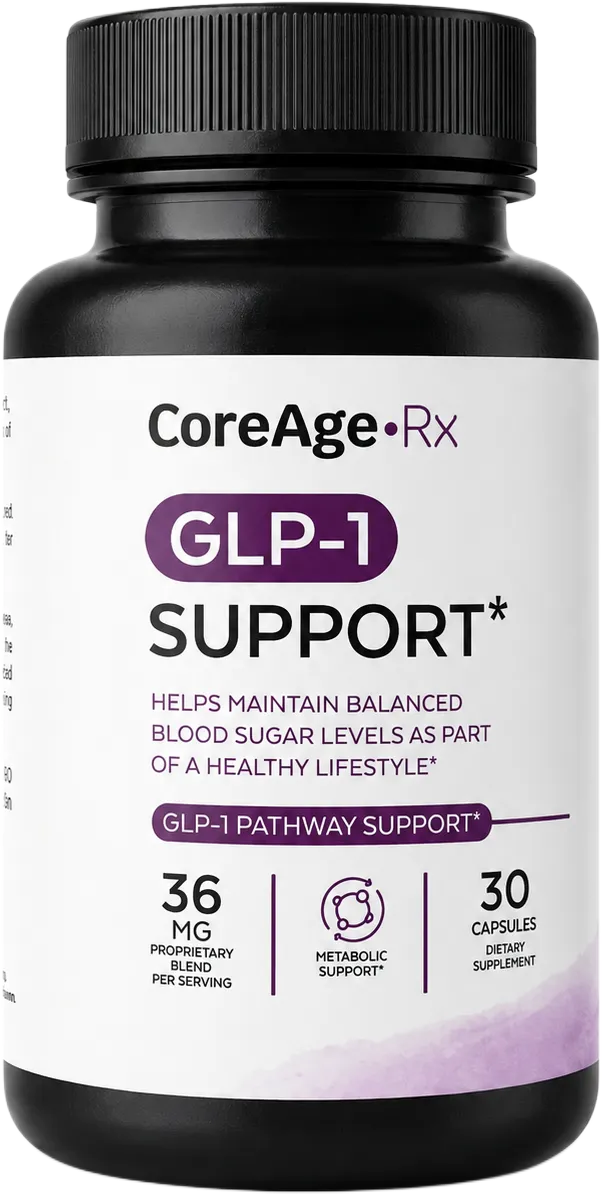
CoreAge Rx GLP-1 Support combines the three listed bacterial species with chicory inulin and potato resistant starch. It is a dietary supplement; it does not replace a GLP-1 prescription. See the current GLP-1 Support™ page and check the bottle you receive before use.
Related reading
- GLP-1 Support Supplements: Ingredients, Evidence, and Expectations
- How to Read a Probiotic Label: Strains, CFUs, and Storage
- Probiotics for Weight Loss: Why Results Do Not Apply to Every Product
- How fiber supplements differ from probiotic products
Educational information, not individualized medical advice. Product information and linked research checked September 15, 2026. Ingredient research does not establish identical effects for a finished supplement.