Probiotic research does not support treating every product as a weight-loss supplement. Some studies report small improvements, others do not, and results depend on the strain, formula, population, and accompanying diet. A promising microbiome finding is not a guaranteed change on the scale.
Look beyond the headline average
The NIH probiotic review describes inconsistent weight-related results and small effects of uncertain practical importance in some analyses. A pooled average across different products cannot be assigned to a bottle containing different organisms or undisclosed amounts.
Ask what was tested and whether the difference was meaningful to participants. A small change in a laboratory marker, waist measurement, or bacterial abundance is not the same outcome as sustained weight loss or improved health.
Understand control groups
If both the supplement group and placebo group lose weight, the relevant question is whether the groups differ. Reporting only the change from baseline in the supplement group can make an ordinary lifestyle effect look like a product effect.
A 2025 Akkermansia trial illustrates this issue: both groups improved on some measures, but overall between-group differences in weight and HbA1c were not significant. More favorable subgroup findings were interesting, but they did not establish a universal effect.

Use a study-to-product checklist
| Check | What you need |
|---|---|
| Organism | Exact strain or preparation |
| Amount | A comparable serving and measurement |
| Participants | A population relevant to your circumstances |
| Other interventions | Diet, activity, and treatment changes |
| Outcome and duration | The result measured and how long it lasted |
This helps separate a reasonable research discussion from a sales claim that skips the details. Animal and laboratory studies can suggest mechanisms, but they do not predict an individual’s result from a commercial supplement.
What this means for GLP-1 Support
CoreAge Rx’s formula lists three species plus inulin and resistant starch. The reviewed public materials do not disclose strain IDs or CFUs, and do not establish a trial showing a specific weight-loss effect from the finished combination.
It should not be presented as a replacement for prescribed GLP-1 treatment or as a product that reproduces the results of medication trials. The main supplement guide explains the difference between the name and the clinical evidence.
Keep your decision practical
If you are considering a product, define a realistic reason, review it with your care team when appropriate, and decide how you would assess usefulness and tolerance. Do not use a supplement to justify skipping meals, follow-up, or prescribed treatment.
Read Akkermansia research and label interpretation for a closer look at the evidence gaps. Weight management involves more than selecting a microbial ingredient with a promising headline.
A pooled average is not a promise for every product
Reviews may combine trials that use different strains, combinations, amounts, populations, and durations. The resulting average can be informative about the studies included, but it does not identify one universal probiotic effect that belongs to every bottle.
This matters when a product page cites a review without showing whether the formula resembles the tested interventions. A positive average across varied studies does not establish that a particular undisclosed-strain blend produces the same result.
The NIH probiotic guidance discusses the importance of strain and product specificity. Read the review alongside the actual label rather than treating the category word probiotic as sufficient evidence of equivalence.

Understand the role of the comparison group
People can lose weight during a study for reasons that also affect the control group, such as dietary guidance, activity changes, or participation in a structured program. A change from the starting weight in the supplement group does not by itself show an added supplement effect.
The key comparison is what happened relative to the appropriate control under the study design. If both groups changed similarly, reporting only the supplement group’s before-and-after number can be misleading.
This principle also applies to testimonials. A person who begins a supplement while changing meals and exercise cannot isolate the capsule’s contribution from the experience alone. The story may be sincere while remaining insufficient to establish a product-specific effect.
Look at outcome, size, precision, and duration
A study may measure body weight, waist circumference, body-composition estimates, blood markers, or microbial changes. These outcomes are different and should not be substituted for one another. A change in a laboratory marker is not automatically a measured loss of body fat.
Consider how large and precise the reported difference is and how long it was observed. A short study may not answer whether a change persists. A statistically supported difference may still need clinical context to determine whether it is meaningful for a person’s goals.
Avoid interpreting a nonsignificant result as a confirmed benefit simply because its direction looks favorable. Also avoid treating it as proof that no future study could find an effect. Accurate summaries preserve what was established and what remains uncertain.
Use the Akkermansia trials as a concrete example
The 2019 exploratory Akkermansia trial found improvements in some metabolic measures with a defined preparation, while its body-weight difference did not meet conventional statistical significance. The 2025 trial found no significant overall between-group difference in body weight or HbA1c, while reporting more favorable findings in a subgroup.
These results illustrate why a headline such as “Akkermansia causes weight loss” is too broad. The preparation, population, overall comparison, and subgroup findings all matter. The Akkermansia article explains the two studies in more detail.
The trials also do not establish that a different blend containing a species-level Akkermansia entry reproduces either result. Study evidence and product identity need to be connected before a direct claim is justified.
Compare CoreAge Rx GLP-1 Support with that standard
The reviewed product information names three bacterial species but does not disclose strain IDs or CFUs. It also lists 211 mg inulin and 100 mg resistant starch. Those details identify a combination formula, not a direct match to every study on its individual ingredients.
The front-label 36 mg statement is a weight, not a viable-organism count or a guarantee of a particular effect. The product name likewise does not establish the mechanism or weight-loss results of a GLP-1 prescription.
Ask whether the finished formula has suitable human research for the proposed outcome. If that evidence is unavailable in the reviewed material, describe the limitation. Ingredient studies can provide background without becoming clinical proof for the commercial combination.
Keep the broader weight-management plan in view
Food intake, activity, sleep, medical conditions, and treatment can all affect a weight-management plan. A microbial supplement should not be used to replace adequate meals or prescribed care. It should also not create pressure to reduce food further when the expected result does not appear.
If appetite is low during treatment, the priority may be maintaining adequate protein and overall nourishment. If digestive symptoms are persistent, the priority may be assessment. A supplement marketed for weight-related support does not automatically answer either problem.
The NIH weight-loss supplement review provides broader context for evaluating product claims. Discuss the actual goal and formula with your care team when medical treatment or health conditions are involved.
Judge practical value without overstating causation
If a clinician supports a product trial, decide what you will monitor and when to review it. Record major changes in medicines, meals, and activity so later observations have context. A short personal trial can help assess tolerance and convenience, but it cannot isolate a clinical effect with the certainty of a controlled study.
Cost and storage requirements are legitimate considerations. A product may be inconvenient or difficult to maintain even when the research topic is interesting. Continuing should remain a decision based on the actual routine and evidence, not on a sunk purchase cost.
Do not escalate servings to chase a scale result. More of an unspecified blend does not establish a stronger effect and changes the entire formula. Follow the current label and reassess the original purpose.
Frequently asked questions
Do all probiotic strains have the same weight effect?
No. Strains, preparations, amounts, and populations differ. A result for one intervention cannot automatically be transferred to every product in the category.
Is a before-and-after weight change enough to prove benefit?
No. Other changes and the control-group comparison matter. A person or study group can lose weight during a broader program without establishing an added effect from the supplement itself.
Does a microbiome change prove fat loss?
No. Microbial measurements and body-fat outcomes are different endpoints. Look for the clinical outcome actually measured and avoid substituting a mechanism for a demonstrated result.
Can GLP-1 Support replace prescription weight treatment?
It should not be treated as a replacement. It is a dietary supplement with different ingredients and evidence. Keep prescription decisions and monitoring with the prescriber.
Should I choose the highest CFU count for weight loss?
The largest number alone does not identify the most relevant evidence. The exact strain, preparation, amount used in suitable research, and personal circumstances matter more than a category-wide higher-is-better rule.
Explore GLP-1 Support™
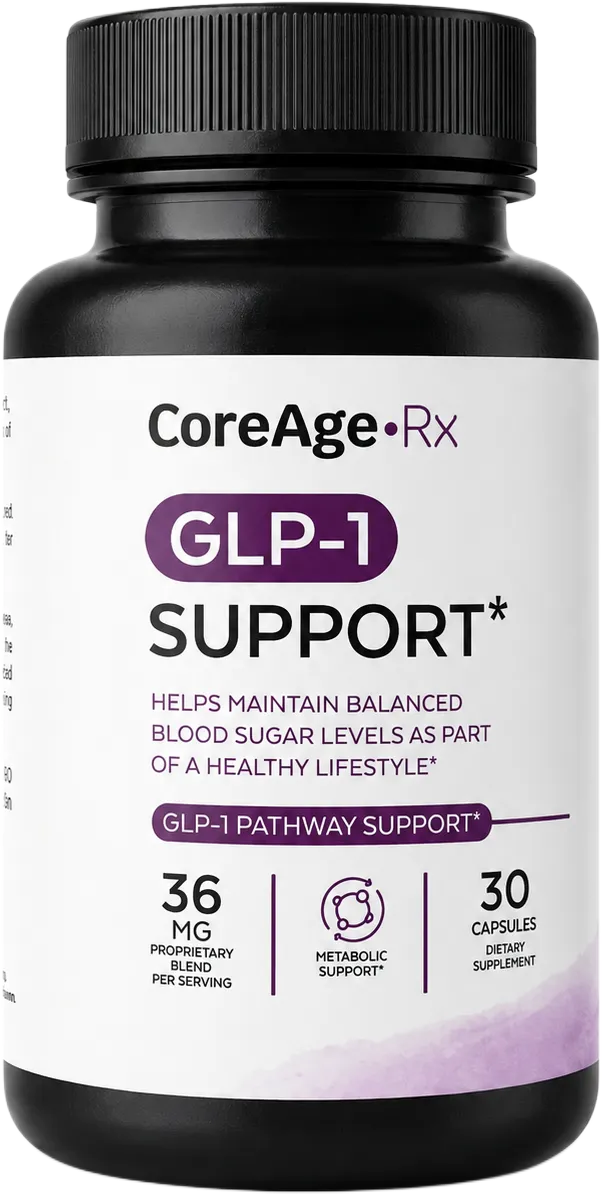
CoreAge Rx GLP-1 Support combines the three listed bacterial species with chicory inulin and potato resistant starch. It is a dietary supplement; it does not replace a GLP-1 prescription. See the current GLP-1 Support™ page and check the bottle you receive before use.
Related reading
- GLP-1 Support Supplements: Ingredients, Evidence, and Expectations
- Akkermansia Muciniphila Supplements: What Human Research Shows
- Resistant Starch and Gut Health: Foods, Supplements, and Amounts
- How fiber supplements differ from probiotic products
Educational information, not individualized medical advice. Product information and linked research checked September 15, 2026. Ingredient research does not establish identical effects for a finished supplement.