Apple cider vinegar powder in a capsule is not automatically equivalent to a measured amount of liquid vinegar. The powder amount, composition, and acetic-acid content would be needed for a meaningful comparison. A shared ingredient name does not establish the same effect.
Start with the disclosed amount
A label may list vinegar powder separately or include it within a proprietary blend. If only the blend total is shown, you cannot calculate the vinegar powder amount or its active constituents. The FDA’s labeling guidance explains that individual amounts may be undisclosed within such blends.
Avoid converting milligrams of an unspecified powder into tablespoons of liquid vinegar. Liquid products have their own concentration and preparation, and the supplement panel may not provide enough information to connect the two.
The Full House example
Full House lists apple cider vinegar powder after konjac root extract, psyllium husk powder, and glucomannan. The pictured panel gives a 1,525 mg total blend per two capsules, not a separate amount of vinegar powder or acetic acid.
That means the label does not support a precise comparison with a study using a defined quantity of liquid vinegar. It also does not show that vinegar is the principal contributor to any fullness or digestive effect from the blend.

Questions to ask about a research claim
| Research detail | Why it matters |
|---|---|
| Liquid or powder | The preparations may differ |
| Amount and concentration | A name alone does not establish dose equivalence |
| Finished formula | A combination may contain other active ingredients |
| Outcome measured | Blood tests, appetite ratings, and weight are different outcomes |
| Study quality and status | A result needs a credible design and current publication status |
Do not rely on a dramatic headline without checking the actual study and whether the product matches it. Evidence about one preparation cannot be used to promise a specific result from an undisclosed amount in another.
Do not use the ingredient to change treatment
Vinegar powder is not a substitute for prescribed diabetes or weight-management treatment. Discuss a multi-ingredient supplement with your clinician if you take medicines or have a medical condition. The FDA supplement overview explains why nonprescription availability does not remove interaction and safety questions.
Do not add liquid vinegar or extra capsules simply to make a product resemble a study. That creates a new regimen with its own tolerability and medication considerations.
Keep the whole formula in view
For Full House, the practical questions include the undisclosed individual amounts, the directed two-capsule serving, and the 8 oz water instruction. Read fiber and fullness and the Full House ingredient guide to evaluate the combination as labeled rather than assigning all of its intended benefits to one recognizable ingredient.
The ingredient name does not establish the preparation
Apple cider vinegar can appear in discussions of liquid foods, capsules, gummies, or powdered blends. Those formats should not be assumed to provide the same amount of the same relevant components. The product’s actual preparation and disclosure matter.
A study using a measured volume of a particular liquid cannot be converted into a powder-capsule dose from the words “apple cider vinegar” alone. You would need suitable information about the powder’s amount and composition to begin evaluating equivalence.
This is the central question for a blend such as Full House. The reviewed panel identifies apple cider vinegar powder as an ingredient, but it does not disclose its individual amount or an acetic-acid amount. A familiar name is useful for identification, but it leaves important dose questions unanswered.

Work through the missing-information problem
Full House lists 1,525 mg of a total proprietary blend per two capsules. That blend also includes konjac root extract, psyllium husk powder, and glucomannan. The entire 1,525 mg cannot be assigned to the vinegar powder.
Dividing the total equally among four ingredients would not solve the problem. It would assume a recipe the label does not disclose. Even a known powder weight would not automatically reveal an equivalent volume of liquid vinegar without appropriate composition information.
The honest comparison therefore records the vinegar-powder amount as undisclosed in the reviewed panel. This prevents a precise-looking calculation from becoming the basis for a health claim or an increased serving.
Read a research claim from the outcome backward
If a claim concerns body weight, look for a study that measured body weight under suitable conditions. If it concerns blood glucose, ask which glucose measure, population, and intervention were studied. An appetite rating, a laboratory mechanism, and a clinical outcome are different kinds of evidence.
Then work backward to the product: does the form match, is the relevant amount known, and was the finished formula tested? A result involving liquid vinegar does not automatically establish the same result for an undisclosed amount in a multi-ingredient capsule.
Study quality and publication status also matter. Before relying on a dramatic finding, check the original publication for corrections or retractions and consider the design and follow-up period. A widely repeated headline does not become more reliable through repetition.
Keep glucose and weight treatment with the care team
A vinegar ingredient should not be used as a reason to change prescribed diabetes or weight-management treatment. The reviewed Full House label does not establish a substitute for those medicines or for clinical monitoring.
If you take medicines or have a relevant medical condition, bring the whole formula into the review. The question is not only whether vinegar has been studied somewhere; it is whether this exact product and routine fit your circumstances.
Report symptoms or unexpected changes to the appropriate clinician. Do not interpret a new sensation as proof that the supplement is correcting blood sugar or accelerating fat loss. Such conclusions require appropriate assessment rather than inference from how a serving feels.
Review the rest of the formula with equal care
Full House is not a standalone apple cider vinegar product. Its fiber-related ingredients and water directions remain relevant even if the vinegar name drew your attention. The reviewed serving is two capsules daily with an 8 oz glass of water.
Do not ignore swelling-fiber precautions because an article is focused on vinegar. Swallowing difficulty, significant unexplained digestive symptoms, fluid restrictions, and oral-medicine timing may affect the overall decision. The Full House ingredient guide considers the formula together.
Likewise, increasing the serving to obtain more vinegar powder increases every other blend ingredient. Missing amounts cannot be repaired by taking more capsules. If a quantified ingredient is central to the purpose, discuss a product with suitable information rather than guessing.
Compare practical value without promising a treatment effect
Someone may prefer capsules to the taste of liquid vinegar, but preference does not establish dose equivalence or effectiveness. Compare the actual directions, disclosed amounts, other ingredients, current price, and purpose of use.
If the main reason for purchase is a specific clinical promise, ask what evidence supports the exact formula and amount. The NIH weight-loss supplement review provides a broader framework for evaluating supplement claims, while the FDA guidance explains regulatory limits.
If the information needed for the comparison is unavailable, keep that limitation in the decision. An optional product does not need to be defended as a treatment to be evaluated honestly for its practical features.
A focused question list for the manufacturer
| Information to request | What it would clarify |
|---|---|
| Individual vinegar-powder amount | How much of the ingredient is in the serving |
| Relevant composition or standardization | Whether a comparison with another preparation is possible |
| Research on the finished formula | Whether ingredient findings apply directly to this product |
| Current full label | Directions and other ingredients in the actual item |
| Explanation of a specific health claim | Which outcome and evidence the claim relies on |
These questions are more useful than asking only whether the product is “strong.” Strength has no clear meaning until the relevant substance, amount, and purpose are identified.
Frequently asked questions
How many tablespoons of vinegar equal two Full House capsules?
The reviewed information does not support that conversion. The individual powder amount and relevant composition are not disclosed. Do not invent a liquid equivalent from the total blend weight.
Does the powder automatically have the same effects as liquid vinegar?
No equivalence should be assumed from the ingredient name alone. Form, amount, composition, and the study conditions matter. A multi-ingredient capsule is a separate product to evaluate.
Is the whole 1,525 mg blend apple cider vinegar?
No. That is the combined blend weight for four listed ingredients. The panel does not state how much belongs to the vinegar powder.
Can I take extra capsules to reach a research amount?
Do not increase the serving based on a calculation the label cannot support. Extra capsules also increase the fiber-related components. Follow the current directions and seek individualized advice about the actual goal.
Explore Full House™
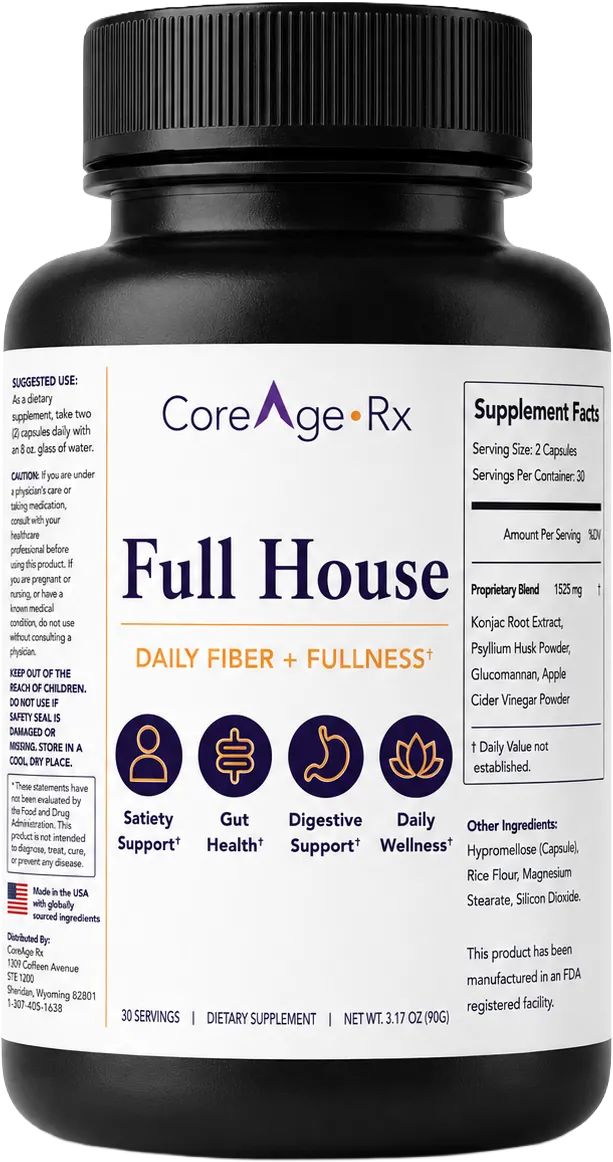
Full House combines konjac root extract, psyllium husk powder, glucomannan, and apple cider vinegar powder in a 1,525 mg proprietary blend per two capsules. See the current Full House™ page and check the bottle you receive before use.
Related reading
- Fiber Supplements: Types, Labels, and How to Choose
- Glucomannan and Konjac: Understanding This Fiber Ingredient
- Fiber and Fullness: What the Evidence Can and Cannot Promise
- Constipation while taking a GLP-1 medication
Educational information, not individualized medical advice. Product information and linked research checked September 15, 2026. Ingredient research does not establish identical effects for a finished supplement.