
Full House is CoreAge Rx’s daily fiber and fullness supplement. This guide reviews its public product information and pictured label, including what the disclosed blend weight can and cannot tell you. It is not a hands-on review or a clinical test of the finished formula.
The pictured label at a glance
| Item | Disclosed information |
|---|---|
| Serving | Two capsules |
| Servings per container | 30 |
| Proprietary blend | 1,525 mg per serving |
| Suggested use | Two capsules daily with an 8 oz glass of water |
| Storage | Cool, dry place |
The 1,525 mg is the total blend, equivalent to 1.525 g of blend material. It is not a stated amount of dietary fiber, psyllium, glucomannan, or vinegar powder individually.
What is inside?
The blend lists konjac root extract, psyllium husk powder, glucomannan, and apple cider vinegar powder. The pictured other-ingredients section lists hypromellose for the capsule, rice flour, magnesium stearate, and silicon dioxide.
The FDA’s labeling guidance explains the disclosure pattern used for proprietary blends. Because individual amounts are not provided, the panel does not establish that the product matches a study using a specified dose of isolated psyllium or glucomannan.

Understand the ingredient evidence
Psyllium is used in bulk-forming laxative products, as described by MedlinePlus. Glucomannan is a konjac-derived fiber, but NIH’s review finds inconsistent weight-loss evidence. Those facts do not establish identical effects from this particular combination.
The names “konjac root extract” and “glucomannan” should not be added together as two known doses. The extract concentration and separate amounts are undisclosed. Apple cider vinegar powder also cannot be equated to a measured amount of liquid vinegar from this panel.
Who should review it before use?
The pictured caution calls for clinician consultation with medication use, pregnancy, nursing, or a known medical condition. Difficulty swallowing, a history of obstruction, or significant unexplained digestive symptoms are especially relevant questions for water-absorbing fibers.
If you have a fluid restriction, discuss how that fits with the directed glass of water. Ask a pharmacist about oral medicine timing rather than assuming a general interval applies to everything you take.
What is a reasonable expectation?
Consider the product’s intended role in a daily routine, but do not expect a guaranteed appetite reduction, weight change, or constipation treatment from an undisclosed ingredient amount. If you are trying to reach a fiber target, use food labels and products that disclose dietary-fiber grams appropriately.
The main fiber guide, fiber-and-fullness article, and medicine-timing checklist can help you decide what to ask. Check the current bottle before use and reassess any routine that causes persistent discomfort or does not address a clear need.
What the label review can establish
This guide evaluates the reviewed public label and product information. It identifies the ingredients, disclosed serving, directions, and limits of the available amounts. It does not claim that the finished formula has been tested for every outcome discussed in ingredient research.
That distinction is especially important for proprietary blends. A label can identify relevant ingredients while leaving the quantities needed for a precise research comparison unknown. A practical review should show both the useful information and the unresolved questions.
Use the current bottle for final directions. If its panel differs from the reviewed material, ask the manufacturer to clarify the change before relying on an older description.

Translate the serving without changing its meaning
The reviewed serving is two capsules containing a 1,525 mg proprietary blend. Converting the unit gives 1.525 g of total blend. It does not establish 1.525 g dietary fiber, 1.525 g psyllium, or 1.525 g glucomannan.
The blend contains four listed components: konjac root extract, psyllium husk powder, glucomannan, and apple cider vinegar powder. Their individual amounts are not disclosed in the reviewed panel. Equal division would be an invented formula rather than a label fact.
This is the most important arithmetic point for comparing Full House with foods or other supplements. A product that states dietary-fiber grams provides a different kind of information from a product stating only a mixed-blend weight.
Review each ingredient at the appropriate level
Konjac root extract: identifies a source-related ingredient, but the reviewed label does not give its individual amount or a specification that would support a precise glucomannan conversion.
Psyllium husk powder: identifies a fiber ingredient used in bulk-forming products. Research and instructions for quantified psyllium preparations provide context, while the amount in this blend remains undisclosed.
Glucomannan: identifies a konjac-associated soluble fiber discussed in fullness and weight-management research. Findings should be read with their dose and preparation details, and the NIH review describes inconsistent weight-loss evidence.
Apple cider vinegar powder: identifies another blend component. Its individual amount and a liquid-vinegar equivalent are not established by the reviewed information. The vinegar-powder guide explains why format and composition matter.
These descriptions identify the ingredients’ roles in the comparison. They do not add four separate benefit promises into a guaranteed effect for the finished capsule.
Include the capsule and other ingredients in the review
The reviewed other ingredients are hypromellose for the capsule, rice flour, magnesium stearate, and silicon dioxide. This information is relevant when checking preferences, restrictions, or a previous reaction.
Do not assume the capsule can be opened or mixed into food simply because the contents are powder. The reviewed directions describe taking capsules with water. Ask the manufacturer or a qualified professional before changing the method of use.
If a specific allergy or medically required restriction matters, review the current label and obtain relevant manufacturer information. A general ingredient list does not establish every manufacturing detail needed for an individual restriction.
Make the directed routine concrete
The reviewed directions specify two capsules daily with an 8 oz glass of water. Have the water ready before taking the serving. A capsule format does not remove the liquid requirement for a formula containing swelling fibers.
Choose a time that fits medicines and ordinary daily activities. Ask a pharmacist to review oral-medicine timing when relevant; do not assume one universal separation interval applies to all drugs. If fluids are restricted or swallowing is difficult, get individualized advice before use.
Store the product in a cool, dry place according to the current label. Keep the bottle and lot information available if a question or reaction needs to be discussed. Accurate product identification helps both manufacturer and clinical reviews.
Match expectations to the evidence
| Proposed expectation | What the reviewed information supports |
|---|---|
| A capsule-format blend | The ingredient list and two-capsule directions identify that format |
| A known daily dietary-fiber contribution | A dietary-fiber amount is not stated in the reviewed panel |
| Equivalence to isolated psyllium or glucomannan studies | Individual amounts are not disclosed |
| Predictable appetite suppression or weight loss | Not established by the label or ingredient names |
| Suitability with every medicine or digestive condition | Requires individualized review |
This table helps keep the product’s practical features separate from claims that require more evidence. The FDA labeling guidance and fiber review provide context for that distinction.
Know when the supplement decision needs clinical input
Discuss use before starting if you have swallowing difficulty, relevant bowel conditions, a fluid restriction, significant unexplained symptoms, or medicines requiring review. Bring the complete label and explain the reason you are considering the product.
Seek prompt assessment for severe or worsening abdominal pain, repeated vomiting, trouble swallowing, blood in stool, or inability to pass stool and gas. Those symptoms should not be interpreted as useful fullness or a reason to take more capsules.
If the product is being considered for persistent constipation, keep the symptom plan with a clinician. A supplement comparison cannot determine every underlying cause or establish that a proprietary blend is the appropriate treatment.
Frequently asked questions
Does Full House provide 1.525 g of fiber?
The reviewed panel states 1.525 g of total proprietary blend, not a dietary-fiber amount. Preserve that distinction when comparing products or recording intake.
Can I tell how much psyllium is in the serving?
Not from the reviewed panel. Psyllium is listed, but its individual amount is not disclosed. Do not calculate an amount by dividing the blend equally among ingredients.
Is this a replacement for a food-fiber plan?
It should be evaluated for a specific purpose while fiber-containing foods and broader nutrition remain visible. A capsule blend does not reproduce all the nutrients and meal structure supplied by foods.
Can I take more for a stronger fullness effect?
Do not exceed the current directions to chase a sensation. Extra servings increase every ingredient, and the reviewed information does not establish a predictable dose-response for the finished product. Reassess the goal and suitability with a qualified professional.
Explore Full House™
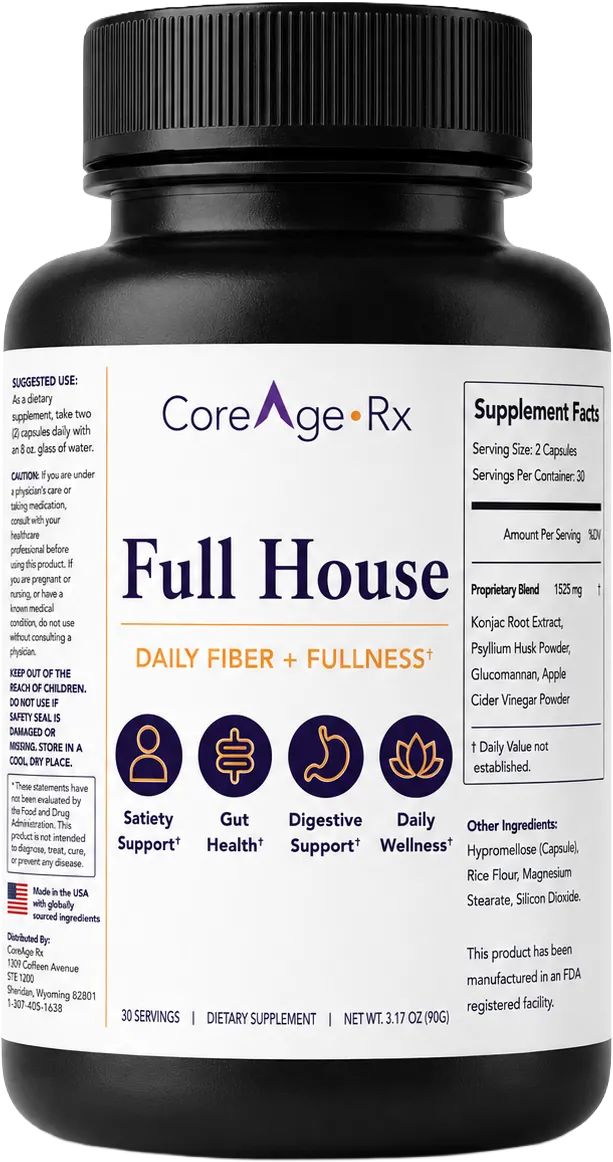
Full House combines konjac root extract, psyllium husk powder, glucomannan, and apple cider vinegar powder in a 1,525 mg proprietary blend per two capsules. See the current Full House™ page and check the bottle you receive before use.
Related reading
- Fiber Supplements: Types, Labels, and How to Choose
- Psyllium vs. Glucomannan: What Is the Difference?
- Fiber Capsules vs. Powder: Compare Grams, Not Serving Counts
- Constipation while taking a GLP-1 medication
Educational information, not individualized medical advice. Product information and linked research checked September 15, 2026. Ingredient research does not establish identical effects for a finished supplement.