Psyllium and glucomannan are different fiber ingredients. Both can absorb water and form viscous material, but their sources, studied uses, and product directions differ. They should not be substituted gram-for-gram or capsule-for-capsule without checking the actual formulation.
Compare the ingredients
| Question | Psyllium | Glucomannan |
|---|---|---|
| Source | Psyllium seed husk | Konjac plant |
| Common discussion | Stool regularity and gel-forming fiber | Viscous fiber and fullness claims |
| Evidence applies to | The studied psyllium amount and preparation | The studied glucomannan amount and preparation |
| Important use issue | Adequate liquid and medicine review | Adequate liquid and swallowing precautions |
MedlinePlus describes psyllium as a bulk-forming laxative. The NIH weight-loss supplement review describes glucomannan and finds that weight-loss findings are inconsistent. A shared ability to form a gel does not mean identical clinical outcomes.
Match the evidence to the question
Research about stool frequency does not automatically show weight loss. A short-term fullness score does not establish lasting appetite control. Look for the outcome measured, the participants, the amount, and the duration.
The fiber evidence review explains why the physical properties of fibers matter. It is more useful to identify a suitable ingredient for a clear goal than to choose a winner based on a general “gut health” label.

Full House contains both names
The pictured Full House panel lists konjac root extract, psyllium husk powder, glucomannan, and apple cider vinegar powder in a 1,525 mg proprietary blend per two capsules. It does not disclose the individual amount of either psyllium or glucomannan.
Konjac and glucomannan are related terms, but the label lists them separately. Do not assume equal quantities, a particular extract concentration, or that both entries represent the same standardized fiber amount. See the konjac and glucomannan guide for that distinction.
Water is not optional
Follow the current product’s fluid directions. Full House’s pictured label specifies an 8 oz glass of water with its two-capsule serving. People with difficulty swallowing, possible bowel obstruction, or significant unexplained digestive symptoms need clinical advice before using swelling fibers.
If your clinician has restricted fluids, ask how that affects the supplement decision rather than ignoring either set of instructions. For oral medicines, get a product-specific timing plan from a pharmacist.
Make a fair choice
Compare disclosed amounts, tolerability, convenience, and the actual reason for use. A product with both ingredients is not automatically twice as effective. Our fiber supplement guide and capsules-versus-powder comparison can help you organize the information before deciding.

Compare the outcome before choosing an ingredient
Someone asking about regular bowel movements is asking a different question from someone asking about fullness or weight loss. A fiber can have evidence relevant to one outcome without being established for every other outcome. Start with the purpose rather than declaring one ingredient universally superior.
Psyllium is used in bulk-forming laxative products, while glucomannan is often discussed in relation to viscous fiber and weight-management claims. The evidence and preparation details need to be read in that context. A shared ability to interact with water does not make the clinical questions identical.
If the concern is persistent constipation or a new bowel change, a clinician can help determine whether either ingredient is appropriate. If the concern is appetite, look for suitable research on that outcome and avoid turning a fullness rating into a guaranteed weight-loss prediction.
Understand the physical-property comparison
Fibers can differ in how they form gels, hold water, and are fermented. These differences help explain why a broad category such as soluble fiber does not identify one uniform effect. The fiber review discusses why those properties matter when evaluating supplements.
For a shopper, the practical implication is simple: do not assume two products are interchangeable because each lists a soluble fiber. The ingredient amount, preparation, directions, and other ingredients can change the comparison.
This also applies to foods and supplements. Eating a food that contains fiber and taking a concentrated product may involve different amounts and structures. A familiar food source can help identify an ingredient without establishing a serving equivalence for a capsule or powder.
Read a study with four matching questions
First, did the study examine the outcome you care about? Second, did it use the same ingredient preparation? Third, is the relevant amount disclosed in the product you are considering? Fourth, do the participants and study conditions resemble your situation enough to make the comparison useful?
If any of these answers is unclear, keep the limitation visible. For example, a trial using a known amount of isolated glucomannan cannot establish the same result for a combination product whose glucomannan amount is not disclosed.
The NIH weight-loss supplement review describes inconsistent weight-loss findings for glucomannan. That uncertainty should not disappear when the ingredient is placed in a blend with another fiber. Combining names is not the same as demonstrating a combined clinical effect.
Work through the Full House panel
Full House lists konjac root extract, psyllium husk powder, glucomannan, and apple cider vinegar powder within a 1,525 mg proprietary blend per two capsules. The panel identifies both psyllium and glucomannan, but it does not quantify either separately.
The total converts to 1.525 g of blend. That conversion does not reveal dietary-fiber grams or the amount of each component. Dividing the total by four would produce an invented equal-proportion formula, not the disclosed composition.
Konjac root extract and glucomannan are related terms but appear as separate entries. Do not assume a particular extract concentration or add both entries as if their individual fiber amounts were known. The konjac guide explains why source and quantified ingredient are different questions.
Compare convenience only after the amount and purpose are clear
Keep your comparison notes with the current labels. If a retailer changes a formula photograph or you switch package sizes, recheck the serving rather than carrying an old assumption forward. The relevant comparison is between the products actually available and the directions on the bottle received. This small record also makes a clinician or pharmacist discussion more efficient.
Capsules can be appealing because they do not require mixing. Powders can be appealing because the serving information may be easy to compare or because the person prefers a drink. Neither format is automatically more effective, and neither removes the need to follow fluid directions.
Consider what you can use accurately and comfortably. A large capsule count may be impractical for one person; a thick drink may be unpleasant for another. Those preferences matter, but they should not be used to overlook a swallowing problem or an undisclosed amount central to the decision.
Current cost, servings, and preparation time also affect value. Compare like information where possible and acknowledge where the labels do not permit a precise comparison. The capsules-versus-powder article provides a worksheet for that step.
Put water and medicines into the same plan
Follow the exact product’s liquid instructions. Full House’s reviewed directions specify an 8 oz glass of water with two capsules. A small sip should not be assumed equivalent, and dry swallowing is not an appropriate shortcut.
If you have difficulty swallowing, suspected obstruction, significant unexplained abdominal symptoms, or a fluid restriction, seek advice before using swelling fibers. These are questions of suitability, not simply product preference.
Ask a pharmacist to review oral medicines and the full supplement label. Do not borrow a universal spacing interval from a different product or move a prescribed medicine without guidance. The daily routine should be workable after the clinical requirements are understood.
Frequently asked questions
Which is better for everyone, psyllium or glucomannan?
There is no useful universal winner across all goals and health circumstances. Match the ingredient, amount, and evidence to the purpose. Persistent symptoms or medical restrictions call for individualized advice.
Does a product containing both provide twice the benefit?
No such conclusion follows from the ingredient list. A combination requires evidence for the actual formula and amounts. Full House’s reviewed blend does not disclose the individual quantities needed for a precise study comparison.
Can I substitute the same number of capsules?
No. Capsule counts are not standardized doses. Compare the actual ingredient or dietary-fiber amounts and follow each product’s directions. One capsule from one product may represent a different formula from another.
Can I increase Full House to match an isolated-fiber study?
Do not calculate a higher serving from undisclosed ingredient amounts. Increasing the product changes every blend component and exceeds the reviewed routine. Discuss a suitable product and amount with a clinician or dietitian instead.
Explore Full House™
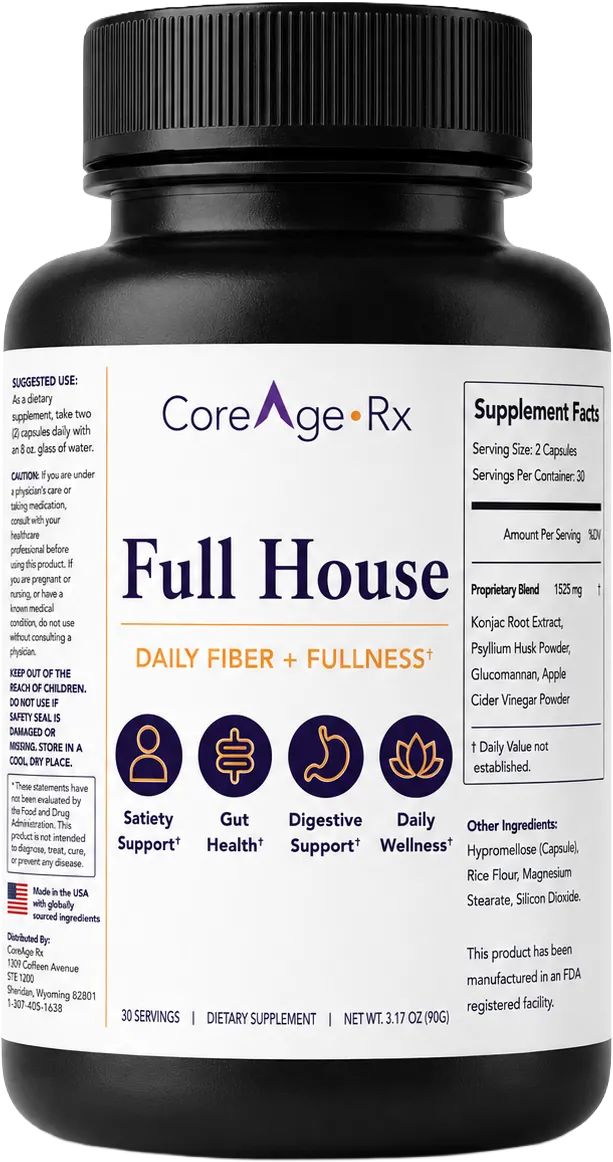
Full House combines konjac root extract, psyllium husk powder, glucomannan, and apple cider vinegar powder in a 1,525 mg proprietary blend per two capsules. See the current Full House™ page and check the bottle you receive before use.
Related reading
- Fiber Supplements: Types, Labels, and How to Choose
- Fiber Capsules vs. Powder: Compare Grams, Not Serving Counts
- Fiber and Fullness: What the Evidence Can and Cannot Promise
- Constipation while taking a GLP-1 medication
Educational information, not individualized medical advice. Product information and linked research checked September 15, 2026. Ingredient research does not establish identical effects for a finished supplement.