Glucomannan is a soluble fiber obtained from konjac. The terms are related, but “konjac root extract” and a specified amount of glucomannan are not automatically equivalent label statements. The concentration and preparation matter when comparing a product with research.
Source versus quantified ingredient
Konjac identifies the plant source. Glucomannan identifies a particular fiber component. An extract can vary in composition, so its total weight does not necessarily tell you how much glucomannan it provides unless that is disclosed.
This distinction becomes especially important in a proprietary blend. The FDA labeling guidance explains how a total blend weight can be listed without individual ingredient amounts. Do not fill those missing amounts in by assuming equal proportions.
What the weight-loss evidence says
Glucomannan is often marketed for fullness because it absorbs water and becomes viscous. However, the NIH review of weight-loss supplements describes inconsistent findings and studies that do not show a meaningful weight-loss advantage.
That means the ingredient’s physical behavior should not be turned into a guaranteed outcome. A study also needs to be matched by amount, preparation, population, and duration before it can inform a specific product decision.

Full House lists both terms
The pictured Full House panel lists konjac root extract and glucomannan separately, along with psyllium husk powder and apple cider vinegar powder. Together they make up a 1,525 mg proprietary blend per two capsules.
The panel does not disclose a standardized glucomannan percentage for the extract or a separate glucomannan amount. Do not add the two names together as though each were a full, known dose of the same fiber. Our Full House label guide keeps those quantities distinct.
Water and swallowing precautions
Water-absorbing fibers need to be used according to their directions. Full House’s pictured label calls for an 8 oz glass of water with the two-capsule serving. People with difficulty swallowing, possible obstruction, or significant unexplained abdominal symptoms should get clinical advice before use.
The NIH review describes concerns with glucomannan products taken with inadequate liquid. Do not dry-swallow a product or use extra servings to chase a stronger fullness effect. If fluid intake is restricted for a medical reason, ask whether the product fits your plan.
Compare the practical alternatives
If your goal is more dietary fiber, first review foods and disclosed fiber grams. If your goal is a digestive symptom, discuss the appropriate ingredient and amount with a clinician. The psyllium-versus-glucomannan guide and fiber-water article help organize those questions without treating all swelling fibers as interchangeable.
Separate the source plant from a quantified fiber ingredient
Konjac names the plant source, while glucomannan identifies a fiber associated with that source. A product listing konjac root extract may still need to disclose additional information before its glucomannan amount can be known. The names are related, but they do not supply a universal conversion.
This matters when comparing a supplement with research. A known amount of glucomannan in a study is a specific exposure. An unspecified amount of konjac extract in a blend does not automatically establish the same exposure.
Ask whether the product provides an individual amount, extract specification, or other information relevant to the comparison. If that information is absent, keep the quantity unknown rather than treating every milligram of an extract as confirmed glucomannan.

Read Full House’s two related entries carefully
The reviewed Full House panel lists konjac root extract and glucomannan separately, alongside psyllium husk powder and apple cider vinegar powder. All four sit within a 1,525 mg proprietary blend per two capsules.
The panel does not disclose how much of either konjac root extract or glucomannan is present. It also does not state a dietary-fiber total. You cannot add imagined amounts for the two related entries or assume they represent equal quantities of the same standardized material.
The total blend converts to 1.525 g, but the conversion does not reveal the formula’s proportions. This is a label-reading limit that should remain explicit in any discussion of dose, expected fullness, or comparison with an isolated-fiber trial.
Understand the evidence question behind weight-management claims
Glucomannan has been studied in weight-management contexts, but the NIH review describes inconsistent findings. A claim should therefore reflect the uncertainty and the details of the studied intervention.
Look for the amount, preparation, timing, accompanying diet, study duration, and population. A result under one set of conditions does not establish that every konjac-containing product produces the same change. Nor does a short-term fullness measure guarantee a long-term weight outcome.
If a product combines glucomannan with other ingredients, evidence for the exact formula becomes a separate question. The presence of a studied ingredient does not prove that the blend supplies the studied dose or reproduces the result.
Keep water and swallowing precautions prominent
Glucomannan interacts with water, which is one reason product preparation and swallowing instructions matter. Follow the exact label. For Full House, the reviewed directions specify two capsules daily with an 8 oz glass of water.
Do not dry-swallow the product or assume a small sip is equivalent. If you have difficulty swallowing, a relevant obstruction history, significant unexplained abdominal symptoms, or a fluid restriction, seek individualized advice before use.
More water does not authorize a larger serving. Likewise, opening capsules into a drink is not automatically appropriate. The fiber-water article explains how to separate the product’s use instructions from general daily hydration questions.
Compare alternatives according to the real goal
If the goal is increasing dietary fiber, foods and products with clearly disclosed dietary-fiber amounts can be compared directly where the information permits. If the goal is a symptom such as constipation, a clinician can help identify a suitable ingredient and plan. If the goal is appetite management, the evidence for that outcome needs attention.
Psyllium, glucomannan, and food-based fibers should not be treated as interchangeable simply because they are all discussed for digestion. Properties, amounts, preparation, and tolerance vary. The psyllium comparison provides a structured way to consider those differences.
Convenience and preferences remain valid considerations after suitability and information are clear. A capsule may fit one routine and a powder another. The format alone does not establish equivalent ingredients or clinical results.
Questions that improve a manufacturer or clinician discussion
Keep a copy of any clarification with the product label. A response about one formulation, lot, or package should not automatically be applied to a different product later. If the manufacturer provides an extract specification, ask whether it describes the ingredient in the current serving and whether it supports the particular comparison you are trying to make.
| Question | Why the answer matters |
|---|---|
| How much glucomannan is in a serving? | Allows a meaningful amount comparison |
| What does the konjac extract specification indicate? | Clarifies whether a conversion is supported |
| Is dietary fiber separately disclosed? | Prevents blend weight being counted as a nutrient |
| Was the exact formula studied? | Separates ingredient evidence from product evidence |
| What water and swallowing instructions apply? | Makes intended use clear |
| How should it fit with oral medicines? | Supports an individualized timing plan |
An unanswered question should remain unanswered in the comparison. Do not fill it with the amount used by a different brand or in a study of another preparation.
Reassess if the routine does not fit
If a supplement repeatedly causes discomfort or is difficult to take as directed, discuss whether it belongs in the plan. Do not assume persistence or a larger dose is the only way to obtain benefit. A different food or clinical approach may address the original need more clearly.
Seek prompt assessment for severe pain, vomiting, trouble swallowing, or inability to pass stool and gas. Those symptoms should not be treated as evidence that a swelling fiber is creating useful fullness.
Frequently asked questions
Is konjac root extract always pure glucomannan?
Do not assume that without an appropriate specification. The source name alone does not establish the composition or amount needed for a precise comparison. Use the product’s actual disclosure or ask the manufacturer.
Does Full House disclose the glucomannan dose?
The reviewed panel lists it within a proprietary blend but does not provide an individual amount. The 1,525 mg total describes the whole blend, not glucomannan alone.
Can I use study amounts to calculate more capsules?
No reliable calculation is possible from missing individual amounts, and increasing the serving changes every ingredient. Follow the current directions and discuss an appropriate product choice with a qualified professional.
Does taking it before food guarantee weight loss?
No. Timing alone does not establish dose equivalence or a predictable outcome. The evidence for weight loss is inconsistent, and the broader meal and treatment plan remains important.
Explore Full House™
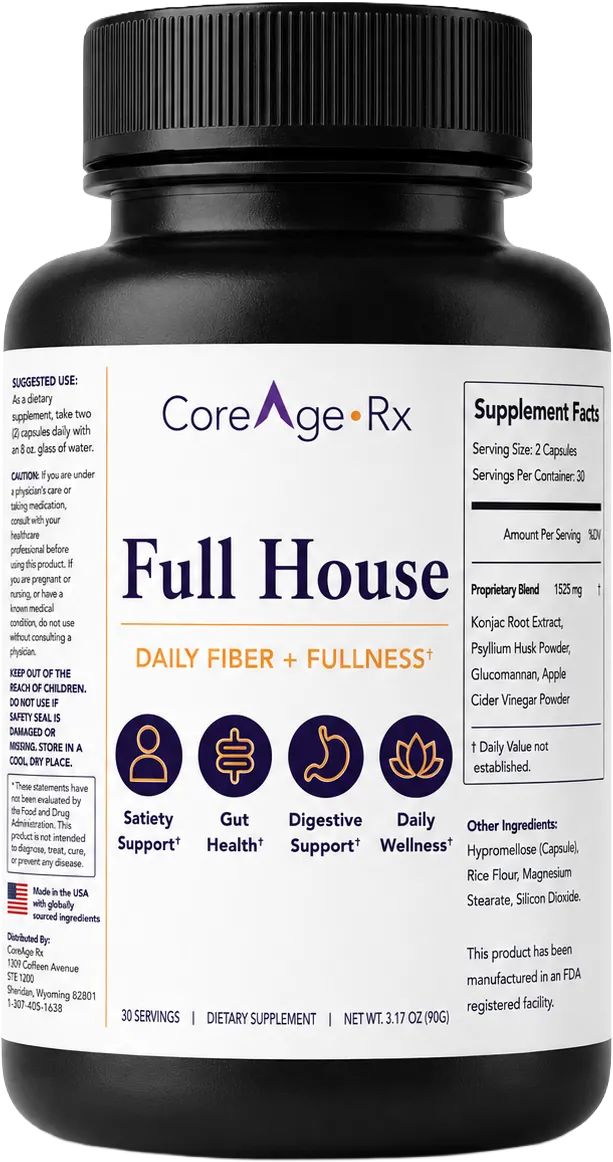
Full House combines konjac root extract, psyllium husk powder, glucomannan, and apple cider vinegar powder in a 1,525 mg proprietary blend per two capsules. See the current Full House™ page and check the bottle you receive before use.
Related reading
- Fiber Supplements: Types, Labels, and How to Choose
- Psyllium vs. Glucomannan: What Is the Difference?
- Why Water Matters When You Take a Fiber Supplement
- Constipation while taking a GLP-1 medication
Educational information, not individualized medical advice. Product information and linked research checked September 15, 2026. Ingredient research does not establish identical effects for a finished supplement.