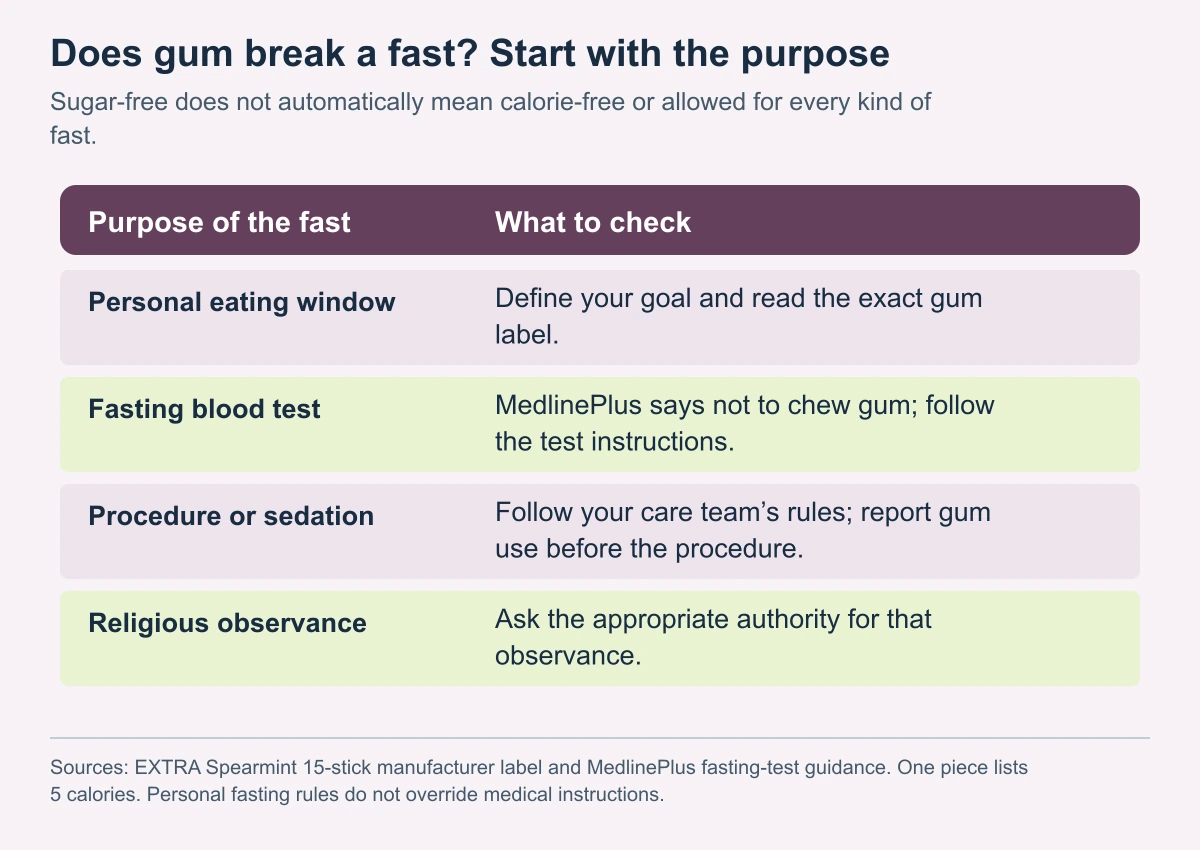
Whether gum breaks a fast depends on what the fast is for and what the gum contains. A gum with calories does not meet a strictly zero-calorie rule, even if it is sugar-free. For a fasting blood test, MedlinePlus specifically says not to chew gum. For a procedure, follow the care team’s instructions and report any gum use.
A personal eating window, a laboratory test, anesthesia preparation, and a religious observance are different situations. A nutrition label can tell you about the gum, but it cannot establish a universal rule for all of them. This guide explains an actual product example, medical fasting instructions, sweetener concerns, and common questions about whether a small amount of gum means you need to change your routine.
Start with the purpose of the fast
Before looking for a calorie threshold, name the instruction or goal you are following. If a clinician ordered the fast, use that clinician’s preparation rules. If it is a personal routine, be clear about how you have defined it. If it is a religious observance, ask the appropriate authority for that observance.
| Purpose | What should guide the decision? |
|---|---|
| Personal eating window | Your defined goal, the actual gum label, and any relevant health advice. |
| Fasting blood test | The laboratory or clinician’s instructions; MedlinePlus says not to chew gum. |
| Procedure or sedation | The procedure team’s instructions and individualized assessment. |
| Religious observance | The rules for that particular observance, clarified with the appropriate authority. |
One situation cannot automatically answer another. A gum someone uses during a personal routine may still conflict with a laboratory instruction. Our water-while-fasting guide explains the same distinction for drinks.
Does sugar-free gum contain calories?
It can. As an exact manufacturer example, EXTRA Spearmint Sugar Free Chewing Gum, 15-Stick Single Pack lists the following for one piece weighing 2.5 grams. These are product-specific figures, not a universal gum panel. Manufacturer label
| Nutrition item | One piece in this example |
|---|---|
| Calories | 5 |
| Total carbohydrate | 2 grams |
| Sugar alcohol | 2 grams |
| Total sugars | 0 grams |
| Added sugars | 0 grams |
| Protein | 0 grams |
The sugar-alcohol line is part of the carbohydrate information, not an extra amount to add on top of total carbohydrate. This panel therefore does not mean four grams of carbohydrate per piece.
The ingredient list includes sorbitol, gum base, glycerol, and other ingredients, including aspartame and acesulfame potassium. It carries a phenylalanine warning. Check your actual package because another flavor, product, or market may have different ingredients.
FDA explains that sugar alcohols are used as sugar substitutes in foods including chewing gum and can contribute calories. “Sugar-free” is therefore not the same question as “calorie-free.” FDA sweetener information
Does five calories end an intermittent fast?
For a rule you define as strictly no energy intake, a calorie-containing gum does not meet that rule. For a routine defined around scheduled meals or another personal goal, the answer depends on that definition and your circumstances.
The manufacturer label does not measure whether one piece changes a person’s long-term weight outcome, insulin response, or other biological endpoint. It cannot establish that a tiny amount is either irrelevant to every purpose or enough to erase all benefit.
Avoid inventing a universal threshold such as “anything under 50 calories never counts.” That statement would need evidence for the particular goal, not simply a low number on a label. Repeated pieces also contribute more than one piece, even when the per-piece amount is small.
Our calorie-intake guide and balanced-meal guide help place food choices in the wider routine. A gum decision alone does not describe the rest of your eating pattern.
What about insulin or autophagy?
An ingredient list or Nutrition Facts panel cannot tell you a person’s insulin response or quantify autophagy. The sources reviewed here do not establish a universal gum amount that guarantees either outcome during a fast.
If an online claim says a particular sweetener always stops autophagy, or that zero sugar guarantees no physiological response, ask what was measured and in whom. A claim about a laboratory process, a short-term response, and long-term health are different claims.
You do not need to turn uncertainty into stricter and stricter restriction. If a fasting routine creates distress, rigid food rules, or difficulty eating enough, discuss the pattern with a qualified health professional. A more severe rule does not automatically answer the scientific question.

Can you chew gum before a fasting blood test?
MedlinePlus’s fasting-test guidance says not to eat or drink anything except plain water during a requested blood-test fast, and also says not to chew gum. Use the instructions for the actual test, including how long to fast and what to do with your medicines. Not all blood tests require fasting. MedlinePlus preparation guidance
Do not decide that a sugar-free gum is allowed because it has little energy. Medical preparation rules are intended to support interpretable results, not simply to preserve a personal calorie goal.
If you make a preparation mistake, tell the laboratory or ordering clinician. They can decide whether the test should proceed or be rescheduled. Do not conceal the gum use, and do not automatically cancel the appointment without asking.
For medication instructions, MedlinePlus advises asking the provider and not stopping a medicine unless instructed. A fasting article should not become a reason to skip necessary treatment on your own.
What do anesthesia guidelines say about gum?
The 2023 American Society of Anesthesiologists guideline suggests that elective procedures need not be delayed solely because a healthy adult has chewed gum, after the gum is removed before a sedative or anesthetic is given. The suggestion is based on very-low-strength evidence, and the guideline does not encourage gum use before surgery. Official guideline full text
Its intended population is limited. The guidance discusses conditions that may increase aspiration risk, including gastroparesis, diabetes, obesity, pregnancy, previous gastric surgery, and other circumstances. The anesthesia team must apply clinical judgment to the individual situation.
That is a clinician-facing guideline, not permission to override your procedure instructions. If you chewed gum, tell the team what you used and when. They can decide what the information means for the planned procedure.
What if you take a GLP-1 medicine before a procedure?
Tell the procedure and anesthesia teams which medicines you take. The current Zepbound label includes a warning about pulmonary aspiration during general anesthesia or deep sedation and directs patients to inform health professionals about planned procedures. Zepbound prescribing information
This article does not supply a medication-hold schedule or a procedure-specific fasting plan. Ask the teams involved for instructions about the actual medicine, symptoms, procedure, and preparation. Do not derive that plan from the gum’s calories.
Our semaglutide questions guide and tirzepatide questions guide cover related treatment questions. If you are considering a weight-management service, the CoreAge Rx semaglutide page provides information; your fasting routine and existing medicines should be part of the clinical discussion.
Can sugar alcohols cause digestive symptoms?
NIDDK states that sugar alcohols commonly found in sugar-free candies and gum may cause diarrhea in some people. The effect is not established for every person or every amount. Diarrhea causes
If you notice symptoms, record the actual product and how much you use, including other sugar-free foods. A person repeatedly chewing gum may have a different exposure from someone using one piece occasionally.
Do not assume every digestive symptom comes from gum. Medicines, illnesses, and other factors can also matter. Persistent diarrhea, vomiting, or difficulty keeping fluids down should be reviewed medically, particularly during treatment. Our nausea and vomiting guide and hydration guide discuss related concerns.
Why does the aspartame warning matter?
The identified EXTRA product contains aspartame and warns that it contains phenylalanine. FDA says people with phenylketonuria should avoid or restrict aspartame according to their care needs. A product’s small calorie amount does not remove that ingredient consideration. FDA sweetener guidance
Read the actual ingredients and warnings if you have PKU, allergies, or other medically important restrictions. Do not transfer the ingredients from this spearmint example to every gum marketed as sugar-free.
Questions people commonly ask
If you chew one piece, must you restart the whole fast?
For a medical fast, tell the care team and let it decide. For a personal routine, the answer depends on your goal and definition; the label does not establish that you need to compensate with a longer restriction. If the routine is difficult to manage, seek individualized advice.
Is swallowing the gum the deciding factor?
The label applies to the gum product, and medical instructions may prohibit chewing regardless of whether you plan to swallow it. For anesthesia or sedation, gum must be removed before medication is given under the cited guideline. Follow your own team’s instructions.
Are breath mints interchangeable with gum?
They are different products with their own serving sizes and ingredients. Read the actual mint label and ask the testing or procedure team when preparation rules apply. Do not use the five-calorie gum example to assign numbers or permission to a mint.
Does chewing more gum make a fast more effective?
The reviewed sources do not establish that chewing gum makes a personal fast more effective for weight management. It can add ingredient exposure and may create digestive symptoms in some people. Choose the routine based on an appropriate goal and care advice, not an assumed gum benefit.
What should you do before an upcoming appointment?
Read the written preparation instructions, clarify any gum or medication questions in advance, and report mistakes honestly. A clear conversation with the team is more useful than searching for a calorie loophole when the fast has a medical purpose.
Educational information for adults; individual treatment decisions require a qualified clinician. Sources reviewed September 30, 2026. Original AI-generated article images depict fictional people and objects, not patient outcomes. Other editorial images are illustrative. Graphics summarize the cited sources.