
Night sweats while taking progesterone do not, by themselves, show that your dose is too high. They may reflect ongoing menopause symptoms, another cause of sweating, or a treatment issue that needs review. The useful next step is to identify the exact prescription, why it was prescribed, and when the symptoms occur.
Progesterone also has more than one role in hormone therapy. Protecting the uterine lining during estrogen treatment is different from treating hot flashes and night sweats. Research about progesterone alone does not automatically describe the effects of a combined HRT prescription.
This guide explains those distinctions, the evidence from an original perimenopause trial, and the questions to bring to your clinician. For the broader treatment discussion, start with our menopause hormone therapy guide.
Why progesterone may be part of your HRT prescription
For a person who has a uterus and uses systemic estrogen, a progestogen is generally added to help protect the uterine lining. Estrogen without adequate protection can increase the risk of endometrial hyperplasia, an abnormal thickening of that lining. The oral PROMETRIUM label describes use with estrogen for this purpose in postmenopausal women with a uterus. PROMETRIUM prescribing and patient information, ACOG hormone therapy FAQ.
That protective role does not mean the progesterone dose should be adjusted according to how much you sweat on one night. The estrogen product, progesterone product, regimen, bleeding history, and whether you have a uterus all matter to the overall prescription.
“Progestogen” is a broader term that includes progesterone and other medicines with progesterone-like effects. Oral micronized progesterone, a different progestin, and a compounded preparation should not be treated as the same product. A study of one formulation cannot establish an interchangeable dose for all of them.
Our estrogen and progesterone HRT guide explains why the combination is prescribed. Ask your clinician which job each component is doing before interpreting symptoms as evidence that one is unnecessary.
Can progesterone help night sweats?
There is research on oral progesterone and vasomotor symptoms, the medical term for hot flashes and night sweats. The findings need to be described with their population, treatment period, and limitations intact.
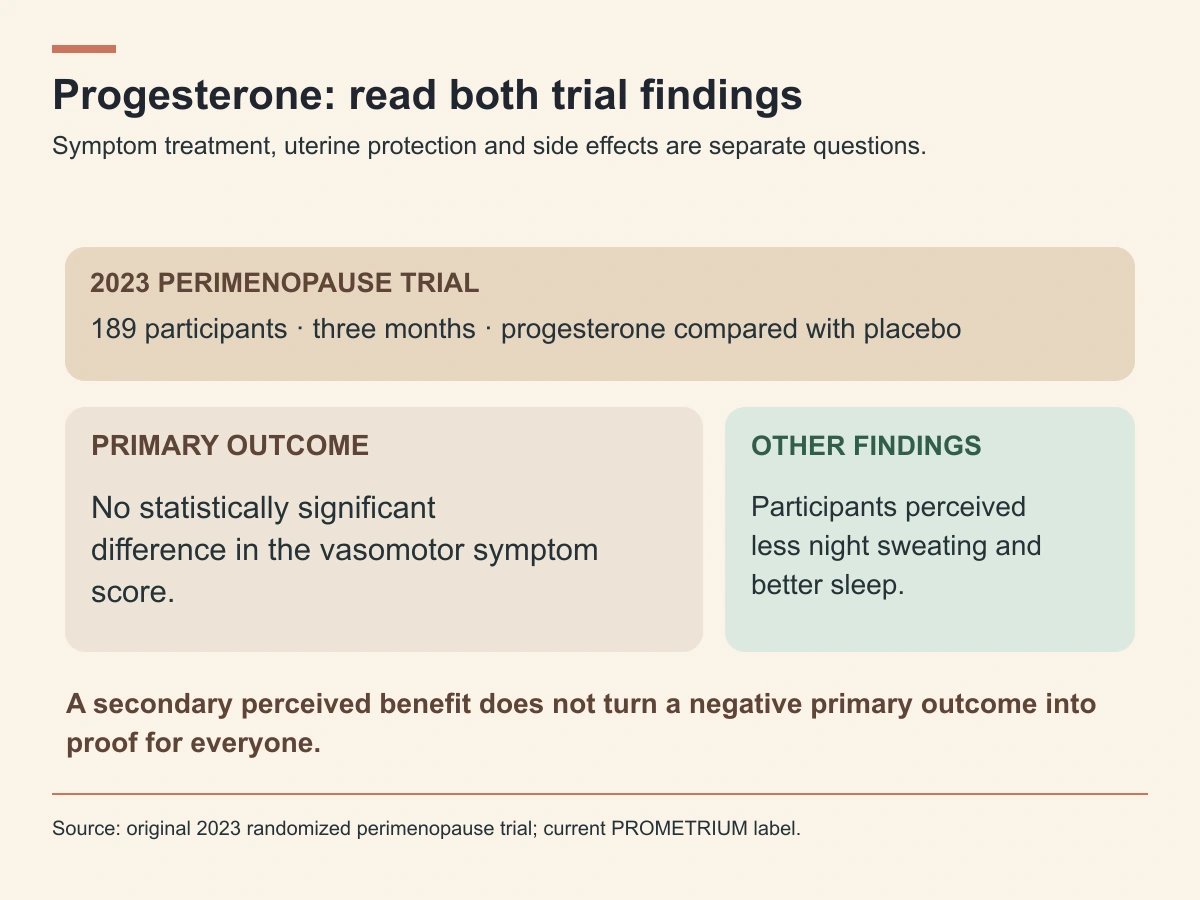
An original trial published in 2023 randomized 189 perimenopausal women to oral micronized progesterone or placebo after a baseline observation month. The tested regimen was 300 mg at bedtime for three months. That is a research regimen, not a recommended dose for readers or proof that a different prescription is wrong. Original perimenopause randomized trial.
The trial’s primary outcome was a vasomotor symptom score during the third treatment month. The progesterone and placebo groups did not differ statistically on that primary outcome: the reported P value was 0.222. The confidence interval included no effect, and the authors discussed the study’s limited power.
Participants taking progesterone did report better perceived night-sweat and sleep outcomes on separate measures. Those secondary findings are relevant, but they should be presented alongside the primary result rather than replacing it. The trial did not establish a universal response or a dose-adjustment rule.
Reading the trial without overstating it
| Part of the study | What was reported | What that does not establish |
|---|---|---|
| Participants | 189 perimenopausal women randomized | Results for every postmenopausal patient or HRT combination |
| Tested treatment | Oral micronized progesterone, 300 mg at bedtime, for three months | A personal starting dose or a dose for other formulations |
| Primary symptom score | No statistically significant difference from placebo | A proven primary-outcome benefit |
| Separate patient-reported measures | Better perceived night sweats and sleep quality with progesterone | That every symptom diary measure improved |
| Study limitations | Limited power and a particular recruited population | A final answer for all patients or long-term safety |
For example, the paper distinguished perceived sleep improvement from calendar-recorded sleep findings. “Participants felt their sleep was better” and “all measures of sleep improved” are different statements. Keeping that distinction helps you understand why an individual might describe benefit even when a study’s main result is inconclusive. Original perimenopause randomized trial.
The study also does not tell you that increasing progesterone will necessarily relieve persistent sweats. Dose decisions must account for the entire treatment purpose and adverse effects, not just one favorable secondary result.
Can too much progesterone cause night sweats?
A sweating episode is not an overdose test. You cannot work backward from the symptom to determine the amount of progesterone in your body or the correct prescription.
The current PROMETRIUM information includes a trial table in which night sweats were reported in 7% of the group receiving cyclic progesterone with conjugated estrogens, compared with 17% of the placebo group. These were events recorded during a combined-regimen trial. The numbers do not describe progesterone-alone side-effect frequency, establish a dose-response relationship, or show that sweating indicates excessive progesterone. PROMETRIUM prescribing information.
The same symptom can also be part of the problem HRT is intended to address. If night sweats began before treatment and continue after treatment starts, that is different from a new pattern emerging after a prescription change. Neither pattern can be interpreted adequately without the treatment details.
If you accidentally take an extra dose, contact your pharmacist or prescribing clinician promptly for product-specific advice. Do not wait for night sweats to appear before asking what to do. If symptoms are severe, seek urgent medical help.

Other explanations deserve attention
Menopause is one possible cause of night sweats, but it is not the only one. NHS guidance lists anxiety, some medicines, low blood glucose, and alcohol or drug use among possible explanations. An overheated room or heavy bedding can also cause ordinary nighttime sweating. NHS night sweats guidance.
This matters when you take several medicines. A recently started antidepressant, steroid, diabetes medicine, or another prescription may change the questions your clinician asks. Do not identify the cause solely by choosing the medicine whose name contains “hormone.”
Describe whether you feel a brief wave of heat, wake with damp clothing, or regularly soak bedding despite a cool room. Those are useful details. They do not establish a diagnosis, but they help the clinician understand what you mean by night sweats.
Recurring drenching sweats, sweats that wake or worry you, or sweating accompanied by fever, cough, diarrhea, or unexplained weight loss should be evaluated. A symptom that sounds menopausal should not prevent assessment of other possibilities. NHS night sweats guidance.
What to track before a treatment review
A short record can make the appointment more useful without turning your evenings into a complicated experiment. Record:
- The exact medicine names, strengths, and formulations.
- Whether progesterone is prescribed every day or on selected days.
- The date treatment started or changed.
- When sweating occurs and whether it wakes you.
- Associated symptoms, including dizziness, unusual bleeding, fever, or palpitations.
- Missed doses, other new medicines, and changes in sleep conditions.
Bring the actual dispensing label or a clear medication list. “I take HRT” does not identify the estrogen route, the progesterone formulation, or the schedule.
If you are perimenopausal and still have changing cycles, explain the timing of symptoms relative to those cycles. Our perimenopause HRT guide covers why symptoms, bleeding patterns, and treatment goals need to be considered together.
The purpose of tracking is to improve the conversation. Do not deliberately skip prescribed progesterone or alternate doses to test a theory about sweating, particularly when it provides uterine protection during systemic estrogen treatment.
Side effects and safety questions beyond sweating
Oral PROMETRIUM can cause drowsiness or dizziness; its patient information directs bedtime administration. The label describes episodes of marked dizziness or drowsiness and advises patients to discuss concerning symptoms with their healthcare provider. A research bedtime regimen does not authorize changing your own dose. PROMETRIUM patient information.
The named PROMETRIUM capsules contain peanut oil and are contraindicated in people allergic to peanuts. That product-specific ingredient matters; do not assume every progesterone preparation has identical inactive ingredients.
The label also identifies important contraindications, including unexplained genital bleeding, certain cancer histories, blood-clot or arterial clotting disease histories, and liver disease. Your clinician should review your history before prescribing. A description of progesterone as “natural” or “bioidentical” does not remove the need for this assessment. PROMETRIUM prescribing information.
Seek urgent help for symptoms suggesting a serious reaction, such as new difficulty breathing, severe chest pain, fainting, or sudden speech, vision, or movement problems. Do not attribute those symptoms to a routine adjustment period or wait for the next HRT review.

How an HRT review can address persistent symptoms
A useful review separates three issues: whether the prescription is being used as intended, whether it is achieving its goals, and whether symptoms need another explanation.
Ask whether your night sweats fit the expected treatment response, whether other symptoms change the assessment, and when the regimen should be reviewed again. The clinician may consider the whole HRT plan or alternatives according to your history and preferences. There is no universal increase, decrease, or switch that can be inferred from sweating alone.
ACOG describes systemic estrogen as the most effective treatment for hot flashes and night sweats, while also emphasizing individual risks and shared decisions. That general guidance does not mean estrogen is suitable for every person. ACOG hormone therapy FAQ.
For practical expectations around sleep, see HRT, hot flashes, and sleep. Better sleep may be an important goal, but the follow-up should still include bleeding, tolerability, and safety.
Common questions about progesterone and night sweats
Does sweating mean my progesterone dose is too high?
No. It is a symptom to discuss, not a measurement of dose adequacy. Timing, the complete HRT regimen, other medicines, and associated symptoms help determine the next step.
Should I stop progesterone if the sweats continue?
Do not make that change based on sweating alone. If it is protecting the uterine lining during systemic estrogen treatment, stopping it changes the prescription’s protective role. Contact your clinician for an assessment and instructions.
Is the 300 mg dose in the trial the usual dose for everyone?
No. It was the regimen tested in a particular perimenopause study. It is not a personal dose recommendation and should not be transferred to different products, indications, or combined HRT schedules. Original perimenopause randomized trial.
Can night sweats happen even when HRT is appropriate?
Symptoms may persist during treatment, but persistence deserves review rather than an automatic assumption about why. A clinician can assess treatment response, adherence, other causes, and the overall plan.
Where can I learn about the available treatment services?
CoreAge Rx’s oral progesterone information and estrogen information describe those services. Use them alongside the educational guides and a qualified clinician’s assessment. A product page or an online dose discussion cannot determine which HRT regimen fits your symptoms and history.
Educational information for adults; individual treatment decisions require a qualified clinician. Sources reviewed October 2, 2026. Original AI-generated article images depict fictional people and objects, not patient outcomes. Other editorial images are illustrative. Graphics summarize the cited sources.