
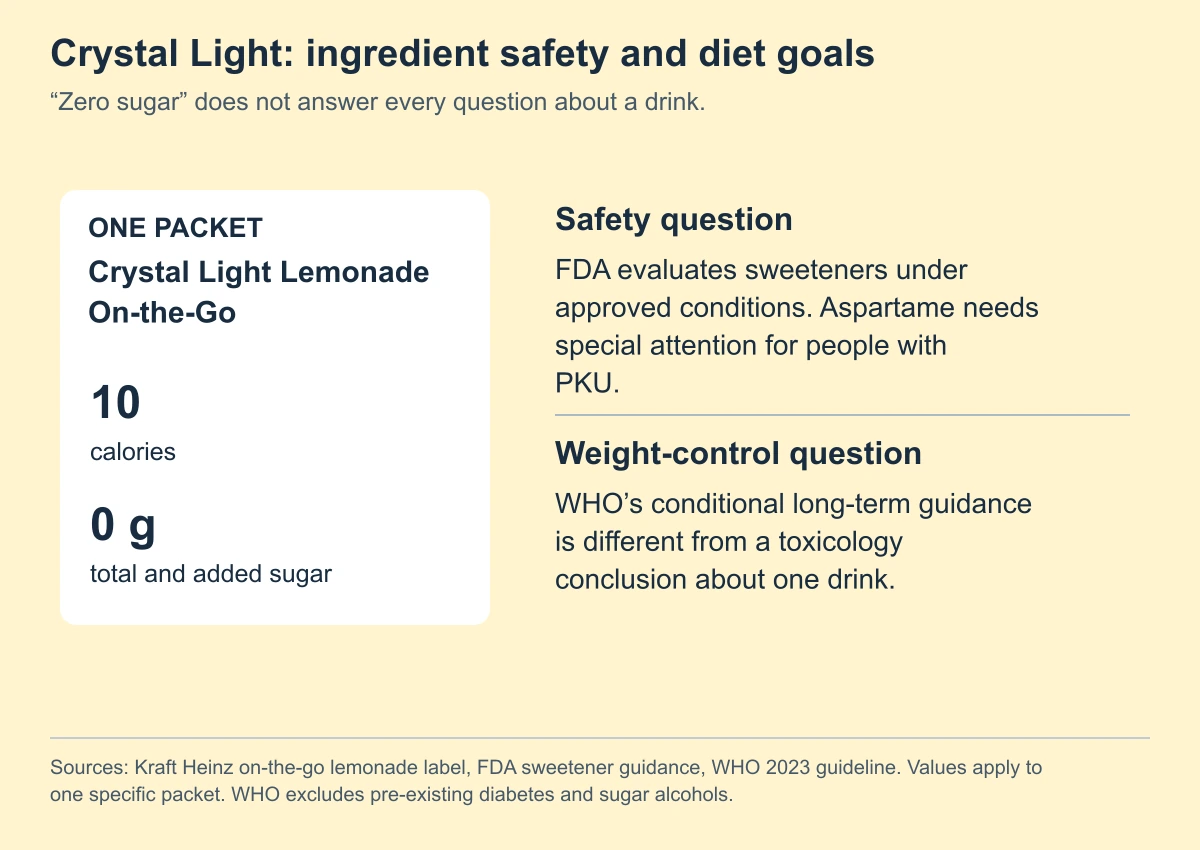
Crystal Light is a brand with different products, so the answer depends on the actual variety, ingredients, serving, and your health needs. FDA considers approved sweeteners such as aspartame safe for the general population under their approved conditions of use. People with phenylketonuria need special attention to aspartame, and a lower-calorie drink is not automatically a long-term weight-loss treatment.
Instead of assigning every packet a universal “good” or “bad” label, check what is in yours and what it replaces. This guide uses one manufacturer example, explains the FDA and WHO evidence, and covers sugar, calories, caffeine questions, hydration, and common concerns during weight-management treatment. FDA sweetener information
Which Crystal Light product are we discussing?
The example is Crystal Light Lemonade On-the-Go Powdered Drink Mix, on the Kraft Heinz page for UPC 00043000945025. The described box contains ten individual packets. The manufacturer lists a serving as one packet, prepared with two cups of water. Manufacturer product and label
| Item | One packet in this example |
|---|---|
| Calories | 10 |
| Total sugars | 0 grams |
| Added sugars | 0 grams |
| Sodium | 70 milligrams |
| Protein | 0 grams |
| Potassium | 140 milligrams |
These figures are not a nutrition panel for every Crystal Light flavor, size, or formulation. Read the package you actually bought, especially when comparing a packet for a bottle with a mix intended to make a larger pitcher.
Mixing this packet with more water changes the concentration and volume, but it does not remove the ingredients or calories in the packet. If you drink the entire prepared mixture, you have used the entire packet. A serving comparison should account for both the mix and the amount consumed.
What sweeteners and other ingredients are listed?
The captured lemonade label lists aspartame and acesulfame potassium, along with ingredients including citric acid, potassium citrate, sodium citrate, magnesium oxide, maltodextrin, natural flavor, soy lecithin, and artificial color including Yellow 5. It includes a phenylalanine warning and states that it contains soy. Specific ingredient list
That list helps answer ingredient questions, but it does not give the amount of every ingredient in a packet. You cannot calculate an exact sweetener dose or a personalized daily packet maximum from the ingredient names alone.
Marketing descriptions also answer only the claim they make. For example, a statement about natural flavor does not establish that the product has no artificial color. Check the relevant line instead of assuming one phrase describes all the ingredients.
Is aspartame unsafe?
FDA states that the scientific evidence supports aspartame’s safety for the general population when manufactured and used under its approved conditions. It also explains its evaluation of the 2023 cancer-related classifications and notes that those classifications do not establish that consuming aspartame is actually linked to cancer. FDA assessment
That is a statement about the sweetener’s approved use, not FDA endorsement of a particular branded drink or a recommendation to consume as much as possible. It also does not mean that every ingredient suits every person.
If a concern is about a specific reaction, allergy, medical restriction, or diagnosed condition, bring the product label to a health professional. An ingredient’s regulatory status and your individual instructions need to be considered together.
Why is the phenylalanine warning important?
People with phenylketonuria, often shortened to PKU, have difficulty metabolizing phenylalanine. FDA says they should avoid or restrict aspartame, and labels for products containing it must identify the phenylalanine concern. The lemonade example here carries that warning. FDA PKU information
If you have PKU, use the instructions supplied by your clinical team and check each actual product. Do not assume that all flavors have the same ingredients or that a drink labeled zero sugar is suitable for that condition.
The soy declaration answers a separate question. If soy avoidance is part of your allergy plan, the label example should be reviewed accordingly. A packet that fits one person’s preferences can still conflict with another person’s medically important restrictions.
What does WHO say about sweeteners and weight?
WHO’s 2023 guideline makes a conditional recommendation against using non-sugar sweeteners for long-term weight control. It acknowledges that observed associations can be affected by participants’ baseline characteristics and complicated patterns of sweetener use. The recommendation excludes people with pre-existing diabetes and does not cover sugar alcohols. WHO guidance
This answers a different question from FDA’s approved-conditions safety assessment. It does not establish that one packet causes weight gain or that a particular branded drink is toxic. It does suggest that long-term weight-management goals should not depend on sweeteners alone.
For the wider eating pattern, see our balanced-meal guide and calorie-intake guide. A beverage choice is one part of that pattern, rather than a complete plan.

Can Crystal Light help with weight management?
The immediate comparison depends on what it replaces. Substituting the identified 10-calorie packet drink for a beverage with more calories changes that beverage’s contribution. Adding the drink to a routine that already includes only plain water is a different situation.
Neither comparison predicts your eventual weight. Food, drinks, activity, health, and other factors remain relevant. NIDDK describes weight management as a broader process rather than the result of selecting one product. NIDDK overview
Ask what makes the drink useful for you: taste, convenience, an alternative to a usual sweetened beverage, or something else. That practical reason can be assessed without promising a particular weight result. If you find the routine makes your eating pattern more difficult or symptoms change, discuss the experience rather than assuming the sweetener must be the sole explanation.
Does zero sugar mean zero calories?
No. The manufacturer example reports zero total and added sugars while also reporting 10 calories per packet. Sugar and calorie lines answer different questions, and the ingredient list does not provide enough information to assign an exact calorie contribution to each ingredient. Manufacturer label
FDA recommends reviewing the serving size and calories along with nutrients and ingredients. Do not treat one front-of-package claim as the entire label. FDA label guidance
The same distinction appears in our coconut-water sugar guide: zero added sugar does not mean zero total sugar. Product-specific information is more useful than assuming every drink with a particular marketing phrase is identical.
Does it contain caffeine?
Check the exact variety and its current label. The captured ingredient list for the on-the-go lemonade example does not name caffeine, but this article should not be used to assign a caffeine amount to every product sold under the brand.
If caffeine is relevant to sleep, medication advice, or a health condition, look for a caffeine statement and the actual ingredients on your packet. Ask the manufacturer or your clinician when the information you need is not clear. Do not transfer a statement from one flavor to another.
Our hydration guide discusses drinks in the wider daily routine. If evening drinks are connected with repeated bathroom trips or interrupted sleep, discuss timing and symptoms with your clinician rather than relying on a brand name to resolve the issue.
Is it appropriate for everyone who needs more fluids?
Taste can be a practical reason someone chooses a flavored drink, but a generic hydration suggestion does not override a prescribed fluid or nutrient limit. The manufacturer example contains sodium and potassium; those amounts may be relevant if your care team has given you specific instructions.
Bring the exact label and the amount you use to that conversation. Ask how the prepared drink fits within the plan, including how much fluid it makes. The right answer cannot be established from “zero sugar” alone.
Unusually strong or persistent thirst also deserves its own review. NIDDK lists feeling very thirsty and frequent urination among diabetes symptoms and advises discussing symptoms with a health professional. Those symptoms do not diagnose diabetes by themselves. Diabetes symptoms

What if you take semaglutide or tirzepatide?
Consider the drink alongside symptoms, food intake, fluids, and your treatment instructions. A flavored drink does not replace adequate nutrition or resolve persistent vomiting, diarrhea, or difficulty keeping fluids down.
The Zepbound label includes gastrointestinal adverse reactions and warns about kidney injury related to volume depletion. If intake or symptoms become a problem, contact the prescribing team rather than trying to solve everything by adding more packets. Zepbound warnings
Our semaglutide questions guide, tirzepatide questions guide, and nausea guide cover related concerns. For service information, see the CoreAge Rx semaglutide page; treatment decisions still require a clinical assessment.
Questions people commonly ask
Does Crystal Light automatically make you gain weight?
The reviewed sources do not establish that this particular product automatically causes weight gain. A change after introducing a drink is information to review, but it does not isolate the cause. Consider the overall pattern and medical context.
How many packets can you have each day?
This article cannot establish a personal maximum. FDA’s acceptable daily intake for a sweetener is not a recommended amount to consume, and the exact sweetener quantity in this packet is not supplied by the captured ingredient list. Review the product instructions and individual health concerns rather than inventing a packet count.
Can you use it during a fasting blood test?
MedlinePlus advises plain water during a requested blood-test fast and specifically excludes other beverages. Do not treat zero sugar as permission to use a flavored drink. Follow your test instructions. Blood-test fasting guidance Our water-while-fasting guide explains why fasting purposes have different rules.
What is the most useful next step?
Read your actual packet’s serving, calories, ingredients, allergen statement, and relevant warnings. Consider what the prepared drink replaces and whether it fits your care instructions. That gives you a concrete answer for your situation without relying on a universal claim about the entire brand.
Educational information for adults; individual treatment decisions require a qualified clinician. Sources reviewed September 30, 2026. Original AI-generated article images depict fictional people and objects, not patient outcomes. Other editorial images are illustrative. Graphics summarize the cited sources.