Coconut water naturally contains sugar. A bottle can have no added sugar and still provide total sugar, carbohydrate, and calories. The amount depends on the product, flavor, serving size, and how much you drink.
The useful question is therefore not simply whether a carton says “natural.” Read the total-sugars and added-sugars lines, then check whether the numbers describe one serving or the entire container. Coconut water can be an enjoyable drink, but it is not automatically sugar-free or a weight-loss treatment.
What is the difference between total sugar and added sugar?
Total sugars include sugars naturally present in a food or beverage plus any sugars added during processing. The added-sugars line identifies the added portion of that total. It is not a second amount to add onto total sugar.
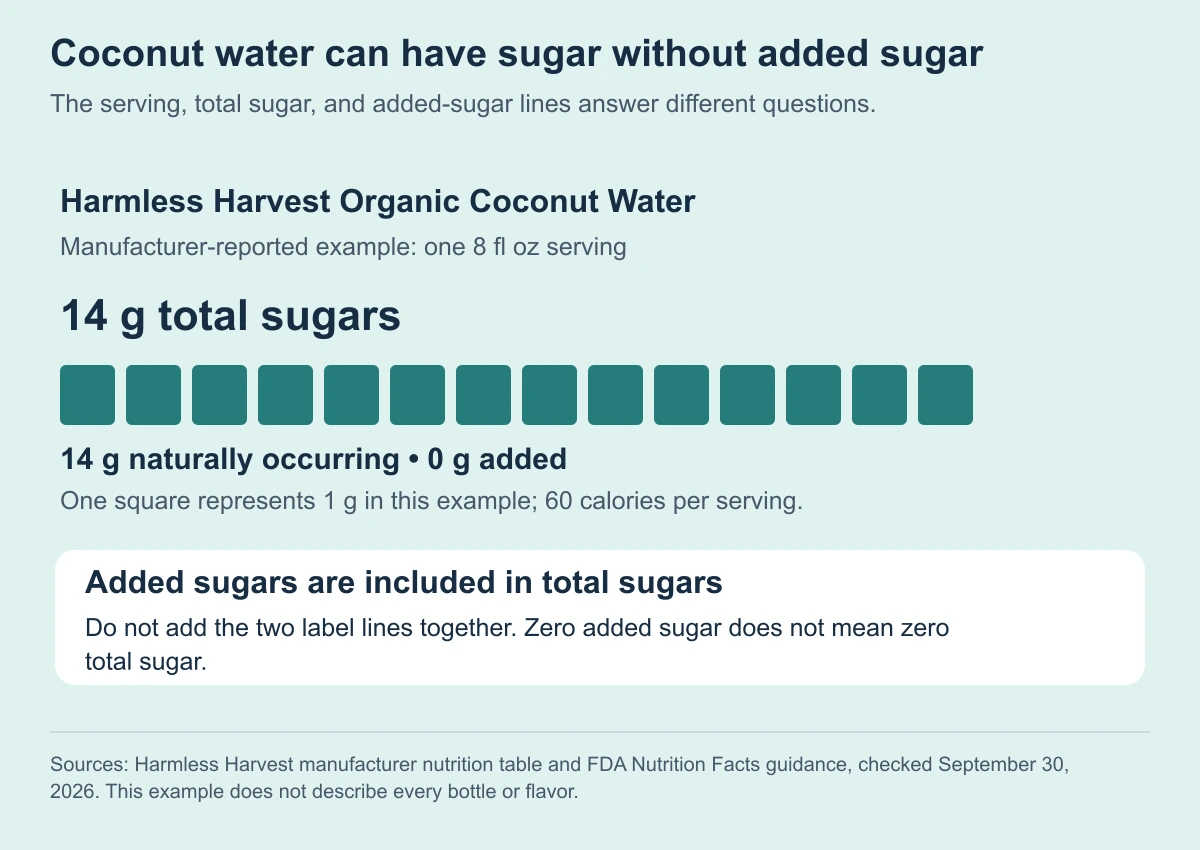
For example, a label showing 14 grams total sugars and zero grams added sugars still describes a drink containing 14 grams of sugar in the listed serving. A label with 14 grams total and two grams added describes 14 grams total, with two of those grams added. The second example is arithmetic to explain label wording, not a claim about a particular coconut-water brand.
The FDA’s added-sugars explanation describes these separate lines. Ingredient wording and front-of-package claims can provide context, but they do not replace the serving size and Nutrition Facts.
How much sugar is in a real manufacturer example?
Harmless Harvest publishes a manufacturer-reproduced nutrition table for its Organic Coconut Water. The table identifies one eight-fluid-ounce serving, rather than every bottle size or coconut-water product.
| Label detail | Amount in the manufacturer’s 8 fl oz example |
|---|---|
| Calories | 60 |
| Total carbohydrate | 15 g |
| Total sugars | 14 g |
| Added sugars | 0 g |
| Sodium | 40 mg |
| Potassium | 541 mg |
Source: Harmless Harvest’s manufacturer nutrition table, checked September 30, 2026. Its product page also describes Organic Coconut Water as having no added sugar. Check your actual package for its current serving and formulation.
These figures illustrate why “no added sugar” and “no sugar” are different. They do not establish a daily target, describe all brands, or independently validate the manufacturer’s exercise and hydration marketing claims.
Does the whole bottle contain one serving?
Not necessarily. A container can provide more than one listed serving. Before using the calorie or sugar number, compare the container amount with the reference serving and check whether the package supplies a per-container column.
If a drink genuinely contains two servings with 14 grams sugar each, the arithmetic would be 28 grams for both servings. That is a calculation from the example, not a statement about the contents of a named bottle. Nutrition labels also use rounded numbers, so scaled estimates are not laboratory measurements.
The FDA Nutrition Facts guide explains why the serving size comes first. Serving sizes reflect reference amounts, not a personalized recommendation to finish that amount. This distinction also appears in our cracker nutrition guide: a smaller serving can make a product look lower in calories without being an equal-amount comparison.
Does “pure,” “organic,” or “unsweetened” mean sugar-free?
Those words do not remove the sugar naturally present in coconut water. A product containing only coconut water can still have a total-sugars amount. A useful comparison therefore checks both the ingredient list and Nutrition Facts.
Flavor changes deserve another label check. A drink with fruit juice, another fruit ingredient, a sweetener, or a creamy coconut component may have different amounts. Do not transfer a plain product’s numbers to a flavored version just because the packages share a brand name.
Similarly, a product promoted as having no added sugar still has to be evaluated for the amount you drink and the rest of your eating pattern. The claim answers one question about formulation, rather than providing a complete health assessment.
Is the natural sugar in coconut water a problem?
That depends on the person’s needs and the context. Naturally occurring sugar is not the same label category as added sugar, but coconut water still contributes carbohydrate and energy. An ingredient’s natural origin does not make the amount irrelevant.
Consider what the drink is replacing. Choosing it instead of plain water adds beverage carbohydrate and calories. Choosing it instead of another sweetened drink could raise or lower those amounts depending on equal serving sizes and the actual labels. Compare the two products rather than assuming the tropical name settles the decision.
There is no need to turn one drink into a forbidden food for every adult. Taste, cost, portion, medical needs, and the overall pattern matter. Our balanced-meal guide uses the same practical approach to food choices without assigning all responsibility for weight to one item.

Can you drink coconut water if you have diabetes?
A drink’s total carbohydrate amount belongs in an individualized diabetes eating plan. “No added sugar” does not mean that a beverage has no effect relevant to glucose management. Look at carbohydrate per serving and the actual amount consumed.
Ask the clinician or dietitian how beverage choices fit your meals, glucose monitoring, and medicines. Avoid assigning a universal safe portion from a single manufacturer’s example. People’s treatment plans and responses differ. NIDDK’s diabetes nutrition guidance.
If you take semaglutide for diabetes, the product and other medicines also matter. An injection schedule is not a reason to replace meals with coconut water or independently change insulin. Our semaglutide and Ozempic guide explains why the treatment indication and complete plan should stay clear.
Do the electrolytes make it necessary for daily hydration?
Coconut water can supply fluid and electrolytes, including potassium. That does not make it necessary for everyone or establish that it is the best choice in every hydration situation. Routine drinking, prolonged exercise, vomiting, and diarrhea are different circumstances.
For everyday use, choose a drink you can include comfortably while considering its nutrients and any restrictions. A fixed rule such as “everyone needs a bottle each morning” is not established by the label. Nor does the presence of potassium prove that more is always better.
Our water while fasting guide discusses why hydration questions need to be separated from claims about detoxification or faster fat loss. A beverage choice should support the actual situation, rather than acquire a special status from an electrolyte claim.
Is coconut water an oral rehydration solution for diarrhea?
Do not assume that a retail coconut-water drink has the composition of a medical oral rehydration solution. A beverage’s marketing about electrolytes does not make it an established treatment for significant fluid loss.
NIDDK discusses replacing fluid and electrolytes during diarrhea, including the role of oral rehydration solutions. People with relevant medical conditions may need individual guidance on the type and amount of fluid. NIDDK diarrhea treatment.
If diarrhea accompanies a GLP-1 medicine, the symptoms need assessment, especially if they persist or limit drinking. Our Ozempic diarrhea guide and Zepbound diarrhea guide explain product-specific evidence and concerning symptoms. Severe pain, faintness, reduced urination, or inability to keep fluids down should not be managed by repeatedly buying a different drink.
Who needs to pay closer attention to potassium?
People with chronic kidney disease or a prescribed potassium restriction should discuss their beverage choices with the care team. Kidney-related nutrition guidance is individualized; the potassium amount in a drink can matter when deciding what fits the plan. NIDDK kidney nutrition guidance.
Medicines can also affect the discussion. Spironolactone labeling identifies hyperkalemia, or high blood potassium, as an important risk. If you take it, ask about potassium-rich drinks, supplements, salt substitutes, and other medicines in the context of your monitoring plan. This does not mean every person taking spironolactone must follow the same beverage ban. Spironolactone label.
Our spironolactone and weight-change guide explains why fluid balance, kidney function, potassium, and body-fat changes should be treated as separate questions.
Does coconut water help you lose weight or reduce belly fat?
The manufacturer nutrition table does not demonstrate a weight-loss effect. A drink can fit an eating pattern without being a treatment that causes fat loss. There is no basis here for promising that coconut water targets belly fat, offsets another food, or reproduces the effects of a prescription medicine.
If weight management is the goal, consider the complete pattern of food, drinks, physical activity, sleep, health conditions, and treatment when appropriate. NIDDK describes overweight and obesity as involving several factors, rather than one drink choice. NIDDK overview.
For questions about prescription care, CoreAge Rx’s semaglutide information and tirzepatide information provide starting points for discussing available care and eligibility. A product consultation and an everyday beverage preference are different decisions.
How should you compare products at the shelf?
Begin with an equal amount of drink. Check the listed serving, servings per container, total carbohydrate, total sugars, added sugars, and relevant electrolytes. Read the ingredient list for the exact flavor and product.
Then decide whether the drink fits your preferences and needs at the amount you expect to consume. The most useful choice is an informed one: coconut water can contain natural sugar, no added sugar does not mean sugar-free, and a label example is a reference rather than a universal daily prescription.
Educational information for adults; individual treatment decisions require a qualified clinician. Sources reviewed September 30, 2026. Original AI-generated article images depict fictional people and objects, not patient outcomes. Other editorial images are illustrative. Graphics summarize the cited sources.