Semaglutide is the active ingredient in Ozempic and Wegovy. It is a modified peptide that activates the GLP-1 receptor. The finished medicines also contain inactive ingredients, and those ingredients can differ between a multi-dose pen, a single-dose injection, and a tablet.
That distinction matters when comparing labels, asking about an allergy, or reviewing a compounded preparation. “Contains semaglutide” does not describe the complete formulation, its route, its device, or its approval status. Start with the exact product and presentation on the package. Sources: Ozempic prescribing information, Wegovy prescribing information.
Is Ozempic a peptide? Is semaglutide a peptide?
Yes. A peptide is a chain of amino acids. Semaglutide is a GLP-1 analogue, meaning it resembles the naturally occurring hormone GLP-1 while incorporating changes that affect how it behaves in the body. Ozempic is a branded medicine containing that active peptide.
The manufacturer describes a peptide backbone produced through yeast fermentation and chemical modifications that help protect it from rapid breakdown and support albumin binding. Albumin is a protein in the blood. These formulation and molecular features help explain why the approved injection can be used weekly. Ozempic label, description and clinical pharmacology.
The word “peptide” is a chemical description, not a guarantee of safety or a statement that all peptide products are equivalent. An approved prescription medicine, a compounded preparation, and a product sold for research can have very different evidence and quality oversight. Our semaglutide and Ozempic comparison separates the ingredient from the finished medicine.
What is an active ingredient versus an inactive ingredient?
The active ingredient produces the medicine’s intended pharmacologic action. For the products discussed here, that ingredient is semaglutide, which binds to and activates GLP-1 receptors.
Inactive ingredients are other components of the finished formulation. Their presence can support a usable liquid or tablet, but the term does not mean that they are irrelevant to every patient. A person with a suspected reaction may need the full ingredient list reviewed, rather than only the active ingredient’s name.
Do not assume that every symptom is an allergy to an inactive ingredient. Digestive adverse effects, another medicine, and an unrelated illness can also matter. If a clinician is assessing a reaction, provide the exact package and a description of what occurred, including its timing and whether the presentation recently changed.
Which ingredients are in Ozempic injections?
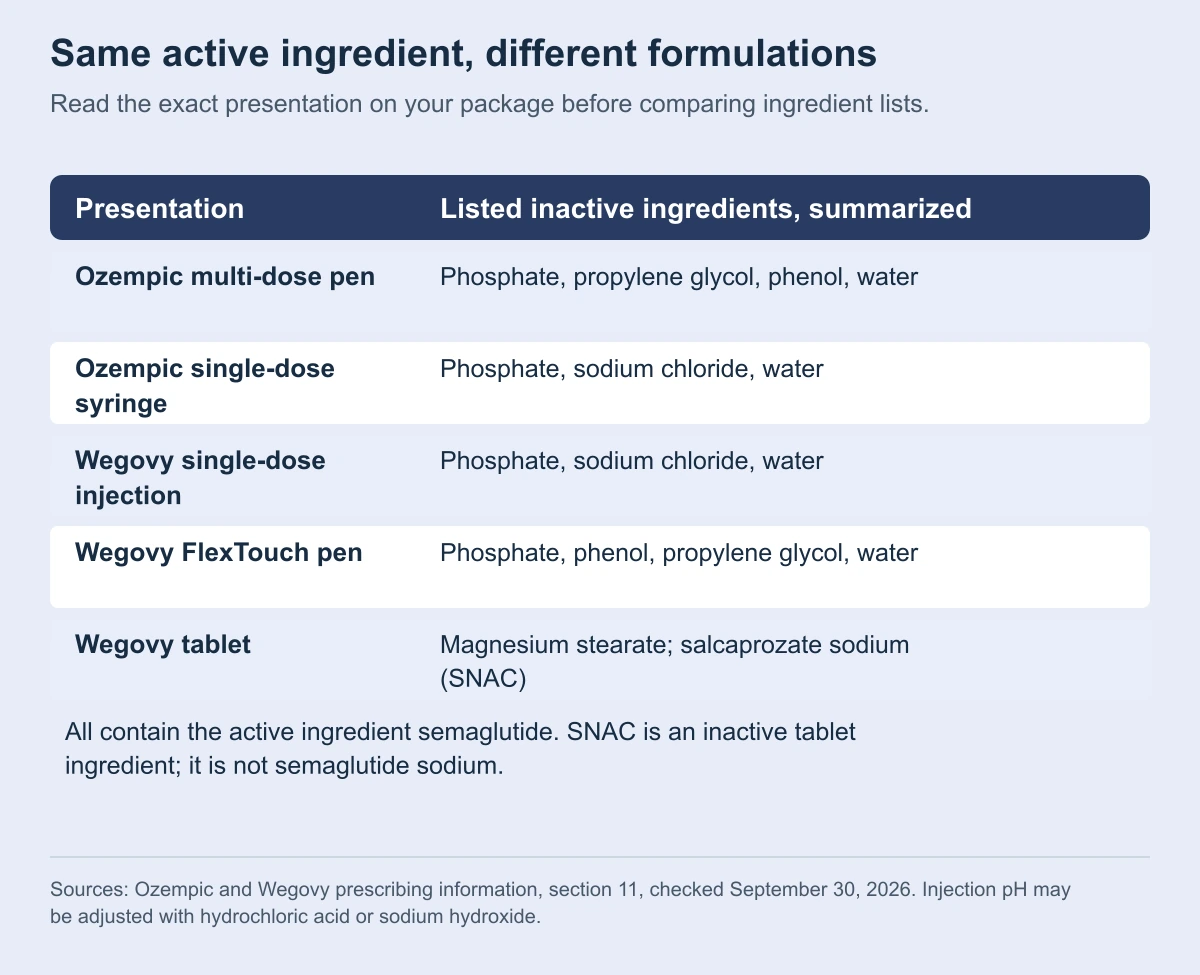
The current U.S. label describes more than one injection presentation. The multi-dose pens and single-dose prefilled syringes do not have identical inactive ingredient lists.
| Ozempic presentation | Active ingredient | Listed inactive ingredients |
|---|---|---|
| Multi-dose, single-patient-use pen | Semaglutide | Disodium phosphate dihydrate, propylene glycol, phenol, and water for injections |
| Single-dose prefilled syringe | Semaglutide | Disodium phosphate dihydrate, sodium chloride, and water for injection |
Hydrochloric acid or sodium hydroxide may be used to adjust the injection’s pH. Source: Ozempic prescribing information, section 11.
The table summarizes the ingredient names, not their quantities or a recipe for making medicine. It also does not identify every package sold in every country. Use the current label for the actual presentation dispensed to you, especially if a pharmacy changes the device or a package looks different from the one you previously received.
Which ingredients are in Wegovy injections and tablets?
Wegovy also has presentation-specific formulations. Its single-dose injection and FlexTouch pen should not be treated as the same inactive-ingredient list, and its tablets have another formulation.
| Wegovy presentation | Active ingredient | Listed inactive ingredients |
|---|---|---|
| Single-dose injection | Semaglutide | Disodium phosphate dihydrate, sodium chloride, and water for injection |
| FlexTouch multi-dose pen | Semaglutide | Disodium phosphate dihydrate, phenol, propylene glycol, and water for injections |
| Tablet | Semaglutide | Magnesium stearate and salcaprozate sodium, also called SNAC |
The injection labeling also allows hydrochloric acid or sodium hydroxide for pH adjustment. Source: Wegovy prescribing information, section 11.
An ingredient comparison is only one part of identifying a medicine. Confirm the strength, route, device, prescribed schedule, and complete instructions. The current label includes multiple strengths and presentations; familiarity with an older pen does not replace checking a newer package.
Is SNAC the same as semaglutide sodium?
No. Salcaprozate sodium, or SNAC, is listed as an inactive ingredient in Wegovy tablets. It is a separate ingredient from the active semaglutide peptide. Seeing the word “sodium” in that tablet ingredient does not mean the approved tablet uses semaglutide sodium as its active ingredient. Wegovy label.
FDA identifies semaglutide sodium and semaglutide acetate as salt forms that are different active ingredients from the one used in approved drugs. The agency says it lacks information showing they have the same chemical and pharmacologic properties, and is not aware of a lawful basis for their use in compounding. FDA’s current GLP-1 concerns.
Those are different questions: one concerns a listed inactive ingredient in an approved tablet; the other concerns the active ingredient used in an unapproved preparation. If wording on a pharmacy label is unclear, ask the pharmacist to identify the active form explicitly rather than interpreting similar-sounding names yourself.

Our guide to Mounjaro ingredients and natural-drink claims explains tirzepatide, presentation-specific inactive ingredients and why a viral beverage is not an equivalent medicine.
Does the same active ingredient mean the same medicine?
No. The products can differ in indication, strength, route, delivery system, other ingredients, and how they are taken. The fact that Ozempic and Wegovy both contain semaglutide does not make their packages interchangeable.
The active ingredient helps explain related pharmacologic effects. It does not establish that one product’s dose, missed-dose rule, storage limit, or administration procedure applies to another. Our semaglutide dosage guide explains why identifying the exact medicine comes before interpreting a number.
For example, approved weekly injections may be administered with or without meals. The current Wegovy tablets have morning, empty-stomach, plain-water, and waiting-period instructions. A similar active ingredient does not remove that difference. Our oral semaglutide versus injections guide explores the formulation and route questions.
Does semaglutide contain B12 or other vitamins?
B12 is not listed among the inactive ingredients of the Ozempic and Wegovy presentations summarized above. A compounded preparation may have additional ingredients, but there is no universal compounded-semaglutide formula to infer from the name alone.
Ask for the complete formulation and why each additional ingredient is included. Also ask whether the evidence being discussed concerns the finished combination, a separate ingredient, or a different preparation. Adding a vitamin does not itself establish better weight outcomes, fewer side effects, or equivalence to an approved medicine.
Nutrition needs during treatment are a separate question from the formula in an injection. Our supplement guide for GLP-1 treatment discusses assessing dietary intake and individual nutrient needs instead of assuming that every patient needs the same vitamin combination.
How should you evaluate a compounded formulation?
Compounded drugs are not FDA approved. FDA does not review them for safety, effectiveness, or quality before they are marketed. The agency says compounded drugs should be used when a patient’s medical needs cannot be met by an FDA-approved drug. FDA guidance.
For a preparation being considered or already dispensed, settle several specific questions:
- What active ingredient and active form does the pharmacy identify?
- What additional ingredients are included?
- What concentration is on this particular label?
- What is the prescribed dose, and how is it measured with the supplied equipment?
- What current storage and handling instructions apply?
- Who can answer questions before the next dose?
These questions help identify a preparation; they do not independently verify its quality. FDA has also warned about products with fraudulent pharmacy names and products sold for research or not for human consumption. Do not treat such wording as an appropriate route to personal treatment.
Can an ingredient list explain a color change or cloudy solution?
An online ingredient comparison cannot determine whether a particular shipment is usable. The Ozempic and Wegovy injection labels describe their solutions as clear and colorless. A damaged package, particles, or a changed appearance requires assessment using the product’s instructions and pharmacy guidance.
Compounded preparations may have additional ingredients, but a marketing explanation should not replace verification of the actual formula and handling. Our semaglutide appearance guide explains what to ask when a product looks different.
Do not try to correct an unexpected appearance by filtering, diluting, warming, or mixing the medicine. Contact the dispensing pharmacy before using a questionable preparation, and report any symptoms that followed an earlier dose.

What if you suspect an allergic reaction?
The approved labels contraindicate use after a serious hypersensitivity reaction to semaglutide or the relevant excipients. Serious allergic reactions can include swelling of the face, lips, tongue, or throat; breathing or swallowing difficulty; and a severe rash or itching. Seek urgent help for a suspected serious reaction. Ozempic label, Wegovy label.
For a nonurgent concern, keep the product name, presentation, ingredient list, and symptom timing available for the clinician. Avoid independently testing a different formulation to determine which ingredient caused a problem. A route or device change can introduce several differences at once.
What is the most useful next step?
Read the name and presentation first, then compare the complete official or pharmacy label. Keep active ingredient, inactive ingredients, dose, concentration, and route as separate pieces of information.
CoreAge Rx’s semaglutide product page provides a starting point for questions about available care and clinical eligibility. If you are comparing treatment options, our semaglutide and tirzepatide guide explains their different active ingredients and evidence. A clear formulation review should support an informed clinical decision, rather than turn ingredient names into a promise of results.
Educational information for adults; individual treatment decisions require a qualified clinician. Sources reviewed September 30, 2026. Original AI-generated article images depict fictional people and objects, not patient outcomes. Other editorial images are illustrative. Graphics summarize the cited sources.