Crackers can fit into a healthy eating pattern, including a plan for weight management. The most useful choice depends on what you need from the snack: more fiber, less sodium, a convenient carbohydrate source, or something enjoyable to serve with a filling topping. A package described as “light,” “natural,” or “multigrain” does not answer all those questions.
Start with the serving weight, ingredients, and Nutrition Facts. Then consider the complete snack. Crackers with beans, vegetables, or another protein source can serve a different purpose from crackers eaten alone. There is no single brand that makes weight loss happen, and an ordinary cracker does not need to become a forbidden food.
What makes a cracker a useful everyday choice?
A practical comparison looks at several features together. Whole-grain ingredients can support a grain choice with more fiber. Sodium matters if you are following an individualized sodium limit. Protein may matter when a snack needs to help bridge a long gap between meals. Taste, cost, accessibility, and digestive tolerance also affect whether the choice works in real life.
The FDA’s Nutrition Facts guide explains why the serving size is the first step. Label amounts describe the listed serving, which may be smaller than the amount you usually eat. Serving sizes reflect amounts commonly consumed; they are not a personalized recommendation about how much you should eat.
Consider these questions at the shelf:
- Is the first grain ingredient whole grain or refined flour?
- How many grams are in the listed serving?
- How much fiber does that serving provide?
- What does the sodium amount mean for the rest of my day?
- Will I eat these alone or with a topping?
- Does the product meet my allergy or medical needs?
Our balanced-meal guide uses the same approach: choose components that work together rather than expecting one food to provide everything.
Are Ritz crackers healthy?
Ritz crackers can be part of a snack, but the Original product in this example supplies little fiber or protein on its own. Its manufacturer ingredient list starts with unbleached enriched flour. That is different from a product whose first ingredient is whole-grain wheat. Enriched flour is not a whole-grain claim.
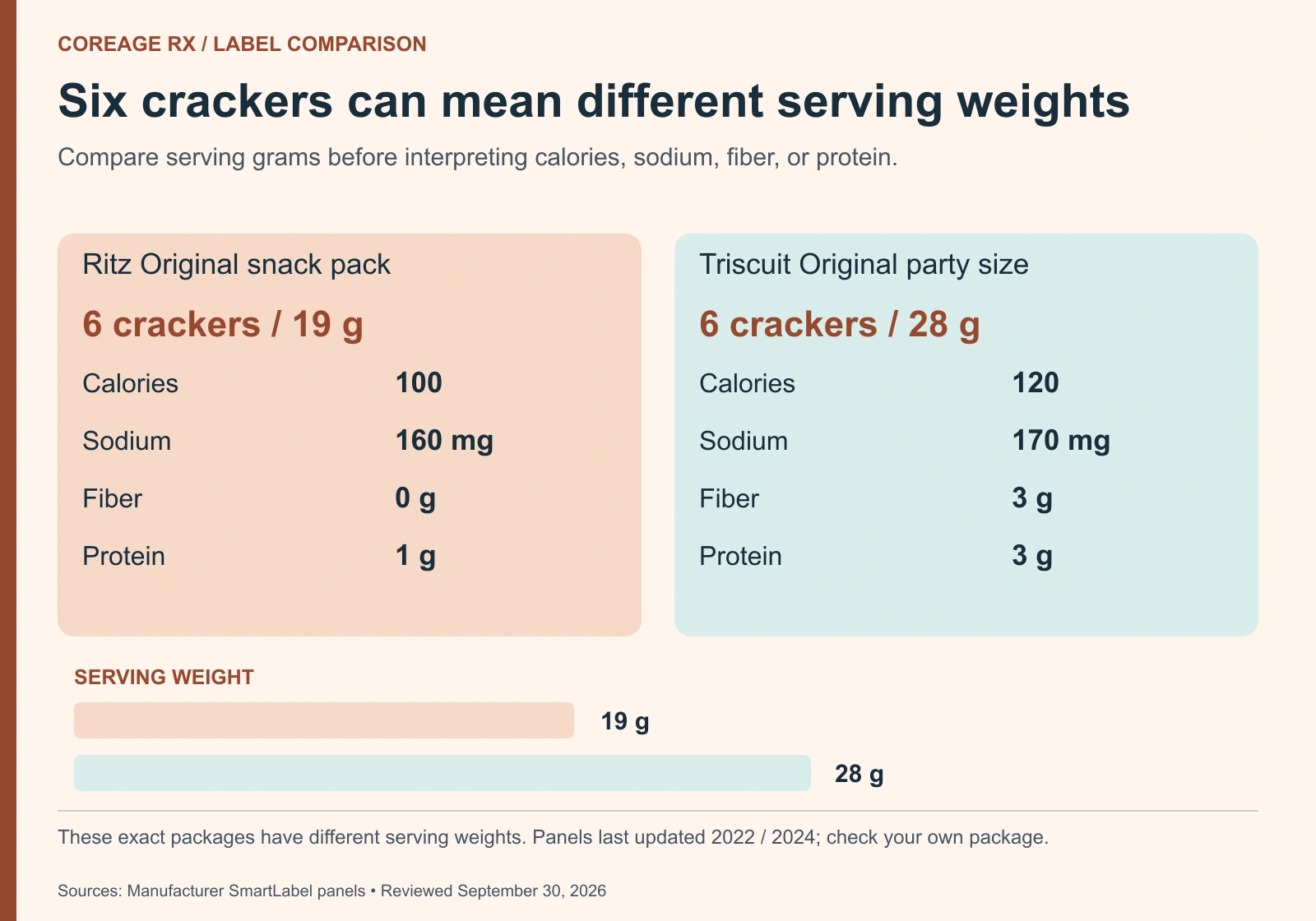
Here are two exact manufacturer label examples checked September 30, 2026. These are different products with different serving weights; they are not a ranking of every cracker sold under either brand.
| Label feature | Ritz Original, 20 snack packs | Triscuit Original, 17-ounce party-size box |
|---|---|---|
| Listed serving | 1 pack, 19 g; package identifies 6 crackers per pack | 6 crackers, 28 g |
| Calories | 100 | 120 |
| Sodium | 160 mg | 170 mg |
| Dietary fiber | 0 g | 3 g |
| Protein | 1 g | 3 g |
| Saturated fat | 1.5 g | 0 g |
| Added sugars | 1 g | 0 g |
Sources: Ritz manufacturer SmartLabel, Triscuit manufacturer SmartLabel. The linked panels were last updated in 2022 and 2024, respectively. Always check the package you buy for changes in formulation or labeling.
Notice that six crackers is not an equal amount of food across these examples: the listed weights are 19 and 28 grams. Ritz appears lower in calories per listed serving partly because that serving is smaller. Comparing only the calorie number or cracker count can therefore be misleading.
For a roughly equal 28-gram comparison, the Ritz label scales mathematically to about 147 calories and 236 milligrams of sodium. Those are estimates from rounded label values, not a laboratory analysis or a suggested serving. The simpler everyday method is to compare serving grams before drawing conclusions.
Does “multigrain” mean whole grain?
No. “Multigrain” indicates more than one grain, but does not by itself establish that the grains are whole. A brown color, seeds on the surface, or a rustic package design also cannot replace the ingredient list.
The manufacturer lists whole-grain wheat first for the Original Triscuit example. Its fiber amount is another useful piece of information. Other flavors, thin versions, filled crackers, and different brands can have different labels, even when their names look similar.
Look for clear whole-grain ingredient wording and check fiber separately. A whole-grain product can still contribute sodium, and a gluten-free product can still have little fiber. Each claim answers a particular question; none provides a complete health assessment.
If you are comparing crackers with another crunchy snack, our pretzel nutrition guide explains similar questions about grain ingredients, salt, and serving sizes.
How do you compare sodium and fiber?
Percent Daily Value provides a quick reference for the listed serving. The FDA describes 5% Daily Value or less as low and 20% or more as high. The reference helps compare products; your own needs may differ. Source: FDA’s Daily Value explanation.
In the manufacturer panels above, both servings list sodium at 7% Daily Value, even though their weights differ. Triscuit lists fiber at 11% Daily Value. It would be inaccurate to call that serving “high fiber” using the FDA’s 20% comparison threshold, or to treat the similar sodium percentages as proof that equal weights contain the same sodium.
For a specific sodium restriction, add the topping. Cheese, deli meat, salted dips, and some canned foods may contribute more sodium. A lower-sodium cracker does not cancel those amounts. Conversely, an unsalted topping can change the balance of a snack without requiring you to replace a cracker you enjoy.
Increase fiber according to tolerance. A sudden large increase is not necessary, especially if you already have digestive symptoms. Our GLP-1 food guide discusses gradual changes and adequate intake during treatment.
Which crackers are best for weight loss?
There is no universal weight-loss cracker. A useful option is one you enjoy, can portion comfortably, and can include in a satisfying eating routine. Choosing solely by the lowest calorie count may leave the snack too small or nutritionally limited for its purpose.
Think about what happens afterward. If a few plain crackers leave you hungry and searching for more food within minutes, the next experiment might be a more complete snack rather than a different brand. If a whole-grain cracker with a topping keeps you comfortable until the next meal, that combination may be useful even if the package has a higher calorie number per serving.
Our food-noise and cravings guide distinguishes appetite, persistent food thoughts, and practical eating patterns. Those experiences deserve more attention than a promise that one packaged snack will control them.
How can you make a cracker snack more filling?
Use crackers as one component. Add foods that contribute protein, fiber, or variety, choosing amounts that fit your appetite and overall plan.
| Starting point | Possible additions | What to check |
|---|---|---|
| Whole-grain crackers | Hummus or white-bean spread and cucumber | Dip serving, sodium, and tolerance |
| A cracker you already enjoy | Egg or tofu salad and tomato | Preparation, allergies, and storage |
| Crackers with a cheese topping | Fruit or vegetables alongside | Cheese amount, saturated fat, and sodium |
| A quick portable snack | A separately packed protein food and fruit | Practical food safety and total snack size |
These are examples rather than prescribed menus. Nut butter, seafood, soy, eggs, dairy, and wheat are not suitable for everyone. Choose foods that meet your own allergy and dietary requirements.
Cream cheese is useful as a spread, but it is not interchangeable with every higher-protein topping. Our cream-cheese guide explains what a verified serving contributes and how to compare alternatives.
Are low-fat or low-calorie crackers better?
They may meet a particular preference, but the claim needs context. A lower-fat product can still have little fiber or considerable sodium. A lower-calorie serving may simply weigh less. The complete ingredient and nutrient profile matters more than a single front-of-package phrase.
Compare similar amounts and think about the complete snack. If changing to a “light” cracker leads you to use considerably more topping or eat several extra servings, the experience may differ from the package comparison. That observation is information about your routine, not a failure of willpower.
You also do not need to count every cracker indefinitely. Briefly checking your typical bowl or packet against the label can help you understand the amount. Afterward, choose a practical serving approach that does not make ordinary eating burdensome.
Can people with diabetes eat crackers?
Crackers commonly supply carbohydrate. The relevant questions include the amount eaten, other foods in the snack, medicines, and your individualized glucose-management plan. “Whole grain” does not mean carbohydrate-free, and a small serving does not automatically make a product appropriate for every situation.
Use total carbohydrate on the label and the amount you actually eat when following a plan from your diabetes team. If you use insulin or a medicine that can cause low blood sugar, follow your established monitoring and treatment instructions. A mixed cracker snack should not replace the team’s specific advice for treating hypoglycemia.

What if you take semaglutide or tirzepatide?
Crackers may be comfortable during some periods of reduced appetite, but repeatedly relying on a few crackers can leave meals inadequate. The joint GLP-1 nutrition advisory emphasizes individualized nutrition assessment and attention to protein, dietary quality, and physical function during treatment.
Smaller, manageable portions can be useful. Persistent nausea, vomiting, inability to eat enough, or dehydration needs clinical review. The goal is adequate nutrition and tolerable meals, not using a medication to make the smallest possible snack feel sufficient.
CoreAge Rx’s semaglutide and tirzepatide service pages describe its programs. Confirm the exact pharmacy product and follow-up plan when considering treatment. A nutritious cracker choice supports eating; it does not substitute for clinical assessment.
Frequently asked questions
Are crackers unhealthy because they are processed?
Processing alone does not answer whether a food works in your diet. Ingredients, nutrient amounts, serving size, and the overall pattern provide more practical information. A packaged whole-grain cracker and a sweet filled cracker may serve different purposes.
Are gluten-free crackers healthier?
Gluten-free labeling is important for people who need to avoid gluten. It does not guarantee more fiber, less sodium, or fewer calories. Compare the actual label and follow medical guidance if you have celiac disease or another diagnosed condition.
Can I eat crackers every day?
They can be an everyday component if they fit your needs and leave room for varied foods. Consider what you eat with them, whether the amount is satisfying, and any specific nutrition restrictions.
Are water crackers healthy?
The name does not establish a particular calorie, fiber or sodium level. Compare the actual package’s serving weight, ingredient list, fiber, sodium and the portion you plan to eat. Different brands and recipes can differ, and a refined-flour water cracker should not be treated as a high-fiber food without checking the label. Consider what the snack adds to the day and what a pairing contributes; “water” is not a guarantee of a lower-calorie or more filling choice. How to Understand and Use the Nutrition Facts Label.
What should I change first?
Check serving grams and fiber, then improve the pairing if needed. That small review often provides more useful information than searching for one supposedly perfect brand.
Educational information for adults; individual treatment decisions require a qualified clinician. Sources reviewed September 30, 2026. Original AI-generated article images depict fictional people and objects, not patient outcomes. Other editorial images are illustrative. Graphics summarize the cited sources.