Pretzels can fit into an eating pattern, but “healthy” is too broad to describe every pretzel or snack combination. A small portion of plain hard pretzels is different from a large soft pretzel with toppings. Sodium, fiber, protein, serving weight, and the foods eaten alongside them all affect the comparison.
Rather than treating pretzels as either a diet food or a forbidden food, read the actual label and consider what you need from the snack. This guide uses current manufacturer information and U.S. nutrition resources checked September 30, 2026, with practical examples for comparing packages and building a more complete snack.
What do you want the snack to provide?
Start with the situation. You may want a crunchy accompaniment to lunch, a convenient snack between meals, something easy to pack, or a small food you can tolerate when appetite is low. The same product may serve those purposes differently.
Consider what else you have eaten and when the next meal is likely. If you want more protein or fiber, look at the pretzel’s label and possible accompaniments. If you are following an individual sodium or carbohydrate plan, use that plan when comparing products.
No single snack determines whether an overall eating pattern supports health or weight management. Our balanced-meal guide explains how variety and practical meal structure fit together. The pretzel question becomes more useful when connected to the rest of the day.
Hard, soft, filled, and flavored pretzels differ
“Pretzel” describes a food category, not one fixed nutrient profile. A bag of hard mini pretzels may use a one-ounce serving. A bakery soft pretzel can be much larger. Filled pieces, sweet coatings, seasoning blends, butter, cheese sauces, and other accompaniments change the complete snack.
Compare the specific preparation and amount you expect to eat. A claim about a plain hard pretzel should not be transferred to a large restaurant portion or a coated product. Similarly, a product called whole grain, unsalted, or gluten free still needs its own ingredient and nutrition review.
For a restaurant or bakery item, use that business’s current nutrition information where available and check whether toppings are included. If the portion differs from a packaged product, compare the total serving you will eat rather than assuming the name makes them equivalent.
Begin with the serving weight
FDA explains that a Nutrition Facts serving is based on amounts people typically consume, not a recommendation for how much you personally should eat. Nutrient values on the label usually refer to that stated serving.
Check grams as well as the number of pieces. Pretzels come in different shapes and sizes, so ten pieces from one bag may not weigh the same as ten from another. For an even comparison, use the same serving weight or account for the difference.
If you eat twice the labeled serving, the listed nutrients generally double for that amount. That is label arithmetic, not a judgment about the portion. A bowl or separate container can make the amount easier to see than eating directly from a large bag.
Three current manufacturer examples
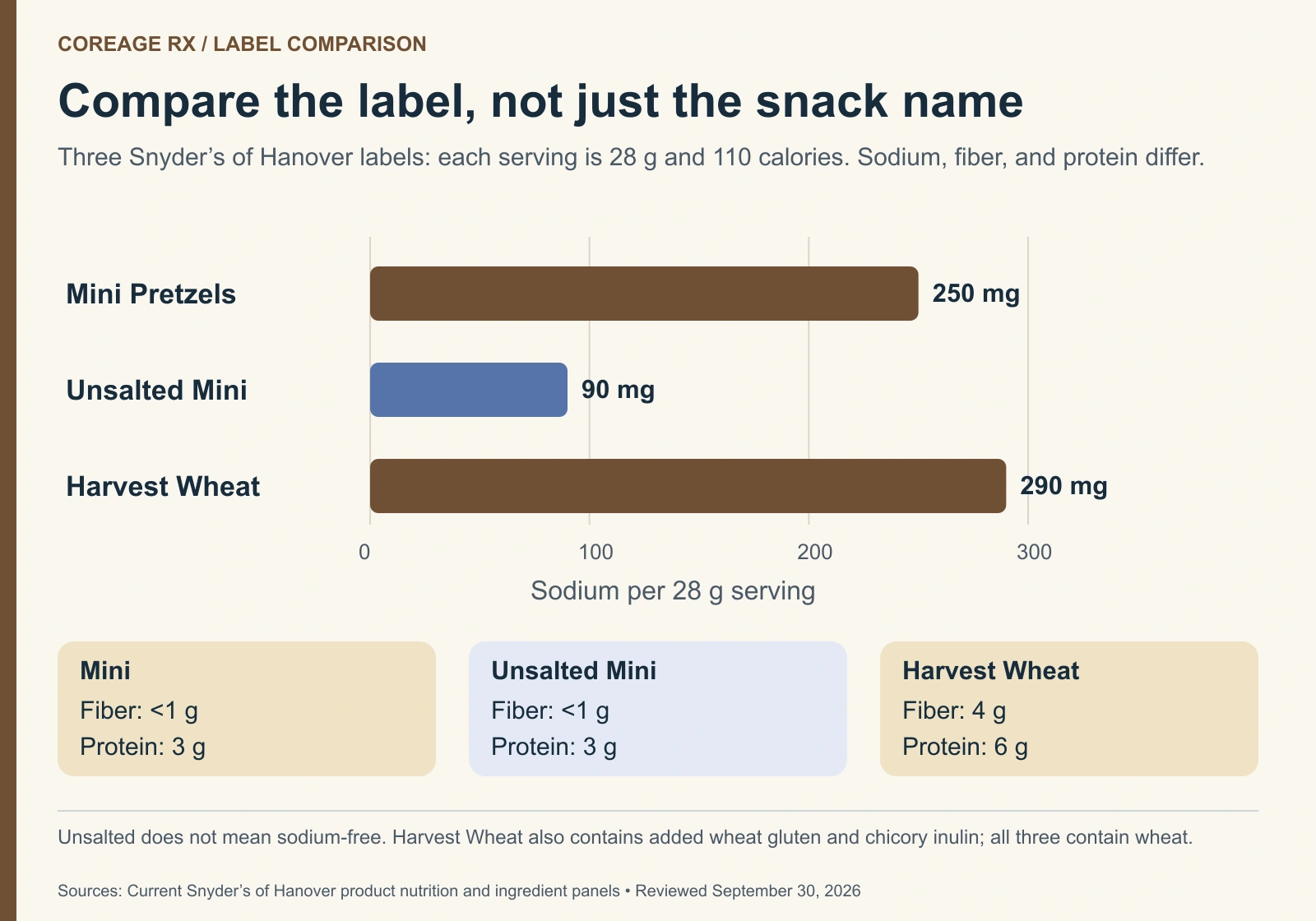
The table uses the manufacturer’s displayed Nutrition Facts for Mini Pretzels, Unsalted Mini Pretzels, and Harvest Wheat Pretzel Sticks. Each listed serving weighs 28 grams. Values were checked directly in the product pages’ nutrition tables on September 30.
| Snyder’s of Hanover product | Serving | Calories | Sodium | Fiber | Protein |
|---|---|---|---|---|---|
| Mini Pretzels | 28 g, about 19 pieces | 110 | 250 mg | Less than 1 g | 3 g |
| Unsalted Mini Pretzels | 28 g, about 19 pieces | 110 | 90 mg | Less than 1 g | 3 g |
| Harvest Wheat Pretzel Sticks | 28 g, about 16 pieces | 110 | 290 mg | 4 g | 6 g |
These are selected label examples, not a ranking of every pretzel or a claim that one product is best for everyone. Check the package you buy because formulations, package sizes, and labels can change. All three examples list wheat as an allergen.
What does the comparison actually show?
The three servings show the same listed calories but different sodium, fiber, and protein. That is why calories alone cannot describe the complete nutritional comparison.
The unsalted example has less sodium than the original example, but it is not sodium free. The wheat-sticks example has more listed fiber and protein while also having more sodium than either mini-pretzel example. A useful choice depends on which of those differences matters for your needs.
The ingredient lists provide another distinction. The original and unsalted minis begin with enriched flour. Harvest Wheat Sticks begin with whole wheat flour and also contain ingredients such as wheat gluten and chicory-root inulin. Their fiber and protein values should be read from the complete product label, not attributed exclusively to the whole wheat.

How do you identify whole grains?
Look at the ingredient list rather than the package color or a general word such as “wheat.” Current U.S. dietary guidance summarized by MedlinePlus emphasizes fiber-rich whole grains and describes looking for whole grains early in the ingredient list.
Whole wheat flour and enriched wheat flour are different descriptions. A dark color, multigrain wording, or rustic package does not by itself tell you the amount of whole grain or fiber. Read the listed ingredients alongside the Nutrition Facts.
Whole-grain options can be useful in an overall pattern, but the entire snack still matters. Portion, sodium, accompaniments, preference, and dietary needs remain relevant. You do not need to turn one package claim into a guarantee about fullness or weight change.
How much sodium is too much?
The answer depends on the rest of your diet and any individualized advice. Use the sodium amount and percent Daily Value to compare equivalent servings. The FDA percent-Daily-Value guide describes 5% DV or less as low and 20% DV or more as high for a nutrient per serving.
Those thresholds help read a label; they do not establish one ideal snack for every person. If you eat more than the listed serving, account for that amount. Also include salty dips, cheese, seasoning, and other foods in the meal.
If a clinician has given you a sodium target, compare the actual snack with that target. “Unsalted” should not replace reading the sodium line. The current unsalted-mini example contains 90 mg per 28-gram serving despite being labeled unsalted.
Can pretzels be part of weight management?
They can be included according to your preferences, portions, and overall nutrition needs. A low-fat package description does not make a food a weight-loss treatment, and a carbohydrate-containing snack does not automatically prevent progress.
Ask whether the snack is serving its intended purpose. If you repeatedly remain hungry after a small pretzel serving, you might try a pairing that adds protein or fiber, choose a different snack, or review the spacing and adequacy of meals. That is a practical experiment, not proof that pretzels are uniquely good or bad.
Our food-noise and cravings guide explains why eating behavior involves more than the nutrient label. A satisfying pattern should be manageable, varied, and suited to the person rather than built around a long list of prohibited foods.
Pairings can make the snack more complete
Consider what the pretzels already provide and what you want to add. Examples include a modest serving with hummus and vegetables, plain yogurt used in a savory dip, or a separate protein food such as an egg or cottage cheese. Fruit can add variety and some fiber.
These are meal ideas, not guaranteed satiety formulas or fixed portions. A pairing adds its own nutrients, calories, allergens, and potentially sodium. Large cheese sauces or sweet dips can change the comparison substantially, so include them when reading the whole snack.
Choose foods you enjoy and tolerate. If a high-fat accompaniment worsens nausea or reflux, a different pairing or smaller amount may fit better. Our food-fiber guide explains ways to add variety without assuming a single supplement or snack can replace a balanced pattern.
What if you take a GLP-1 medicine?
Pretzels are not universally prohibited with Ozempic, Wegovy, Mounjaro, or Zepbound. But reduced appetite can make it easier to fill up on a limited set of foods while missing other nutrients. Consider the snack within the complete eating plan and the prescription’s instructions.
The joint nutrition advisory for GLP-1 treatment emphasizes adequate nutrition, managing digestive symptoms, and protecting muscle through appropriate food and activity support. A few tolerated foods may help in the short term, but ongoing difficulty eating requires contact with the care team.
Our GLP-1 food guide discusses meal structure and tolerability. Our low-appetite nutrition guide explains why supplemental products do not remove the need to assess the real meals you can manage.
Does the pretzel label tell you everything about blood sugar?
It tells you the carbohydrate amount in the stated serving, but it cannot predict one person’s glucose response to a complete snack. Portion, accompanying foods, timing, diabetes medicines, and individual factors all affect the discussion.
If you have a diabetes nutrition plan, use its carbohydrate and monitoring instructions. Do not assume that “low fat” means carbohydrate free or that a whole-grain claim guarantees a particular glucose result. Bring the label to your clinician or dietitian if you need help fitting the snack into the plan.
Avoid changing prescribed medicines to compensate for a snack choice without advice. The nutritional comparison should help implement the care plan, not replace it.
A practical shelf checklist
Before choosing a package, check the serving weight and likely portion, sodium, fiber, protein, ingredients, and allergen information. Compare equivalent amounts and include the dip or other foods you plan to eat with it.
Then consider the purpose: is this a convenient accompaniment, a snack that needs more variety, or one of a few foods you currently tolerate? The right next step may be a lower-sodium version, a different pairing, a whole-grain option, or a conversation about persistent low appetite.
Pretzels do not need a universal healthy-or-unhealthy verdict. The label and eating context provide a more useful answer: what does this particular serving contribute, and how does it fit the rest of your nutrition plan?
Educational information for adults; individual treatment decisions require a qualified clinician. Sources reviewed September 30, 2026. Original AI-generated article images depict fictional people and objects, not patient outcomes. Other editorial images are illustrative. Graphics summarize the cited sources.