
Ketoconazole shampoo is an antifungal treatment used for particular scalp or skin problems. It can be useful when dandruff or seborrheic dermatitis is part of the picture, but treating a flaky scalp and regrowing hair are different outcomes. Research on ketoconazole for pattern hair loss is limited and does not establish it as an interchangeable substitute for proven hair-loss treatments.
If you are noticing thinning, shedding, or scalp symptoms, identify the cause before building a shampoo routine. The U.S. over-the-counter 1% product and prescription 2% formulations have different labeling. More frequent washing or a higher concentration is not automatically a more effective hair-growth strategy.
What does ketoconazole shampoo do?
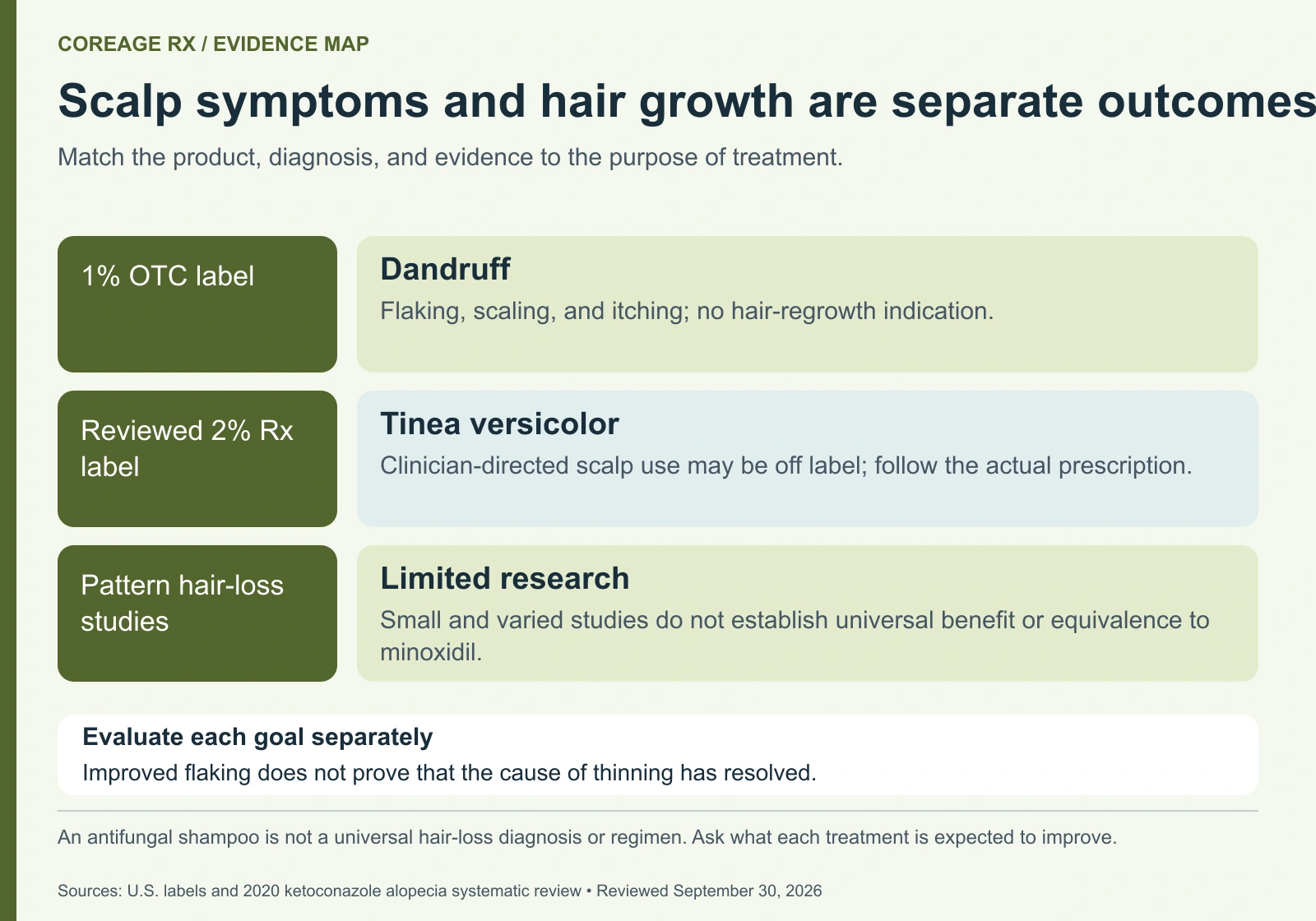
Ketoconazole is an antifungal ingredient. The over-the-counter Nizoral product reviewed here contains 1% ketoconazole and is marketed for controlling flaking, scaling, and itching associated with dandruff. Source: current U.S. Nizoral label.
Seborrheic dermatitis is a scalp condition that can include flaking, irritation, and itching. A review of ketoconazole shampoo for scalp seborrheic dermatitis describes trials showing improvement in those symptoms. Symptom improvement can be valuable even when hair density is not the treatment endpoint.
That distinction should remain clear in product claims. A study showing less scalp flaking cannot automatically support a promise that a receding hairline will regrow. A comfortable scalp and a change in the hair-growth cycle require separate assessment.
Is ketoconazole approved for hair loss?
The U.S. labels reviewed for this guide do not provide a hair-regrowth indication. The 1% Nizoral label addresses dandruff. The specific prescription 2% shampoo label reviewed lists treatment of tinea versicolor, a skin condition associated with Malassezia organisms. Source: ketoconazole 2% prescription label.
Clinicians may use a medicine off label when the clinical circumstances and evidence support that decision. Off-label use is different from an FDA-approved hair-loss indication and does not mean every online regimen is appropriate.
An important practical point: the prescription label’s instructions for one skin condition should not be copied into a universal scalp or hair-loss schedule. Ask the prescriber which problem is being treated, which product to use, and what application and follow-up instructions apply to you.
What does the hair-loss research show?
A systematic review published in 2020 assessed topical ketoconazole for androgenetic alopecia, commonly called pattern hair loss. It included five human studies with 318 participants in total, as well as two animal studies.
The abstract describes findings such as increased hair-shaft diameter, changes in a combined hair-cycle and diameter measure, and photographic or subjective improvement. The authors considered ketoconazole promising as an adjunctive or alternative approach, but stated that randomized controlled trials were needed.
Those are limited and varied measures, not a single large clinical trial proving a reliable regrowth percentage. Animal results should not be presented as patient outcomes. Combining several small studies also does not make every formulation, scalp condition, or patient equivalent.
The evidence supports discussing ketoconazole’s possible role with a clinician. It does not justify a guaranteed timeline, a claim of universal benefit, or a statement that it works as well as minoxidil for everyone.
What about the study comparing ketoconazole and minoxidil?
A 1998 trial abstract compared 2% ketoconazole shampoo with an unmedicated shampoo used with or without 2% minoxidil. It reported similar-looking improvements in selected measures, including hair density, size, and the proportion of follicles in the growth phase.
The authors themselves said the clinical significance awaited further controlled study in a larger group. The abstract does not state the sample size. It would therefore be inaccurate to invent a participant count or describe the report as a definitive equivalence trial.
“Almost similar” surrogate findings are not proof of equal long-term effectiveness, equal safety, or the same treatment role. Our minoxidil results timeline explains why the diagnosis, formulation, and outcome measure matter when discussing hair-growth expectations.
Does ketoconazole block DHT?
Online claims often simplify proposed mechanisms into a promise that the shampoo blocks the hormonal cause of hair loss. The limited clinical evidence reviewed here does not establish a dependable DHT-blocking effect that can be translated into a personal regrowth prediction.
Mechanism proposals can guide research, but they are not the same as a demonstrated patient benefit with a specified product and regimen. Do not choose a shampoo solely because an advertisement presents it as a replacement for all other pattern-loss treatment.
Ask what evidence supports the intended use in your case. If the clinician recommends it as an additional scalp treatment, clarify which outcome it is expected to improve and how that outcome will be evaluated.

How is 1% different from 2% shampoo?
Concentration is one difference; the formulation, prescription status, indication, and directions also matter. A higher concentration does not automatically mean better results for every scalp or a reason to use it more often.
| Product discussed | U.S. labeling reviewed | Question to resolve |
|---|---|---|
| Nizoral 1% ketoconazole | Over-the-counter dandruff product | Does the package fit your symptoms and give clear use instructions? |
| The reviewed ketoconazole 2% shampoo | Prescription label lists tinea versicolor | What condition is your clinician treating, including any off-label scalp use? |
| Ketoconazole discussed in hair-loss research | Limited studies using particular preparations | Does the evidence apply to the proposed role in your care plan? |
Use the actual package and prescription. Other countries’ labeling and online demonstrations may describe different formulations or approved uses. This U.S.-focused guide should not be used to infer that every shampoo with the ingredient has identical instructions.
How often should you use it for hair loss?
There is no universal evidence-based hair-loss schedule established by the studies summarized here. For an over-the-counter dandruff product, follow its current package directions and warnings. For a prescription or clinician-directed off-label use, follow the individualized instructions.
Ask about frequency, where to apply it, contact time, rinsing, and what to do on other wash days. Clarify whether other scalp products should be separated and what symptoms should prompt stopping or reassessment. These details are more useful than copying a daily schedule from a forum.
Do not assume that leaving the shampoo on much longer, using extra product, or combining several medicated shampoos increases regrowth. An irritated scalp can make the routine harder to tolerate and harder to evaluate.
Can it cause irritation or more shedding?
Yes, adverse experiences are possible. The prescription 2% label describes irritation and reports of changes in hair texture, dryness or oiliness, itching, and other reactions. It also includes reports of alopecia and hypersensitivity. Source: ketoconazole shampoo adverse-reaction information.
Postmarketing reports do not establish a known frequency or prove causation in every case. They are still a reason to take a new symptom seriously rather than assuming any increased shedding means the shampoo is working.
Avoid eye contact and follow the product warnings. If a reaction suggests irritation or sensitivity, stop use and seek advice in accordance with the label. Severe swelling, difficulty breathing, or other signs of a serious allergic reaction require urgent help. A product intended for external use should not be swallowed.
How do you know what kind of hair loss you have?
Pattern thinning, sudden diffuse shedding, patchy loss, and scalp disease can require different approaches. The American Academy of Dermatology’s diagnosis and treatment guidance explains that identifying the cause helps determine treatment.
Bring the onset, distribution, scalp symptoms, recent illnesses, medication changes, and relevant dietary changes to the appointment. Photos taken under consistent conditions can help show the trend, but a photograph alone does not establish the diagnosis.
If shedding began during a period of major weight change or difficulty eating, review nutrition and the broader history as well. Our GLP-1 hair-loss guide discusses that separate issue. An antifungal shampoo cannot be assumed to correct every cause of shedding.
Can you combine it with minoxidil?
A clinician may recommend more than one treatment when they serve different purposes. That does not mean every combination is needed, safe, or more effective. Clarify the diagnosis, each product’s role, and how to use the routine without unnecessary irritation.
Topical and oral minoxidil are different approaches. Our minoxidil side-effects guide and oral-minoxidil evidence article explain why the formulation and safety review matter. Oral treatment is not simply a stronger shampoo or a self-directed replacement for a topical product.
If pregnancy, pregnancy planning, breastfeeding, other medicines, or a relevant health condition changes, review the complete plan. Do not continue adding products without making sure the prescribing team knows what you use.

What should a useful follow-up plan include?
Separate the outcomes. Scalp itching and flaking can be tracked differently from hair density or visible thinning. Agree on which changes are expected, how long to evaluate the plan, and when persistent symptoms need another diagnosis or treatment.
Also review adequacy of food intake if appetite or weight is changing. Our semaglutide protein guide provides related nutrition questions for people receiving that treatment; it is not evidence that every hair-loss problem is caused by a protein deficit.
The most useful routine starts with a clear diagnosis and realistic expectations. Ketoconazole may have a role in scalp care or an individualized adjunctive plan, but the limited hair-loss evidence should remain visible in the decision.
Frequently asked questions
Should everyone with thinning hair try it?
The evidence does not establish a need for ketoconazole in every hair-loss routine. If you have no dandruff or diagnosed scalp condition, ask which benefit the proposed addition is meant to provide. Adding a treatment without a clear purpose can complicate the routine and make new irritation harder to attribute.
If the flaking improves, can I stop other hair-loss care?
Improved scalp symptoms do not establish that the underlying cause of thinning has resolved. Review each treatment’s purpose with the clinician before changing it. A shampoo may be helping one part of the problem while another treatment addresses a different outcome.
Can a shampoo diagnosis come from a photograph?
A photograph can show a trend or symptom, but it may not reveal the cause. New patchy loss, ongoing scalp inflammation, or rapidly changing symptoms should be assessed rather than repeatedly treated with a guessed shampoo regimen.
Educational information for adults; individual treatment decisions require a qualified clinician. Sources reviewed September 30, 2026. Original AI-generated article images depict fictional people and objects, not patient outcomes. Other editorial images are illustrative. Graphics summarize the cited sources.