
Lipo-C injections are compounded mixtures sold under a name that does not identify one universal formula. Before asking how many “units” to use or whether a shot burns fat, establish what is actually in the preparation, why it is being prescribed, and what evidence supports that specific use.
One pharmacy’s Lipo-C product combines methionine, choline chloride, L-carnitine, and dexpanthenol. That ingredient list is not proof of weight-loss effectiveness, an FDA approval, or a dosing instruction for another pharmacy’s vial. Empower Pharmacy product description.
What is a Lipo-C injection?
The term is commonly used commercially for an injectable “lipotropic” blend. Lipotropic is a descriptive marketing term; it is not, on its own, a clinical indication or a standardized medicine name. Different products may contain different combinations or amounts.
Empower’s listed product is an intramuscular compounded blend. Its wider weight-management catalog also describes other mixtures, which illustrates why “Lipo,” “MIC,” “B12,” and “Lipo-C” should not be treated as identical. Pharmacy blend descriptions.
The exact prescription and pharmacy label need to identify the preparation you receive. A picture of someone else’s vial, a clinic menu, or an ingredient acronym is not enough to match its concentration, route, supplies, or usable period.
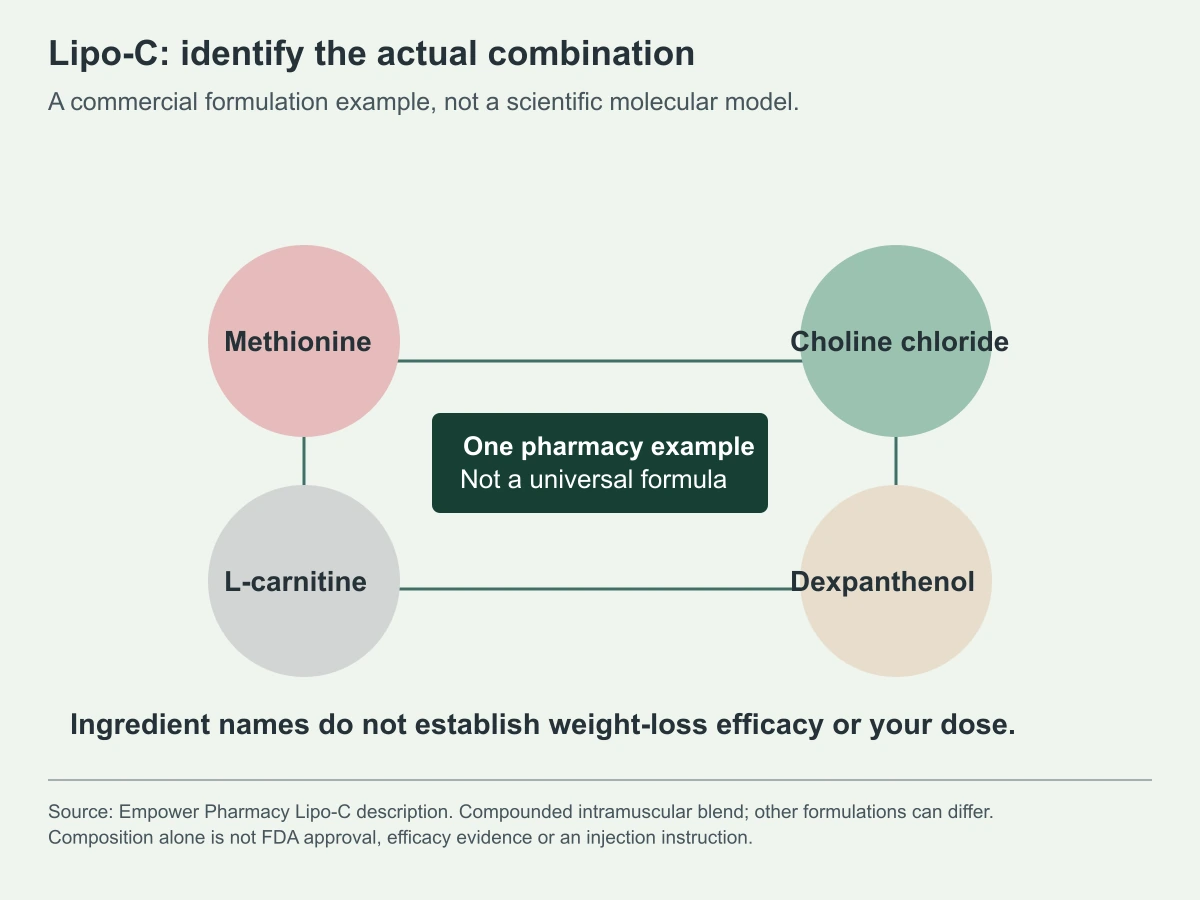
The ingredients: nutritional roles versus treatment claims
| Ingredient in the named example | Useful distinction | What its presence does not prove |
|---|---|---|
| Methionine | An ingredient identified on this pharmacy’s formulation | That every “lipotropic” product uses the same blend |
| Choline chloride | Choline has established nutritional functions | That injecting this blend produces fat loss or “detoxification” |
| L-carnitine | Carnitine is involved in fatty-acid transport | That an injection improves fat loss in a person with adequate carnitine |
| Dexpanthenol | A separate ingredient in this particular mixture | That it is B12, or that all Lipo-C products contain it |
NIH describes choline’s essential nutritional functions and carnitine’s role in transporting fatty acids. Those roles explain biological relevance, but they do not establish that giving extra amounts by injection produces a meaningful weight outcome. NIH choline overview, NIH carnitine overview.
Healthy people generally produce enough carnitine for their needs. A discussion about a diagnosed deficiency is different from a sales claim that everyone seeking weight loss should add a carnitine-containing shot. The reason for treatment should be explicit.
Does Lipo-C help with weight loss?
The primary sources reviewed here do not establish weight-loss effectiveness for this specific compounded four-ingredient injection. Ingredient explanations, customer testimonials, and a commercial product page cannot supply that missing clinical evidence.
NIH reports mixed findings across carnitine weight-loss studies. Much of that literature concerns oral supplementation; it should not be transferred to a different injected mixture, route, or patient population. An oral study also cannot establish the adverse-event rate of an intramuscular compound. NIH carnitine evidence review.
Ask what result the prescriber expects, how it would be measured, and which study supports that expectation for the actual product. “Supports metabolism” is too vague to tell you whether treatment is useful. A proposed benefit should be specific enough to review at follow-up.
Our weight-loss timeline guide explains why a change on the scale does not identify the cause by itself. If meals, activity, a GLP-1 prescription, and a new injection all change at once, an individual result cannot isolate the injection’s contribution.
Is Lipo-C FDA approved?
Compounded drugs are not FDA approved. They can address specific medical needs, but FDA does not evaluate them before marketing for safety, effectiveness, and quality in the same way it evaluates approved finished drugs. FDA compounding information.
Do not confuse an approved ingredient-containing medicine with approval of the blend. For example, the DailyMed levocarnitine injection label addresses defined carnitine-deficiency situations and a labeled intravenous product. It does not approve a compounded intramuscular Lipo-C mixture for weight loss. Levocarnitine prescribing information.
The clinic’s licensing, the pharmacy’s role, the ingredient identity, and the evidence for the proposed use are related but separate questions. A reassuring answer about one does not automatically answer the others.
Why a universal Lipo-C dosage chart can be misleading
A chart can look precise while leaving out the information that makes a measurement meaningful. The drug amounts, concentration, liquid volume, route, frequency, and device must refer to the same actual preparation.
The total contents of a vial are not necessarily the amount to administer. Milliliters describe volume. Milligrams describe an ingredient amount. Syringe “units” refer to markings on a particular device; the word does not establish how much of each ingredient is present.
A compounded blend may contain several concentrations at once. A chart for one mixture cannot safely resolve a prescription for another mixture simply because both are called Lipo-C. Ask the dispensing pharmacist to explain the current label and demonstrate how the written directions match the supplied equipment.
This article intentionally provides no amount, frequency, syringe conversion, injection-site recipe, or mixing instructions. Those details require the actual prescription and professional training. Our milligrams, milliliters, and units guide explains the general measurement distinction in a different medicine context; its examples are not Lipo-C instructions.

What should the label and teaching session cover?
Bring the package and all written instructions to the discussion. Ask the pharmacist or prescribing team to clarify these points before you use the preparation:
- Full ingredient list and concentration of each ingredient.
- Exact route and prescribed schedule.
- How the written amount corresponds to the provided device.
- Whether preparation is required and who should perform it.
- Required storage conditions and all applicable discard dates.
- What to do if the package is damaged or the instructions conflict.
- How to report symptoms and reach someone between visits.
Explain the instructions back in your own words. That gives the professional a chance to detect a misunderstanding. Mention difficulty with small print, vision, hand control, or reaching the instructed site; the routine should fit the person who will administer the medication.
A refill also deserves a fresh check. If the pharmacy changes the formulation or concentration, an old note or saved syringe reminder may no longer match. Familiar packaging is not enough to establish identical contents.
What are the side effects and safety questions?
Without evidence for a standardized product, there is no reliable universal Lipo-C adverse-event table to apply to every compounded mixture. Risks depend on the actual ingredients, concentrations, route, preparation quality, patient history, and use.
Discuss allergies, other medicines, medical conditions, previous reactions to injections, and the reason treatment is being considered. Ingredient supplement information should not be copied into a claimed safety rate for an injected combination.
FDA notes that compounding errors or contamination can cause serious harm. Ask who dispenses the product and what to do if its identity, labeling, or handling is uncertain. A commercial claim of testing is worth clarifying; it does not turn the preparation into an FDA-approved finished drug. FDA risks of compounded drugs.
For severe symptoms such as breathing difficulty, throat swelling, or fainting, seek emergency care. Report persistent or worsening injection-site problems promptly. Do not keep changing sites to work around a recurring reaction without contacting the clinical team.
Is Lipo-C the same as a fat-dissolving injection?
No conclusion about a product can be drawn from the word “lipo” alone. An ingredient blend marketed for systemic wellness is not automatically the same preparation as an injection used for a particular localized cosmetic purpose.
Ask for the exact drug name, route, intended use, and regulatory status. Avoid comparing products by nicknames, before-and-after pictures, or a clinic’s menu category. If the offered treatment differs from the prescription described here, it needs its own evidence and safety review.
Similarly, B12 in another mixture does not establish that the four-ingredient example above contains B12. A diagnosed nutrient deficiency, a cosmetic goal, and long-term weight management are different clinical problems.
Can you combine Lipo-C with semaglutide or tirzepatide?
Tell the clinician about every medicine and supplement before adding an injection. Ask whether there is a defined clinical need, what evidence supports using the combination, and whether the additional product could complicate symptoms or monitoring.
Do not mix products in a vial or syringe based on a social-media instruction. Compatibility, formulation, sterility, and the actual prescription require professional evaluation. Separate prescriptions do not authorize combining their contents.
Our semaglutide questions guide and tirzepatide questions guide cover the broader treatment discussion. CoreAge Rx’s semaglutide and tirzepatide service pages describe separate offerings to review with a clinician; neither is evidence that Lipo-C adds benefit.
Our comparison of Lipo-B versus Lipo-C formulations uses named pharmacy ingredient examples and separates biological nutrient roles from demonstrated weight-loss outcomes. The names alone do not establish a common formula, strength or injection schedule.
How should you compare the cost?
Request the full charge for the proposed course, not just a price “per shot.” Ask whether evaluation, medication, supplies, administration, shipping, and follow-up are included. Establish whether the schedule or quantity could change the total.
Then compare that cost with the clinical question: what benefit is expected and how will the team decide whether to continue? An affordable add-on can still be poor value if its purpose is unclear. An expensive package does not establish better evidence or product quality.
If recurring billing is involved, read renewal and cancellation details before purchasing. Our online prescription guide explains how to evaluate the care arrangement as well as the advertised medication.

Keep the underlying nutrition and health goal in view
If the concern is low food intake, fatigue, or a possible deficiency, ask for assessment of that problem rather than assuming a blend is the answer. Symptoms can have multiple explanations, and an ingredient name cannot diagnose the cause.
For everyday nutrition, the balanced-meal guide offers practical food combinations. The calorie planning guide explains why individual needs matter. Neither guide requires buying an injectable add-on to make meals useful.
A follow-up plan can record the starting concern, relevant measurements, side effects, expenses, and the agreed review date. Decide with the clinician what would count as enough benefit to continue and what would prompt a different approach.
Common Lipo-C questions
Does Lipo-C burn fat directly?
That claim is not established by the sources reviewed for this compounded blend. Nutrient roles in metabolism do not demonstrate a weight-loss effect from an injection.
Is Lipo-C just vitamin B12?
Not necessarily. The named four-ingredient example does not list B12. Other mixtures can differ, so read the actual ingredients rather than rely on the nickname.
How many syringe units should I use?
Obtain the answer from the prescriber and pharmacist for your exact product and device. No universal number applies across concentrations and mixtures.
Is an approved carnitine injection proof that this blend is approved?
No. The labeled product, route, patient population, and indication are separate from a compounded Lipo-C mixture used for weight management.
Can I take it with a GLP-1 prescription?
Have the clinician review the complete medication list and the reason for adding it. Do not assume the combination improves outcomes or mix the products yourself.
What should I ask before paying?
Ask what is being prescribed, why, which evidence supports the actual use, who dispenses it, how use is taught, and how benefit and safety will be reviewed. Those answers are more useful than a generic injection chart.
Educational information for adults; individual treatment decisions require a qualified clinician. Sources reviewed September 30, 2026. Original AI-generated article images depict fictional people and objects, not patient outcomes. Other editorial images are illustrative. Graphics summarize the cited sources.