
Oral minoxidil may help some people with hair loss, but the answer depends on the diagnosis, treatment plan, and evidence being considered. It is not FDA-approved for hair loss, and a swallowed tablet has different safety considerations from a product applied to the scalp. It should not be treated as a universally stronger version of topical minoxidil.
The useful questions are whether the evidence fits your type of hair loss, how progress will be measured, and whether the possible benefit justifies the risks for you. A dermatologist can help answer those questions before a prescription is started or changed.
What is oral minoxidil approved to treat?
The U.S. oral minoxidil label describes a medicine for certain patients with severe hypertension that has not responded adequately to other treatments. Using it for hair loss is an off-label use: the drug is approved, but that particular purpose is outside its approved labeling. Source: oral minoxidil prescribing information.
Off-label prescribing does not mean no clinician can consider the treatment. It does mean that the reason for choosing it, the supporting evidence, and the monitoring plan should be explained clearly. An advertisement for hair tablets should not imply that the FDA has approved oral minoxidil for that purpose.
Topical minoxidil products have their own labeled uses, strengths, and application routines. A topical percentage cannot be converted into a swallowed dose. Never ingest a scalp solution or substitute one route for another without the prescribing clinician’s instructions.
What did a randomized comparison find?
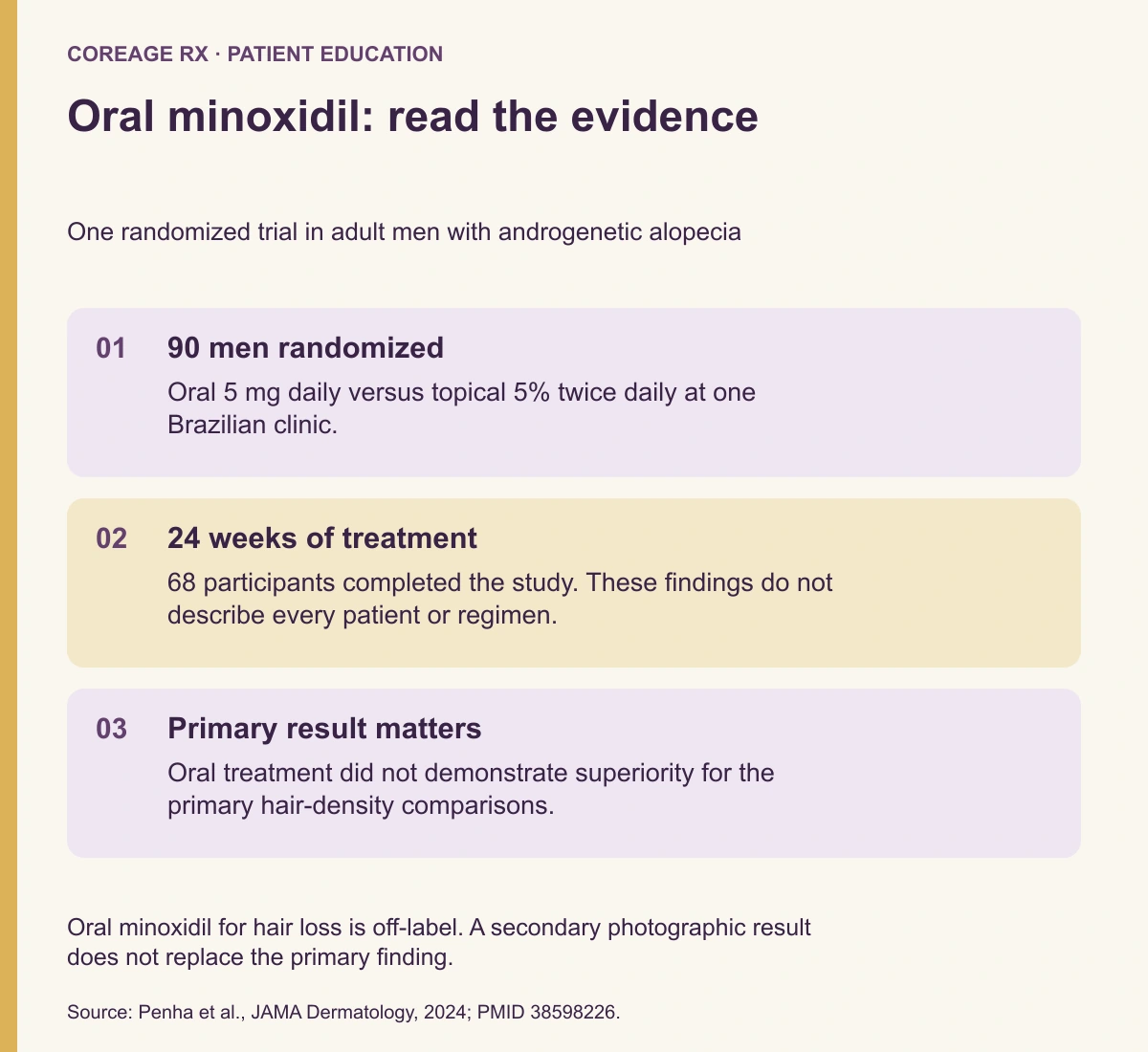
A 2024 randomized trial studied 90 adult men with androgenetic alopecia, a patterned form of hair loss, at one specialist clinic in Brazil. It compared oral minoxidil 5 mg daily with topical minoxidil 5% applied twice daily over 24 weeks. Sixty-eight participants completed the study.
The oral treatment did not demonstrate superiority for the primary hair-density comparisons at the front and vertex of the scalp. A secondary photographic assessment favored oral treatment at the vertex, but not the frontal scalp. Those findings should be kept separate: a favorable secondary photograph rating does not replace the primary outcome.
The study does not prove that the two routes are identical, that neither can help, or that oral treatment is better for everyone. It also does not establish results for every woman, age group, diagnosis, or prescribed regimen. The amounts used in the trial describe the research; they are not instructions for selecting your own dose.
How strong is the broader evidence?
An international expert consensus published in 2025 described encouraging findings from small studies but emphasized the need for larger trials and more standardized guidance. Forty-three hair-loss specialists from twelve countries took part in its consensus process.
The authors identified continuing questions about oral versus topical effectiveness, long-term safety, pediatric use, and other formulations. A consensus statement can help clinicians organize decisions while evidence develops. It is not itself a randomized trial proving a particular amount of hair growth.
That distinction is useful when evaluating a claim such as “clinically proven to work for everyone.” Look for the studied population, comparison treatment, outcome, duration, and number of people who completed follow-up. A collection of positive testimonials cannot answer those questions in the same way.
Why the cause of hair loss comes first
Hair thinning and shedding can have more than one cause. A treatment chosen for patterned loss may not address an illness, nutritional problem, scalp disease, or another trigger. Starting with the most heavily advertised medicine can delay the assessment that would make treatment more useful.
The American Academy of Dermatology recommends identifying the cause through history and examination. Depending on the findings, a dermatologist may consider tests for a suspected disease, deficiency, hormonal issue, or infection. Tests should answer a clinical question, not be ordered as an automatic online shopping list.
Describe when the change began, whether it was sudden or gradual, where it occurs, and any scalp symptoms. Mention recent illness, surgery, pregnancy-related changes, substantial weight changes, and new medicines. If shedding began during weight-management treatment, our Mounjaro and hair-loss guide explains related questions to raise without assuming the injection is the only possible cause.
Oral versus topical: compare the practical tradeoffs
| Question | Topical minoxidil | Oral minoxidil |
|---|---|---|
| How is it used? | Applied to the scalp according to the specific product label | Swallowed under a clinician’s prescription |
| Is the route approved for hair loss? | Certain products have specific labeled hair-loss uses | Hair-loss prescribing is off-label |
| What can make use difficult? | Scalp irritation, application routine, product texture, or unwanted hair growth | Systemic adverse effects, medical suitability, and follow-up requirements |
| Does changing routes guarantee a better result? | No | No |
A person struggling with a topical routine may want to discuss an oral option, but convenience does not erase the safety difference. Likewise, scalp irritation does not establish that every topical formula will cause the same reaction. The complete product and reason for the problem matter.
Our minoxidil side-effects guide compares topical solutions, foams, and oral treatment in more detail. Bring the actual packaging and a list of other products to the appointment.

How long should you wait for a result?
The randomized oral-versus-topical trial assessed outcomes at 24 weeks, not after a few days. That research period is not a promise that everyone will respond by six months, but it illustrates why an immediate photograph is a poor measure of treatment effect.
Agree on a review schedule before starting. Ask which changes the clinician expects to assess and when a lack of benefit should lead to reconsidering the diagnosis or plan. Topical product instructions and timelines should not automatically be copied onto an oral prescription.
Use photographs with consistent lighting, hairstyle, distance, and scalp position if the clinician recommends them. Record the treatment dates and relevant changes in other medicines or health. This makes a later comparison more informative than repeatedly inspecting the hair under different bathroom lighting.
What if shedding changes early in treatment?
A change in shedding deserves context rather than an automatic conclusion that treatment is working or failing. Report when it began, how noticeable it is, whether there are bare patches or scalp symptoms, and whether other health changes occurred at the same time.
Do not increase the dose simply because more hair appears in a brush. Nor should a marketing claim about an expected “shed” be used to dismiss rapid, patchy, painful, or otherwise concerning loss. The clinician should decide whether the pattern fits the treatment course or needs a different assessment.
If treatment is difficult to tolerate, ask how to proceed before the next routine review. Waiting for a hair-growth milestone is not a reason to ignore symptoms elsewhere in the body.
Which side effects matter for oral treatment?
Unwanted hair growth can occur outside the scalp. In the 2024 trial’s oral group, hypertrichosis was reported in 22 of 45 participants and headache in 6 of 45. Those figures belong to the particular trial regimen and population; they should not be advertised as the exact risk for every lower-dose prescription.
The oral label also contains a boxed warning about serious cardiovascular effects, including fluid around the heart that can become severe and possible worsening of angina. The drug’s blood-pressure and fluid-balance effects are relevant even when the treatment goal is cosmetic. Source: oral minoxidil label.
Chest pain, fainting, breathing difficulty, marked swelling, or a rapid heartbeat require prompt medical assessment. Do not treat these as ordinary scalp-product irritation. Tell the evaluating clinician about minoxidil and all other medicines.
What should the clinician review before prescribing?
Discuss cardiovascular and kidney history, blood pressure, previous medication reactions, and all prescriptions and supplements. Pregnancy, breastfeeding, or pregnancy plans also belong in the conversation. The clinician determines which examination, measurements, tests, or specialist advice are appropriate.
Ask who will respond to symptoms between appointments and how treatment will be reviewed if another medicine changes. A standardized online dose chosen without considering medical history is not a substitute for that process.
The hypertension label and low-dose hair-loss prescribing involve different clinical contexts. Do not copy a blood-pressure regimen or add other medicines from the label to manage a hair-treatment side effect yourself.

Can it be combined with finasteride or another hair treatment?
Combination treatment is a separate clinical decision. Adding ingredients can change the evidence, adverse effects, pregnancy considerations, and monitoring needs. A combination should not inherit a claim of safety merely because one ingredient is familiar.
Our finasteride side-effects guide explains issues specific to that drug. If a compounded combination is offered, ask for every ingredient, strength, route, and the reason the complete preparation is appropriate. Evidence for one oral minoxidil tablet regimen does not automatically establish equivalent results for every combination or dissolving formulation.
Frequently asked questions
Is oral minoxidil always better than topical minoxidil?
No. The 24-week randomized study in men did not demonstrate superiority for its primary hair-density comparisons. Medical suitability, tolerability, diagnosis, and the practical routine still matter.
Will it restore all the hair I have lost?
No study discussed here establishes that promise. Ask the dermatologist what improvement is realistic for your diagnosis and which outcomes would justify continuing treatment.
Can I stop once my hair looks better?
Discuss maintenance and any change with the prescribing clinician. A short-term improvement does not establish that the underlying problem has resolved. Do not invent a stop-and-restart schedule from another person’s experience.
What is the most useful first step?
Get the cause assessed, then compare appropriate options. A clear diagnosis, realistic expectations, and a plan for follow-up make the question “Does it work?” much more useful than choosing a tablet from a before-and-after advertisement.
Set product-specific treatment expectations
- Minoxidil results timelines and review points — Compare topical product labels, early shedding questions, safety review, and continued use.
Educational information for adults; individual treatment decisions require a qualified clinician. Sources checked September 27, 2026. Original AI-generated article illustrations depict fictional people and objects, not patient outcomes. Other editorial images are illustrative. Graphics summarize the cited sources.