
The claim that NAD+ nasal spray delivers a compound directly to the brain is more specific than a general claim about cellular energy. It raises several questions: does the formulation enter the relevant pathway, does enough of the compound reach human brain tissue, and does that exposure improve a meaningful clinical outcome?
These questions should be answered separately. Animal studies provide a reason to investigate intranasal NAD+, but they do not complete the chain of evidence for a commercial spray used by people seeking better focus or healthy aging.
Why the nasal route attracts research interest
The nose has anatomical relationships that make intranasal delivery an area of drug-development research. Some substances may be absorbed into circulation, and researchers also investigate pathways associated with the olfactory and trigeminal systems. The contribution of each pathway depends on the substance and delivery conditions.
It is therefore reasonable to study whether a nasal formulation can reach a target beyond the nose. It is not reasonable to assume that every sprayed molecule reaches the brain efficiently or in a therapeutically useful amount.
Formulation, device, deposition, clearance, and the properties of the molecule can affect the result. Evidence for one intranasal medicine should not be used as a blanket validation of another.
Identify the molecule and the formulation
NAD+ is distinct from NADH, nicotinamide, NMN, and NR. These compounds are related through metabolism but have different structures. A study involving one does not automatically establish the delivery behavior of another.
The preparation also matters. Concentration, other ingredients, the delivered volume, and the device can affect how a nasal product is used. A familiar ingredient name does not identify all of those features.
The nasal prescription guide explains why the actual pump and formulation must remain connected to the directions. A generic spray count cannot establish the exposure produced by every bottle.

What the 2007 rat study investigated
A 2007 study used a rat model of transient focal ischemia, an experimental interruption of blood supply to part of the brain. Investigators reported increased brain NAD+ after intranasal delivery and reduced measures of injury under the study conditions.
That finding supports the biological possibility worth investigating. It does not establish that a human nasal product improves ordinary concentration, prevents stroke, or reduces dementia risk. The model involved an acute experimental injury rather than healthy volunteers using a wellness preparation.
The details of the species, condition, administration, and endpoint are therefore central to the interpretation. Removing them can make an animal result appear to answer a human question it did not test.
What the brain-injury study adds
A 2012 rat study examined intranasal NAD+ after traumatic brain injury. It assessed neuronal injury in particular brain regions and other experimental measures. Again, the work concerns a disease model in animals.
An effect on neuronal injury in a model is different from an improvement on a cognitive test, and both are different from preventing neurological disease over years. The appropriate summary should name the outcome actually observed.
These studies should not become instructions for treating a head injury or stroke at home. Suspected brain injury or acute neurological symptoms require medical assessment and established emergency care where indicated.
Species differences are not a small footnote
Rats and humans differ in anatomy, physiology, body size, and the relationship between the nasal cavity and potential delivery pathways. Experimental administration may also differ from a person’s use of a commercial pump.
A dose that produces an effect in an animal is not a human dose recommendation. Simple scaling does not establish equivalent deposition, exposure, or safety. The same caution applies to the time between an experimental injury and administration.
The scientific next step is appropriately designed human research, not a consumer calculation. The NIH clinical-research overview explains why clinical studies need planned methods, participant protections, and relevant outcomes.

Brain exposure and clinical benefit are separate endpoints
Even if a study establishes that a compound reaches a tissue, the clinical question remains: what useful outcome changes? A rise in a measured concentration may help demonstrate exposure, but it does not establish improved memory, attention, or independence.
A cognitive claim needs an appropriate assessment in a relevant population. A disease-prevention claim needs an appropriate design and follow-up for that disease. A broad healthy-aging claim needs more than one laboratory result.
| Research step | Question it answers |
|---|---|
| Formulation and delivery testing | Can the preparation be administered consistently? |
| Human exposure measurement | What reaches a measured compartment, and when? |
| Controlled clinical outcomes | Does the intervention improve a relevant result? |
| Longer follow-up | Are effects durable, and what safety issues emerge? |
Skipping a step does not make the later conclusion more certain.
Blood testing cannot stand in for a brain measurement
A blood NAD-related result comes from a particular sample and method. It does not directly measure the concentration inside brain cells. A claim connecting the two needs supporting evidence rather than an assumption that the body has one uniform NAD+ level.
The NAD+ testing guide explains sample differences and the distinction between a reference interval and a clinical target. This matters when a product is promoted using a before-and-after blood number alongside a brain-benefit claim.
A person can find the laboratory result interesting while still asking what it demonstrates about the symptom they want to improve. These are compatible questions.
Human trial registration is a beginning, not a result
The registered gerotherapy pilot reviewed for this series includes nasal NAD+ in combinations with other interventions. Its record did not contain posted results. The registration shows that a research plan exists; it does not establish absorption into the human brain or cognitive effectiveness.
The combination design also matters. If several medicines and lifestyle interventions change together, a favorable outcome may not identify the contribution of the nasal product alone. Direct claims require a design capable of isolating the relevant effect.
A sponsor’s description of a study should therefore be distinguished from completed, reported results and from independent confirmation.
Testimonials cannot measure a delivery pathway
Someone may report feeling clearer or more alert after using a spray. That experience can be worth discussing with a clinician. It cannot establish which anatomical pathway delivered the compound or whether the reported effect was caused by it.
Sleep, expectations, other treatments, workload, illness recovery, and ordinary variation can influence the experience. An immediate sensation in the nose is also not a test of brain exposure.
The focus article and results guide explain how to describe practical changes without assigning them an unmeasured biological explanation.
Read product language with specific questions
When a product says “direct brain delivery,” ask for human evidence involving the actual ingredient and route. When it says “neuroprotective,” ask which human clinical outcome supports that term. When it says “fast acting,” ask whether the evidence concerns a sensation, a blood measurement, or a meaningful benefit.
These questions help make the evidence review concrete. They do not require a patient to become a pharmacologist; they require the claim to be explained in ordinary language with an appropriate source.
The FDA compounding overview also clarifies why a compounded prescription is not an FDA-approved finished product with established labeling for every advertised use.
Ask whether the studied product matches the offered product
A study can involve intranasal NAD+ and still use a different concentration, formulation, device, or administration method from a commercial product. A shared ingredient name does not settle those differences. Ask which aspects of the preparation were actually studied and which are being inferred.
This is especially important when a research description uses a delivery method that a consumer pump cannot reproduce. The appropriate response is to identify the uncertainty, not to modify a prescribed device or increase the amount in an attempt to imitate an experiment.
Keep the clinical concern in view
If concentration or memory has changed, describe its onset, pattern, and effect on daily tasks. A clinician can assess whether sleep, medication, mood, illness, or a neurological condition needs attention. Sudden changes require a different response from a long-standing mild concern.
Nasal NAD+ research is an area of investigation with interesting preclinical findings and substantial unanswered human questions. A careful discussion preserves both parts of that statement: the reason researchers are interested and the evidence still needed before strong brain-benefit claims can be made.
Explore NAD+ Nasal
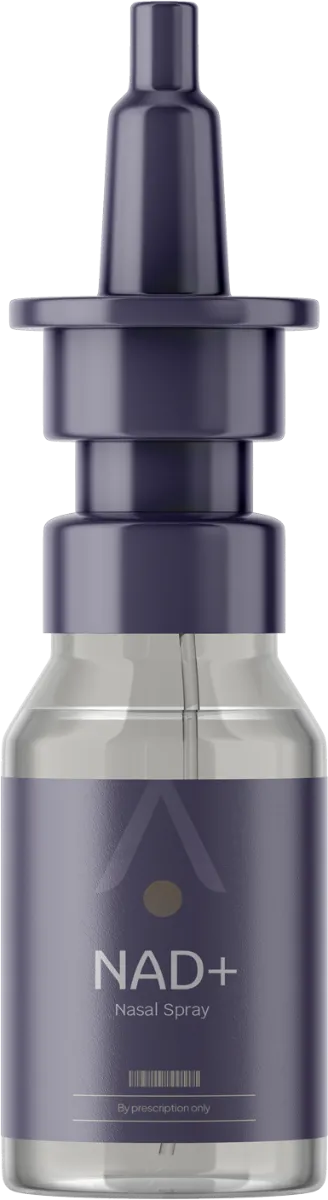
CoreAge Rx lists NAD+ Nasal as a provider-guided compounded nasal spray. The pharmacy’s formulation and pump instructions determine how it is used. Research on oral precursors, IV infusions, or animals does not establish identical benefits from this spray. Review the current NAD+ Nasal page and bring a complete medication and supplement list to the provider discussion.
Related reading
- NAD+ Nasal Spray: How to Understand the Evidence
- NAD+ Nasal Spray vs. Injections: Comparing Route, Routine, and Evidence
- CoreAge Rx NAD+ Nasal: A Product and Evidence Guide
- NAD+ injections versus oral NMN and NR
Educational information; your prescription and clinician’s instructions guide individual care. Product details and linked sources checked September 15, 2026. Studies of another preparation or delivery route do not establish identical results for a finished compounded product. Photographs are illustrative and do not show treatment outcomes.