
A facial estriol cream and menopause hormone therapy are different treatment decisions. They may both involve an estrogen, but their intended goals, formulations, application routes, evidence, and instructions are not interchangeable. A cream prescribed for facial skin should not be substituted for treatment of hot flashes, vaginal symptoms, or other menopause concerns.
At the same time, a facial hormone product belongs on your medication list. The word topical does not guarantee that exposure is entirely local. Review all hormone products with the clinicians involved so a cosmetic goal does not create a gap in the medical history.
Start with the symptom or concern being treated
Facial skin care may focus on dryness, texture, or a defined cosmetic feature. Menopause care may involve symptoms that affect sleep, comfort, sexual health, or daily functioning. Those are different goals that require their own evaluation.
The FDA’s menopause information discusses hormone therapy and the need to consider benefits and risks with a health professional. A skin-care article cannot determine which treatment is appropriate for those symptoms.
If the main issue is a dry, irritated face, a nonhormonal moisturizer or diagnosis of dermatitis may be more relevant than a systemic hormone decision. If the issue is disruptive menopause symptoms, an ordinary cosmetic consultation may be insufficient.
Estriol and estradiol are not interchangeable names
Estriol and estradiol are different estrogens. Products containing them can have different formulations, intended uses, and evidence. Do not substitute one for the other because the names sound similar or both are described as bioidentical.
The FDA states that no estriol-containing drug is FDA-approved and that estriol should not be assumed to be a proven safer estrogen. Some FDA-approved hormone therapies contain hormones chemically identical to those made by the body, so natural-sounding language is not a reliable way to distinguish approval status or safety.
Ask for the exact hormone identity, product name, route, and purpose. That is the basis for a meaningful comparison.
Different routes have different instructions
Hormones may be supplied in oral, transdermal, vaginal, or other preparations for specific purposes. A facial cream is another application context, not a substitute for those labeled or prescribed uses.
Do not apply a vaginal product to the face, use a facial cream vaginally, or spread a facial prescription over a larger area in an attempt to obtain a systemic effect. The vehicle, concentration, amount, and intended tissue exposure differ.
| Treatment discussion | Main question |
|---|---|
| Facial cosmetic concern | Is the skin goal defined, and does the formula’s evidence fit it? |
| Hot flashes or other systemic symptoms | What evaluation and treatment options fit the medical history? |
| Vaginal symptoms | Which local or other treatment is appropriate for the diagnosis? |
| Existing hormone regimen | How does any additional product affect the complete medication review? |
Skin evidence does not establish symptom-treatment evidence
Small studies of topical estrogens have examined skin measurements. The review of estrogen-deficient skin discusses that literature and its variation. Those studies do not establish that a facial estriol cream treats every menopause symptom.
Likewise, evidence about a systemic hormone regimen should not be used to promise a particular cosmetic result from a different facial preparation. The product, exposure, population, and outcome need to match the claim.
The estriol facial-cream evidence guide explains the commonly cited studies and their limits. A concentration that resembles an older study is not proof that a modern combination has identical effects.
Topical does not mean automatically non-systemic
Topical describes where the product is applied. It does not, by itself, show how much is absorbed or whether any exposure occurs beyond that area. Formulation, amount, frequency, application area, and skin condition can influence the context.
Do not interpret unchanged selected hormone measurements in a small study as a guarantee of zero exposure for every user. Equally, do not assume a facial cream has the same quantified risk as a different systemic regimen without supporting evidence.
The useful discussion is what is known about the supplied preparation, what remains uncertain, and how your history affects the decision. The estriol safety questions guide provides a framework.

Review the complete hormone and medication list
Include hormone patches, pills, vaginal products, hormonal contraception, and other compounded preparations. Add the facial product with its exact hormone, concentration, amount, and frequency. Do not leave it off because the prescribing goal is skin appearance.
Tell the clinician about hormone-sensitive conditions, unexplained bleeding, blood-clot or stroke history, liver disease, and other relevant medical concerns. These are topics for individualized review, not a checklist that this article can use to determine suitability.
If more than one clinician is involved, make sure each has the same updated list. A clear record reduces the chance that one product is considered in isolation from the rest of the regimen.
Do not change an existing hormone regimen from a skin-care article
Adding or stopping progesterone, estrogen, or another hormone requires the clinician responsible for that care. A facial estriol prescription should not be used to infer that another medication is unnecessary or that an additional one must be started automatically.
Ask how the facial product fits with the existing plan and whether any monitoring or review changes are appropriate. The answer depends on the individual situation and cannot be supplied by a generic layering guide.
If menopause symptoms worsen, report them through the appropriate medical evaluation. Do not increase facial cream to try to treat them or judge systemic hormone needs by whether the skin looks more hydrated.
Where Time Out fits
Time Out lists estriol 0.3%, vitamin C 5%, and hydrolyzed hyaluronic acid 0.5%. It is presented as a provider-guided facial skin formula. The vitamin C and HA components do not make the estriol component nonhormonal.
Ask what skin concern the product is intended to address and what nonhormonal options may be sufficient. Confirm the prescribed amount, application area, and schedule. Do not extend use to other tissues or body areas without instructions.
The Time Out ingredient guide reviews the full preparation. Its public product description should not be read as an indication for treatment of hot flashes or vaginal symptoms.
Compounded and FDA-approved products are different categories
The FDA’s compounding explanation states that compounded drugs are not FDA-approved. A prescription or a pharmacy-prepared combination does not establish the same premarket review for safety and effectiveness as an approved product.
Ask the provider why the compounded preparation is being considered and what uncertainty applies. A natural or customized description does not answer those evidence questions.
Keep the product in its original container with pharmacy contact details, directions, and beyond-use date. If the formulation changes, update the medication list rather than assuming the new container is equivalent to the old one.
Keep ordinary skin care in the plan
Gentle cleansing, a suitable moisturizer, and sun protection can have useful roles regardless of whether a hormone product is selected. The AAD’s menopause skin-care guidance discusses practical care and assessment of persistent problems.
Dryness alone should not be treated as proof that a hormone prescription is necessary. The menopause dry-skin routine provides a nonhormonal starting framework, while persistent rash or itching needs diagnosis.
If additional actives are used, review retinoids, acids, and pigment products together. A more complicated routine can create irritation that obscures the original skin goal.
Report unexpected symptoms
Ask which local and possible hormonal symptoms should prompt contact. Unexpected vaginal bleeding, breast changes, or other new symptoms deserve assessment rather than being dismissed because the product is used on the face.
Persistent burning, rash, swelling, or blistering after a new product also needs advice. Stop a newly introduced product that causes a marked reaction. Severe facial swelling or breathing difficulty requires urgent medical care.
Do not wait for the cosmetic follow-up if a significant new symptom occurs. Bring the exact product and application history into the medical review.
Coordinate the decisions without confusing them
Facial care and menopause symptom treatment can be discussed together while retaining distinct goals and instructions. A skin response does not establish the need for systemic therapy, and a facial prescription does not replace an appropriate menopause evaluation.
The most useful plan names the concern, identifies the product and route, reviews the full medical history, and defines follow-up. That clarity protects both decisions from assumptions based only on the shared word estrogen.
Explore Time Out™
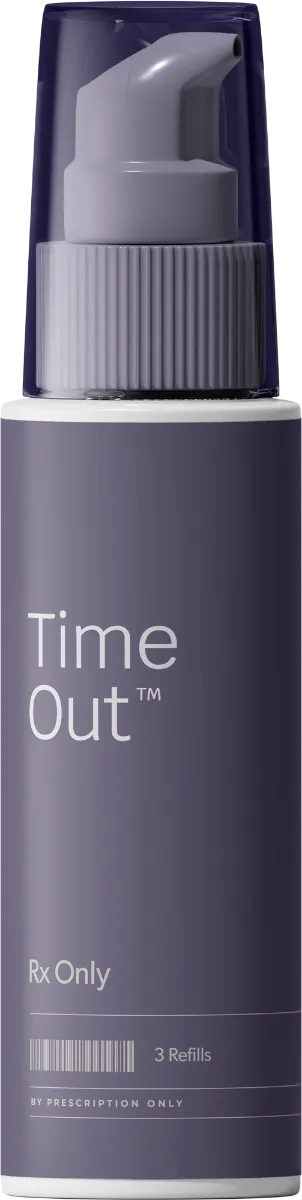
Time Out lists estriol 0.3%, vitamin C 5%, and hydrolyzed hyaluronic acid 0.5%. Estriol is an estrogen, so suitability and use require individual medical review. A facial formulation is not interchangeable with menopause hormone therapy or vaginal estrogen. Review the current Time Out™ page and bring your existing skin-care products to the provider discussion.
Related reading
- Menopausal Skin Care: Dryness, Firmness, and Treatment Questions
- Estriol Face Cream: What Human Skin Research Can Tell Us
- Topical Estriol for Facial Skin: Safety Questions for Your Prescriber
- Time Out Ingredients: Estriol, Vitamin C, and Hydrolyzed Hyaluronic Acid
- Tretinoin versus retinol: choosing a routine
Educational information; your prescription and clinician’s instructions guide individual care. Product details and linked sources checked September 15, 2026. Ingredient research does not establish identical results for a finished compounded formula. Photographs are illustrative and do not show treatment outcomes.