Topical estriol for facial skin requires a medical discussion because estriol is an estrogen. A cosmetic goal does not make a hormone-containing preparation equivalent to an ordinary moisturizer, and the word topical does not guarantee that exposure stays entirely local. The exact formula, amount, area, frequency, and health history all matter.
For a compounded product such as Time Out, ask how the potential benefit and uncertainty apply to you. Small skin studies cannot establish long-term safety for every formulation or medical history. A useful consultation should produce clear instructions and a plan for reporting unexpected symptoms, not just reassurance that the cream is used on the face.
What exactly is in the preparation?
Confirm the hormone identity and strength, the other active ingredients, and the full formula information needed to review allergies. Estriol and estradiol are different estrogens; one should not be substituted for the other based on a similar name.
Time Out lists estriol 0.3%, vitamin C 5%, and hydrolyzed hyaluronic acid 0.5%. Those percentages identify the public ingredient summary, but they do not tell you the amount applied in each use or the amount absorbed.
Ask the pharmacy to clarify the dispensing mechanism, prescribed amount, and storage instructions. Keep the original container so the product cannot be confused with another hormone cream or an older prescription.
Why is a hormone-containing cream being considered?
The goal should be specific: dryness, a defined texture concern, or another clearly described feature. Ask why ordinary moisturizer or other nonhormonal options may or may not meet that goal.
The review of estrogen-deficient skin discusses biological rationale and clinical studies, but the evidence varies by preparation and population. A plausible mechanism does not establish that every mature or dry face needs an estrogen product.
If the skin is persistently itchy, red, painful, or affected by a changing lesion, ask whether diagnosis should come first. A hormonal explanation should not replace assessment of a separate skin condition.
What evidence applies to the finished cream?
Ask the provider to separate ingredient research from evidence for the complete formulation. A study using estriol at the same concentration does not necessarily use the same vehicle, other ingredients, dose, or application area.
The estriol evidence guide reviews the small human studies and their limits. The absence of a reported problem in a short study does not prove that uncommon or longer-term effects cannot occur.
This is a place for a candid explanation of uncertainty. It should not be replaced by claims that natural, bioidentical, or weak estrogen means proven safe for everyone.
What does FDA approval status mean?
The FDA’s menopause information states that there are no FDA-approved estriol-containing drugs and that estriol should not be assumed to be a proven safer estrogen. The FDA compounding explanation describes the distinction between compounded and approved products.
A prescription process does not establish FDA premarket review of the finished compounded cream. Ask how the clinician is weighing the available evidence and why the preparation is being selected for your individual need.
Keep this question separate from whether a pharmacy is legitimate or a clinician is licensed. Those are relevant matters, but they do not turn a compounded product into an FDA-approved one.
Which medical history needs review?
Tell the prescriber about hormone-sensitive cancers or related evaluations, unexplained vaginal bleeding, blood-clot or stroke history, liver disease, and other significant conditions. These are topics for individualized assessment; this article cannot determine suitability from a checklist.
Also review current hormone therapy, vaginal estrogen products, hormonal contraception, and any other compounded hormones. A facial product should not be omitted from the medication list because the treatment goal is skin appearance.
Discuss pregnancy, pregnancy plans, and breastfeeding where relevant. Menopausal symptoms or irregular cycles should not be used to make assumptions about reproductive status or product suitability.

What should the application instructions specify?
| Detail | Question to resolve |
|---|---|
| Amount | How is the prescribed amount measured with this container? |
| Frequency | What exact schedule is intended? |
| Area | Which facial areas are included and excluded? |
| Skin condition | What should happen with irritation, broken skin, or a procedure? |
| Handling | Are handwashing and absorption instructions clear? |
| Missed use | What should be done without applying extra? |
| Review | When is continuation reassessed? |
Do not extend application to the neck, chest, mucosa, or another body area without instructions. Do not use the facial cream as a vaginal preparation or substitute it for a systemic hormone product.
Can topical use still produce systemic exposure?
Topical describes the application route, not a guarantee about where an ingredient goes afterward. The public Time Out information acknowledges that absorption can vary with formulation, dose, area, skin condition, and frequency.
Ask what is known about the supplied preparation and what remains uncertain. Do not interpret a small study with unchanged selected hormone measurements as proof that no exposure occurs under any circumstances.
Equally, do not assume that the quantified risks of a different systemic hormone regimen apply identically to this facial cream. The appropriate discussion is product-specific uncertainty and individual medical judgment, not an unsupported claim of either zero risk or a known identical risk.
How should other skin treatments be coordinated?
Review retinoids, acids, benzoyl peroxide, brightening prescriptions, peels, and recent procedures. Irritated or recently treated skin can change the application context, and a multi-active routine can make reactions harder to interpret.
Ask which products should remain and whether separate timing is needed. Do not add more estriol cream because another product causes dryness, or mix the prescription into a moisturizer to change its strength.
The Time Out ingredient guide and menopausal skin-care guide help organize the routine. The goal is a clear plan with a reason for each step.
What symptoms should be reported?
Ask the prescriber which local and possible hormonal symptoms should prompt contact. Unexpected vaginal bleeding, breast changes, or other new symptoms should be reported for assessment rather than assumed to be unrelated because the product is facial.
Persistent burning, rash, swelling, or blistering after a new product also needs advice. Stop a newly introduced product that causes a marked reaction. Severe facial swelling or breathing difficulty requires urgent medical care.
Do not wait for a scheduled cosmetic review if a significant new symptom occurs. Keep the product name, formulation, and application history available so the clinician can evaluate the exposure accurately.
What monitoring is appropriate?
Ask how the clinician will assess both the skin goal and suitability over time. A monitoring plan should be chosen for the individual situation; do not assume every person needs the same laboratory testing or that a single normal result proves long-term safety.
Record the prescribed use, any changes in amount or area, and other hormone products. Report changes in health history or medications during treatment. This information can be more useful than an isolated photograph of the skin.
At follow-up, discuss whether the benefit is meaningful enough to continue and whether a nonhormonal approach would now be sufficient. An initial prescription should not automatically become indefinite use without reassessment.
How is this different from menopause hormone therapy?
A facial estriol preparation is not a substitute for treatment of hot flashes, vaginal symptoms, or other menopause concerns. Hormone patches, oral medications, and vaginal products have their own indications and instructions.
The facial estriol versus hormone therapy guide explains why these decisions should be coordinated but kept distinct. Do not increase facial application in an attempt to treat symptoms elsewhere in the body.
If menopause symptoms affect daily life, seek an appropriate evaluation and review all products together. A cosmetic skin response cannot determine whether systemic hormone treatment is needed.
Leave with a decision you understand
You should know why the product is being considered, what evidence supports the goal, what remains uncertain, and which aspects of your history affect the decision. The amount, area, schedule, follow-up, and response to problems should all be clear.
Estriol facial care deserves the same careful product identification and medical review as other hormone use. A defined goal and an honest discussion of uncertainty make the plan more useful than broad assurances based on the words topical or natural.
Explore Time Out™
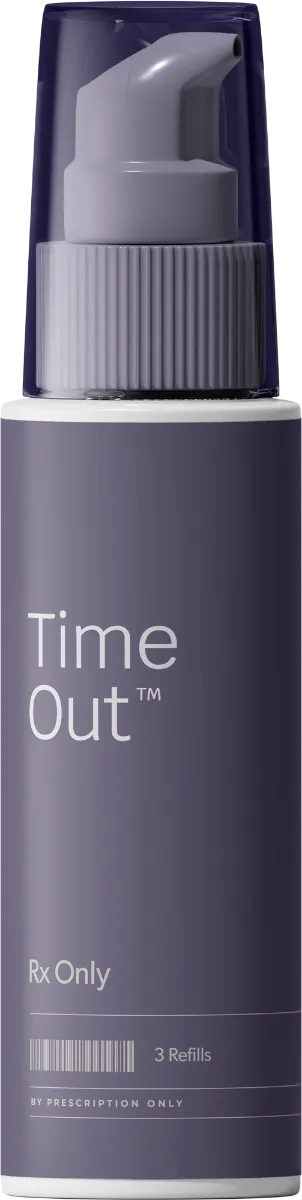
Time Out lists estriol 0.3%, vitamin C 5%, and hydrolyzed hyaluronic acid 0.5%. Estriol is an estrogen, so suitability and use require individual medical review. A facial formulation is not interchangeable with menopause hormone therapy or vaginal estrogen. Review the current Time Out™ page and bring your existing skin-care products to the provider discussion.
Related reading
- Menopausal Skin Care: Dryness, Firmness, and Treatment Questions
- Estriol Face Cream: What Human Skin Research Can Tell Us
- Estriol Face Cream and Menopause Hormone Therapy: Different Decisions
- Time Out Ingredients: Estriol, Vitamin C, and Hydrolyzed Hyaluronic Acid
- Tretinoin versus retinol: choosing a routine
Educational information; your prescription and clinician’s instructions guide individual care. Product details and linked sources checked September 15, 2026. Ingredient research does not establish identical results for a finished compounded formula. Photographs are illustrative and do not show treatment outcomes.