
Choose a creatine supplement by checking the form, the amount per serving, the other ingredients, and the evidence behind any quality claims. A long name or premium price does not establish that a product works better.
Start with creatine monohydrate
Creatine monohydrate is the most widely studied form. The NIH fact sheet notes that alternative forms have not been shown to offer superior performance, stability, or safety. That makes monohydrate a straightforward reference point when comparing labels.
“Micronized” describes particle size; it should not be read as proof of a better clinical result. Flavored and unflavored options may differ in convenience and taste, but the actual creatine amount remains the key dosing number.
Use this comparison sheet
| Label item | What to write down |
|---|---|
| Form | Exact name of the creatine ingredient |
| Amount | Grams of creatine per labeled serving |
| Serving size | Scoops, capsules, or another unit |
| Other ingredients | Flavors, sweeteners, stimulants, or added nutrients |
| Servings per container | The amount available at the stated serving |
| Quality documentation | The specific test, certifier, and product covered |
Compare cost per labeled serving only after the amounts are comparable. A lower container price can hide fewer servings or a smaller creatine amount. Avoid assuming that a proprietary blend provides a clinically studied amount when the individual quantity is undisclosed.

Understand manufacturing language
An FDA-registered facility is not the same as an FDA-approved supplement. The FDA’s supplement guidance explains that dietary supplements are not approved for safety and effectiveness before sale in the way drugs are. Manufacturing statements should not be used as evidence of a treatment benefit.
If a seller claims third-party testing, look for the actual organization, the product covered, and what was tested. Identity, contaminants, and banned-substance screening are different questions. Do not invent a certification because the website uses words such as “clean” or “premium.”
Apply the checklist to Strong Suit
The pictured Strong Suit label lists creatine monohydrate, 5 g per scoop, 30 servings, and no other ingredients. It is unflavored. The total scoop weight is listed as 5.6 g, so distinguish powder weight from the 5 g active ingredient amount.
The page and pictured label describe manufacture in an FDA-registered facility. That statement does not establish independent certification or finished-product clinical testing. Check the current product information if those details are important to your purchase.
Match the product to a real goal
Before buying, decide how it fits your training and how you will judge whether the routine is useful. Read the main creatine guide for evidence and the mixing guide for everyday use. If you have kidney disease, take medication, or have another relevant condition, bring the label to your clinician first.

Create a comparison that starts with disclosed information
Before comparing promotional claims, make a small table for the products you are considering. Include the creatine form, grams per serving, serving directions, other ingredients, servings per container, and any verifiable testing information. Leave an entry marked “not disclosed” when the label does not answer it.
That last step matters. An unknown amount should not become a favorable assumption merely because the packaging looks professional. A simple product with a clearly stated amount may be easier to assess than a complex blend whose individual ingredients cannot be counted.
Also check whether the information refers to the current product. Retailer descriptions, old photographs, and different package sizes can disagree. Use the actual bottle you receive for final preparation directions and contact the manufacturer if the available materials are inconsistent.
Compare creatine grams rather than powder grams
Imagine Product A lists 5 g creatine in one serving, while Product B lists a 12 g flavored powder serving but does not clearly state how much is creatine. Product B’s larger number does not establish a larger creatine dose. It describes the total powder weight unless the panel says otherwise.
Now imagine a third product lists a proprietary blend containing creatine and several other ingredients. The blend total cannot be divided equally among the ingredients without evidence. Ingredient order is not a substitute for individual amounts, and a front-panel claim cannot fill that gap.
Strong Suit’s reviewed label is clearer on this point: it lists 5 g creatine monohydrate in a 5.6 g scoop. That makes the creatine amount identifiable. It does not eliminate the need to check directions, health circumstances, or the rest of your supplement routine.
Understand what quality documentation would answer
Quality questions can include ingredient identity, the amount present, contaminants, and compliance with a particular testing program. Different documents answer different questions. A general manufacturing statement may not provide a batch-specific result, and a certificate should be read for its scope and date.
If a product claims independent certification, verify the product in the certifying organization’s own information rather than relying solely on a logo in an advertisement. Check whether the certification applies to the exact product and what it covers. Do not assume a certification for one item extends to every product sold by the brand.
For competitive athletes, prohibited-substance risk may be an additional consideration that deserves sport-specific professional guidance. A supplement being legal to sell is not the same question as whether its use fits a sport’s rules. Avoid treating vague phrases such as “athlete approved” as complete documentation.
Evaluate form and marketing language separately
Creatine monohydrate provides a useful evidence-based reference point because it has been widely studied. Alternative names, delivery systems, or premium packaging should be evaluated for demonstrated advantages rather than assumed superiority. A more expensive form does not automatically produce a better training outcome.
“Micronized” refers to particle size. It may be relevant to a product’s physical characteristics, but it should not be converted into a promise of greater muscle gain without supporting evidence. Similarly, flavor preference is a practical consideration, not proof of a different biological effect.
The NIH review discusses the evidence on forms, and the FDA supplement guidance explains the difference between marketing a supplement and obtaining drug approval. These sources help separate a clear label from claims that require additional support.
Compare cost without guessing about current prices
Prices and promotions change, so use the current product page or checkout information when making a purchase comparison. Divide the actual price by the stated number of label-directed servings to estimate cost per serving. Be clear about whether shipping, subscriptions, or discounts are included.
Do not compare containers only by their total weight. A larger flavored tub can include more non-creatine ingredients, and a smaller container may still provide a similar number of daily servings. Cost comparisons are meaningful only when the ingredient amount and intended use are clear.
This arithmetic is a purchasing tool, not a reason to take extra servings from a less expensive product. The daily routine should remain aligned with the label and your health needs, regardless of how favorable the per-serving price appears.
A short checklist before opening the tub
- Confirm the exact product name and ingredient form.
- Find the creatine amount per serving and the current preparation directions.
- Check the seal, expiration information, and storage instructions.
- Review other supplements for overlapping creatine.
- Retain the label and lot information if you may need to contact the manufacturer.
- Discuss use first when medical conditions, medicines, pregnancy, breastfeeding, or kidney concerns make individualized advice necessary.
This check should take a few minutes, not become an endless search for a perfect label. The aim is to make the important information visible and identify questions that remain unanswered.
Frequently asked questions
Does a longer ingredient list mean better performance?
No. More ingredients create more claims to evaluate and may make amounts harder to understand. Start with the job you want the product to perform and whether the disclosed ingredients and amounts support that purpose.
Is an FDA-registered facility the same as FDA approval?
No. Facility registration and product approval are different regulatory concepts. Do not interpret a manufacturing statement as proof that the FDA has approved a supplement’s effectiveness for a particular outcome.
Should I choose a powder, capsule, or gummy?
Compare the actual creatine amount, required serving, other ingredients, and directions for each format. Convenience and preferences matter, but the format alone does not establish equivalent amounts or better results. Avoid assuming one gummy or capsule equals one scoop of another product.
What if the manufacturer does not disclose an amount?
Ask for the missing information and keep it marked as unknown until you receive a clear answer. Do not estimate individual ingredient amounts from a proprietary blend total. Transparent information makes a comparison possible; a confident guess does not.
Explore Strong Suit™
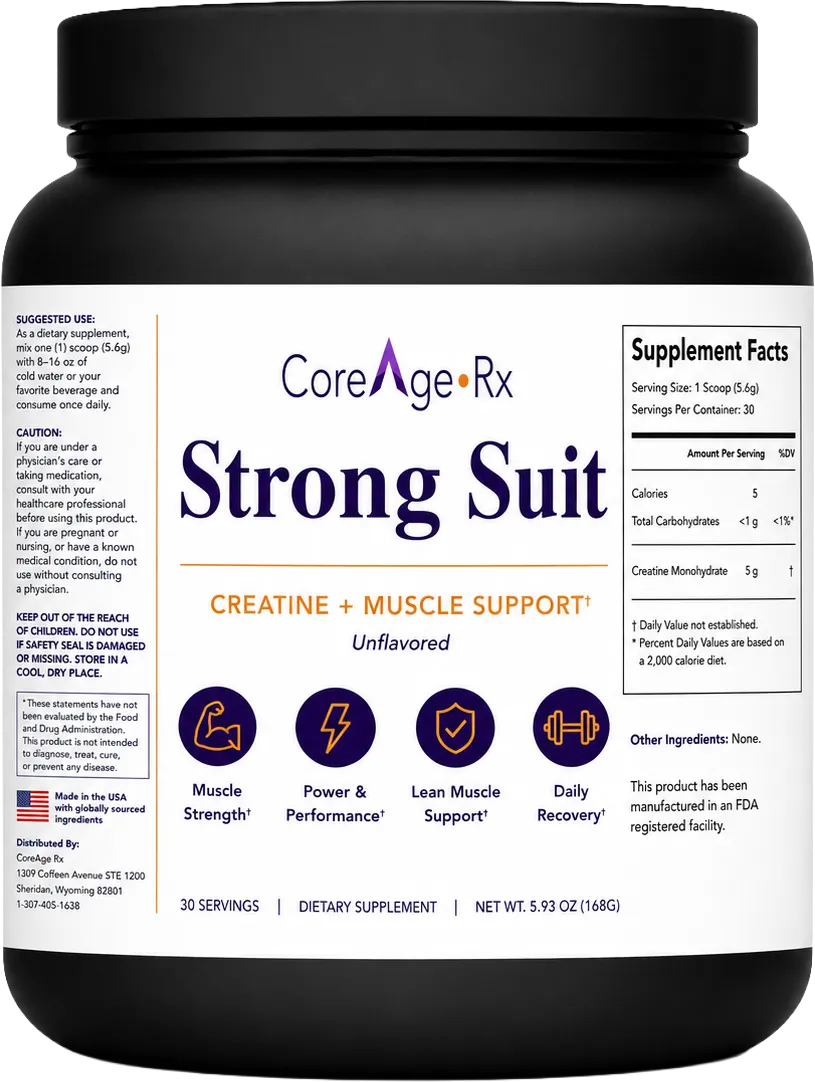
Strong Suit is CoreAge Rx’s unflavored creatine monohydrate powder. The pictured label lists 5 g creatine per scoop and 30 servings. See the current Strong Suit™ page and check the bottle you receive before use.
Related reading
- Creatine Monohydrate: Benefits, Dosing, and What to Expect
- How Much Creatine Should You Take Per Day?
- Do You Need a Creatine Loading Phase?
- Nutrition during GLP-1 treatment
Educational information, not individualized medical advice. Product information and linked research checked September 15, 2026. Ingredient research does not establish identical effects for a finished supplement.