Topical minoxidil belongs on the scalp where the product is intended to be used, rather than mainly on the hair. You can generally return to ordinary combing and styling after the treatment has dried or absorbed as directed by your particular product. The amount, frequency, and washing instructions depend on the formulation; one routine does not fit every foam, solution, or prescription mixture.
If your main question is “Can I comb my hair after applying minoxidil?”, start with the package directions and allow the application to dry before styling. This guide explains that sequence, the differences between named product examples, and the situations that need professional advice.
Identify the product before planning the routine
Check whether you have a solution, aerosol foam, another topical preparation, or an oral prescription. Read the concentration, intended user, application area, directions, and warnings. Keep the carton and leaflet rather than relying only on the bottle’s brand name.
The manufacturer’s men’s Rogaine 5% solution page describes a 1 mL application twice daily. An identified Keeps men’s 5% foam label, packaged by Thirty Madison, describes half a capful twice daily. These are named product examples, not an instruction to convert a dropper volume into foam or to use the same regimen for everyone.
Women’s products, different concentrations, and compounded mixtures require their own directions. An oral minoxidil prescription is a separate treatment with systemic monitoring considerations. Our oral minoxidil evidence guide explains why topical application advice cannot be transferred to pills.
If a pharmacy has supplied a custom preparation, ask it to explain the measured amount, ingredients, and application instructions. A pump, spray, or dropper is not automatically equivalent to another product’s applicator.
Why scalp placement matters
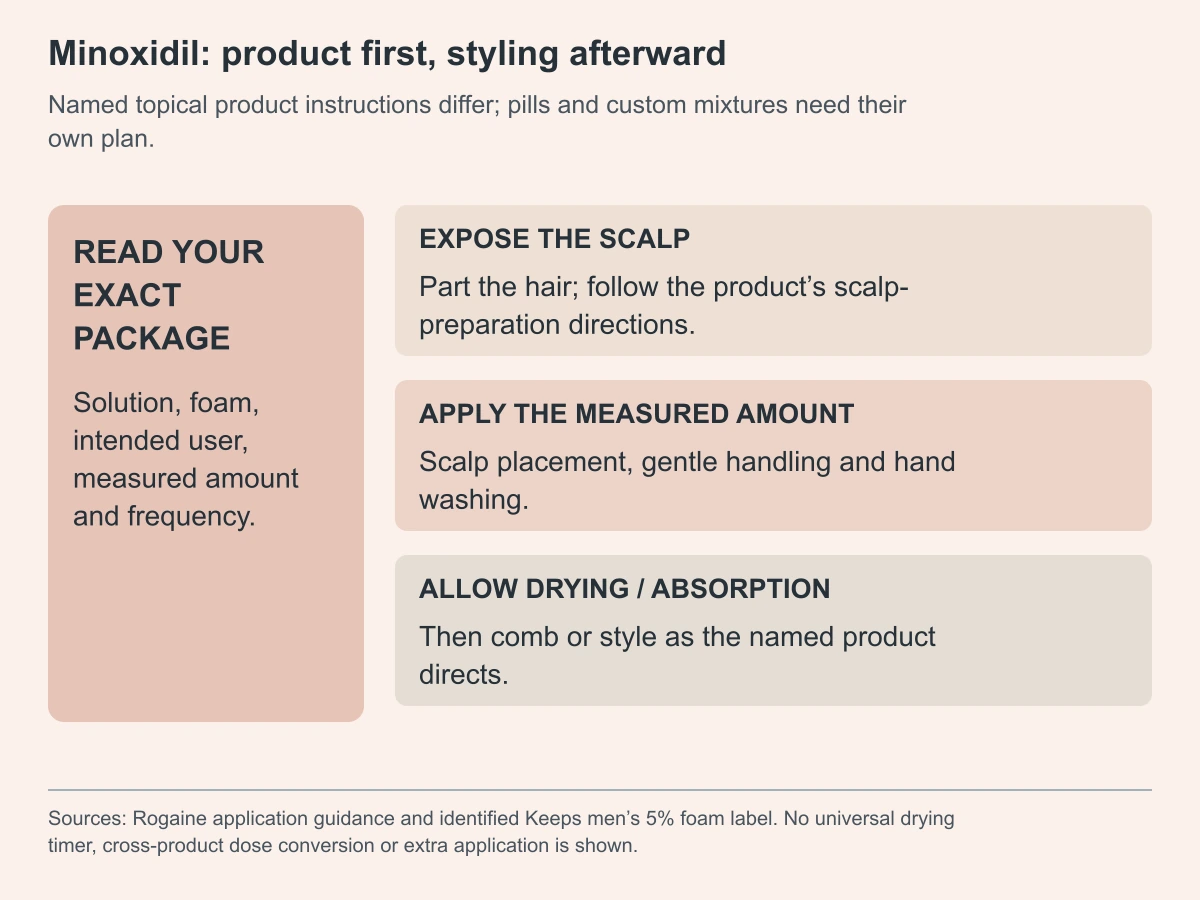
Hair can catch a liquid or foam before it reaches the skin. Parting the hair to expose the relevant scalp area makes it easier to follow the product’s intended application. The Keeps leaflet explicitly distinguishes applying to the scalp from coating the hair.
That does not mean rubbing aggressively or applying to every area of the head. The permitted area and hair-loss pattern depend on the label and your clinician’s advice. The identified men’s foam product has restrictions that should not be expanded into a recommendation for an unknown cause of hair loss.
The AAD’s hair-loss guidance describes several different causes, including inherited patterns, illness-related changes, inflammatory conditions, and medication or nutritional factors. A general hair-growth product cannot establish which one is present.
Sudden or patchy loss, an inflamed or painful scalp, or uncertainty about the cause deserves an assessment. Our minoxidil results timeline also explains why response expectations depend on the actual treatment and diagnosis.
A practical application sequence
Use this sequence to organize the manufacturer’s instructions, while keeping the dose and frequency specific to your package:
- Check that the product and intended scalp area are appropriate for you.
- Prepare the scalp as the exact label directs. The identified Keeps foam leaflet calls for dry scalp skin.
- Part the hair to expose the area rather than coating the hair shafts.
- Measure the labeled amount with the supplied applicator or the specified foam measure.
- Apply gently as directed, avoiding eyes and unintended skin contact.
- Wash your hands and let the application dry before styling or going to bed.
The Rogaine application guidance discusses towel-dried hair and drying before styling. If general website wording and your exact carton differ, ask a pharmacist to clarify the instructions for the product in your hand. Do not combine fragments from several brands into a new regimen.
Keep the application routine simple enough to repeat. A designated place for the package and applicator can help prevent confusion, especially when several people in a household use different hair products.
Can you comb your hair after applying minoxidil?
Combing is not automatically prohibited, but timing matters. Rogaine’s manufacturer advises applying the treatment first and waiting for it to dry before styling. Allowing the product to dry helps avoid distributing a wet application through the hair or onto other skin.
Use gentle ordinary grooming rather than scraping or repeatedly working a wet application across the scalp. A comb is not a measuring device, and vigorous combing does not improve the labeled dose. If grooming causes pain, irritation, or substantial tugging, review the scalp condition and hair-care routine.
There is no universal “wait exactly ten minutes” rule established by these sources. Drying varies with the formulation, amount, hair, and environment. Use the product’s directions and observable drying rather than copying another person’s timer.
If you need to leave quickly in the morning, ask how to fit the prescribed routine around grooming without changing the amount or frequency. Repeated extra applications to compensate for styling are not a supported shortcut.

Foam and solution: what should stay separate?
| Question | Men’s Rogaine 5% solution example | Identified Keeps men’s 5% foam example |
|---|---|---|
| How is the amount described? | 1 mL using the supplied dropper instructions | Half a capful in the product directions |
| How often is that named product used? | Twice daily on the manufacturer page | Twice daily in its Drug Facts |
| Where should it go? | The relevant scalp area exposed by parting the hair | Directly to the scalp, not mainly the hair |
| What happens before styling? | Allow the solution to air dry | Allow it to absorb and follow the leaflet’s styling advice |
| Can more be used for faster results? | Follow the exact package; do not invent a larger dose | The label says more or more often does not improve results |
The table compares two identified products. It is not a substitution chart, and it does not cover every men’s or women’s formulation. A pharmacist can help you read your own package if its applicator, concentration, or instructions differ.
Foam also has dispensing and storage instructions. The identified Keeps leaflet notes that foam melts on warm surfaces and describes preparing cool, dry fingers or a suitable cold surface. These details concern that product’s handling, not a reason to alter its measured amount.
Washing, swimming, and drying questions
Drying before styling and the time before washing are separate instructions. The identified Keeps men’s foam leaflet advises allowing the product to remain on the scalp for about four hours before washing. That product-specific interval should not be assumed for every preparation.
Plan showers around the label rather than washing immediately after application and then adding another dose. If an application was washed off or you are unsure what remains, ask a pharmacist what to do. Uncertainty is not a reliable way to calculate a replacement amount.
General manufacturer pages may discuss rain or swimming, while a specific leaflet also warns against extra or make-up doses. Ask for one coherent instruction for your exact product rather than combining those statements into repeated same-day reapplication.
The Keeps leaflet says the nighttime application should dry completely before bed. Consider pillows, hats, and contact with other people’s skin when arranging the routine. Follow handling and flammability warnings; the aerosol product warns against fire, flames, or smoking during and immediately after application.
What about gel, conditioner, hair color, or a blow dryer?
The identified manufacturer’s advice permits ordinary styling products after the minoxidil application has dried or absorbed appropriately. Using styling products first can make it harder to follow a scalp-directed application routine.
Read the separate precautions around chemical treatments. The Keeps leaflet gives particular instructions about coloring, perming, relaxers, and irritated scalp skin. Rogaine’s general page also discusses avoiding use on the day of a chemical treatment. These are product-specific directions to confirm, rather than a universal schedule for all preparations.
A blow dryer is not a way to increase absorption or make a larger application safe. Rogaine’s solution page says to let it air dry before blow-drying or styling. Use the package advice instead of applying heat directly to a wet treatment.
If your scalp becomes flaky, sore, or red, do not assume that another topical product should automatically be layered on. Review irritation and the full set of hair-care products with a pharmacist or clinician.
Missed doses and uncertain applications
The identified Keeps foam label advises continuing with the next dose after one or two missed daily doses, without making up the missed amount. Its directions also state that more frequent use does not make the product work faster or better.
If you spilled some, used an uncertain pump amount, or cannot remember whether you applied it, explain the situation to a pharmacist. Do not use a large additional dose to create certainty. Ask whether a simpler reminder or application log would help.
Keep different formulations clearly separated. Using a solution and foam together does not automatically mean each can be applied at its full labeled schedule. Any combined prescription plan needs explicit professional instructions. If finasteride is also part of your care, our finasteride side-effects guide explains separate questions to bring to the prescriber.

When should you seek medical advice?
The identified men’s foam label lists chest pain, rapid heartbeat, faintness or dizziness, swelling of the hands or feet, sudden unexplained weight gain, scalp irritation, and unwanted facial hair among reasons to stop use and contact a doctor. Seek urgent care for severe or rapidly worsening symptoms.
The same label has restrictions involving age, pregnancy or breastfeeding, intended users, and unexplained or patchy hair loss. Read those restrictions before starting. A product that is widely available can still be unsuitable for a particular person or scalp condition.
Our minoxidil side-effects guide separates topical concerns from oral treatment. If other hormone or peptide treatments are part of your history, include them in the review. The sermorelin and hair-loss guide explains why timing alone does not establish that one treatment caused shedding.
Frequently asked questions
Can I apply minoxidil to wet hair?
Follow the exact package. The identified Keeps foam leaflet calls for dry scalp skin, while general manufacturer guidance discusses towel-dried hair. Wet hair and a dry scalp are not interchangeable descriptions. Ask a pharmacist if the instructions are unclear.
Should I massage harder to improve results?
No extra benefit is established by forceful rubbing. Apply gently as the product directs, using the measured amount. Pain or irritation is a reason to reassess the routine, not to work the treatment in more aggressively.
Can I comb immediately if the foam looks gone?
Allow the application to dry or absorb as directed before styling. Appearance alone can be misleading, and a fixed timer from another formulation may not apply. Follow the product’s sequence.
Does one missed application ruin progress?
The identified foam leaflet advises resuming the next regular dose without making up missed doses. Consistent use and appropriate follow-up matter more than compensating with extra product. Response varies, and no routine guarantees regrowth for everyone.
Educational information for adults; individual treatment decisions require a qualified clinician. Sources reviewed October 1, 2026. Original AI-generated article images depict fictional people and objects, not patient outcomes. Other editorial images are illustrative. Graphics summarize the cited sources.