
There is no universal alcohol allowance or validated “wait this many hours” rule established by the sources reviewed here for adults using sermorelin. Research on alcohol and nighttime growth-hormone secretion does not, by itself, prove the safety or effectiveness of drinking while taking a particular compounded sermorelin prescription. Discuss the actual preparation, drinking pattern, health conditions, and other medicines with the prescriber or pharmacist.
The practical question is broader than whether one drink “cancels” an injection. Alcohol-related medication interactions, sleep concerns, treatment goals, and reliable administration all deserve a clear plan. This guide separates the hormone evidence from claims that go beyond it.
Why are alcohol and growth hormone discussed together?
Sermorelin is a growth-hormone-releasing hormone peptide. It stimulates the pituitary’s release of growth hormone rather than being the same substance as injected growth hormone. Our sermorelin overview explains that distinction and the limits of adult treatment claims.
Because growth-hormone secretion varies over time and is related to sleep physiology, research about alcohol and nighttime hormone measurements is often cited in marketing discussions. That relationship makes the topic worth investigating, but it does not turn every sleep or alcohol study into a sermorelin-treatment study.
Three questions should remain separate: what alcohol did to a measured hormone in an experiment, what it does to a person’s sleep or other medicines, and what it does to the benefits and risks of the exact sermorelin preparation being used.
An answer to the first question cannot automatically provide a dose schedule, a safe drinking quantity, or a guaranteed treatment result for the third. The sermorelin sleep-evidence guide provides additional context for interpreting claims about sleep and hormone treatment.
What did the original human alcohol study actually test?
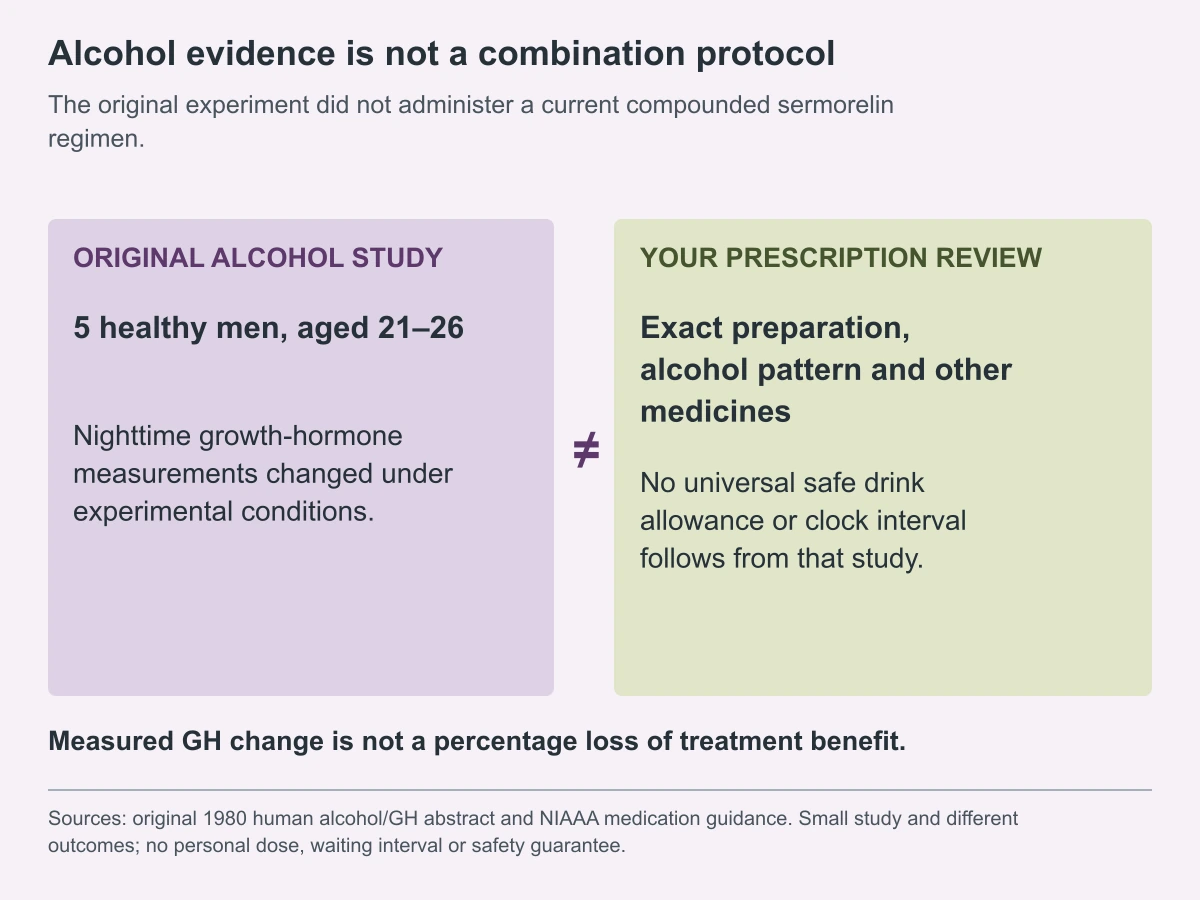
A 1980 human study indexed in the original abstract examined five healthy men aged 21–26. The participants had baseline placebo nights, several alcohol-exposure nights, and a withdrawal night. Researchers recorded sleep and collected repeated blood samples during selected nights.
The alcohol exposure was a specified experimental amount, and nighttime growth-hormone measurements were suppressed on the acute and chronic alcohol nights. The abstract reported suppression of roughly 70–75% under those study conditions, with values returning toward the placebo condition on the withdrawal night.
That is a finding about measured nighttime growth hormone in a small experiment. It is not a finding that alcohol reduces sermorelin treatment benefits by 70–75%. The abstract does not describe administering a current compounded sermorelin prescription or measuring long-term outcomes from that combination.
The small, young, male study population also limits generalization. We reviewed the indexed abstract, not the full original paper. Its result can explain why alcohol and hormone physiology are discussed together while leaving the treatment-specific questions unresolved.
Hormone measurements and treatment outcomes differ
A blood concentration, a person’s sleep experience, body composition, and day-to-day function are different outcomes. A change in one does not establish a proportional change in all the others.
Similarly, a laboratory finding from healthy volunteers cannot determine whether an individual needs treatment, whether a compounded preparation is suitable, or how a clinician should adjust it. The timing and interpretation of laboratory testing also depend on the clinical purpose.
| Claim or question | What the evidence can help discuss | What it does not establish |
|---|---|---|
| Alcohol changed nighttime GH in a study | A specific physiological observation in five healthy men | A percentage loss of sermorelin treatment effectiveness |
| I slept poorly after drinking | A useful symptom and exposure history | A diagnosis of growth-hormone deficiency |
| My laboratory result changed | A reason to review testing conditions and clinical context | A dose adjustment selected from an internet chart |
| I waited several hours | The timing to report to the prescriber | A validated safety or efficacy guarantee |
Our sermorelin and IGF-1 testing guide explains why hormone assessment needs clinical context. Do not use a single result or one disrupted night to diagnose a deficiency or decide that extra treatment is necessary.
Why the exact prescription matters
Historical approval information and a current compounded preparation are separate subjects. The FDA’s 2013 Geref notice discusses earlier sermorelin products approved for pediatric growth-hormone deficiency and diagnostic evaluation, and states that they were not withdrawn for reasons of safety or effectiveness.
That historical determination is not approval of an adult anti-aging regimen or an alcohol-combination protocol. It should not be presented as a guarantee that every preparation, patient, or use has been reviewed and found safe.
The FDA explains that compounded drugs are not FDA-approved. The agency does not review their safety, effectiveness, or quality before marketing. A pharmacy’s exact concentration, ingredients, packaging, and instructions therefore matter to the conversation.
Bring the label and prescribed directions to the pharmacist. The sermorelin label and storage guide can help you identify the questions to ask. Do not borrow dilution, timing, or storage instructions from another vial merely because the ingredient name is the same.

Other medicines may be the more immediate concern
The National Institute on Alcohol Abuse and Alcoholism’s medication-interaction guidance describes several ways alcohol and medicines can interact. Alcohol can affect drug metabolism or effects, and medicines can also influence alcohol’s effects. The consequences depend on the particular combination.
Examples requiring especially careful review include opioids, benzodiazepines, and certain sleep medicines. Combining alcohol with sedating medicines can increase impairment and respiratory risk. A person focused only on sermorelin may overlook another prescription that creates a clearer, more immediate danger.
Over-the-counter products also belong on the medication list. NIAAA discusses interactions involving pain medicines and other commonly used treatments. “Available without a prescription” does not mean “safe with alcohol under every circumstance.”
Tell the clinician about all prescriptions, sleep aids, pain relievers, and supplements, plus the usual amount and pattern of drinking. An interaction checker can support the review, but an empty search result for an uncommon compounded preparation is not evidence of proven safety.
Does a two-hour or next-morning gap make it safe?
The sources reviewed here do not establish a universal timing interval for alcohol and current adult compounded sermorelin treatment. A recommendation found on a commercial page may reflect a provider’s protocol without being a validated combination study.
Ask the prescriber what their instruction is intended to address: medication interaction, sleep quality, administration reliability, a health condition, or another concern. Understanding the reason makes the instruction more useful than following an unexplained clock rule.
If you have already had alcohol and are uncertain about a scheduled dose, contact the prescriber or pharmacist for guidance on the actual prescription. Do not create a catch-up schedule, take an extra dose, or infer that a short peptide half-life resolves every risk.
The sermorelin half-life guide separates peptide clearance from hormone response and clinical effects. A pharmacokinetic number is not a drinking clearance certificate or an instruction for changing a regimen.
How should sleep concerns be discussed?
Describe the sleep problem itself: difficulty falling asleep, repeated waking, early waking, daytime sleepiness, or an inconsistent schedule. Record whether the pattern is connected with drinking days, other medicines, work hours, or other changes.
Treatment goals should identify the outcome being evaluated. A claim about a hormone response is different from a plan to investigate snoring, severe daytime sleepiness, or persistent insomnia. Ask what assessment is appropriate for the actual symptoms.
Do not treat a night of poor sleep as evidence that sermorelin has failed, or use alcohol as a way to manage treatment-related discomfort. Review both issues directly. If the clinician has given you a sleep or alcohol plan, ask how it fits with the full prescription list.
The sermorelin results timeline discusses why follow-up should use meaningful clinical goals. A useful review considers function and symptoms alongside any indicated testing, rather than relying only on a marketing promise about hormone levels.
A useful preparation checklist
Before asking about alcohol, gather information that allows an individualized answer:
- The exact sermorelin label, concentration, ingredients, and prescribed instructions.
- How often and how much you usually drink, including heavier episodes.
- Other prescriptions, over-the-counter medicines, and supplements.
- Liver, glucose, sleep, or other relevant health concerns.
- The treatment goal and any symptoms or laboratory changes being followed.
- What to do if the usual routine is interrupted or a dose is uncertain.
Be specific without trying to make the drinking history sound better or worse. A clinician can make a more useful assessment from an accurate pattern than from a vague description such as “social drinking.”
Ask for written instructions if the plan is complex. Include who to contact after hours and how to handle a missed or uncertain administration. Practical clarity can reduce repeated guesswork.

When should you obtain urgent help?
Severe breathing difficulty, inability to stay awake, marked confusion, collapse, or another severe acute symptom needs urgent medical care. Alcohol and sedating medicines can create dangerous combinations, and the presence of a peptide prescription does not change the need for immediate assessment.
For persistent dizziness, swelling, injection reactions, or another new symptom, contact the treating clinician and report the full exposure history. Our sermorelin side-effects guide helps organize that conversation without diagnosing a reaction from timing alone.
CoreAge Rx’s sermorelin treatment information is a place to explore a clinical assessment and ask about the actual preparation and follow-up. The assessment should include alcohol and other medicines; a product page cannot establish an individual safe combination.
Frequently asked questions
Does alcohol completely cancel a sermorelin dose?
The original alcohol study did not test that claim. It measured nighttime growth hormone under particular experimental conditions. It does not establish complete cancellation or a predictable percentage reduction in treatment benefit.
Is one drink proven safe?
The sources reviewed here do not establish a universal safe allowance for this combination. The exact preparation, other medicines, health conditions, and drinking pattern need professional review.
Can I use an extra dose after drinking?
Do not change the prescribed amount to compensate for a theoretical hormone effect. An experiment about GH secretion is not a dose-adjustment protocol. Ask the prescriber how to handle the actual situation.
Should I use half-life to choose a waiting interval?
No universal alcohol interval follows from peptide clearance. Hormone response, other medicines, impairment, and the clinical treatment plan are separate considerations. Use explicit instructions for your prescription.
Educational information for adults; individual treatment decisions require a qualified clinician. Sources reviewed October 1, 2026. Original AI-generated article images depict fictional people and objects, not patient outcomes. Other editorial images are illustrative. Graphics summarize the cited sources.